Ransomware Negotiation Firms and Their Legal Exposure
Negotiators face prosecution risk merely by handling ransom payments to sanctioned actors.
Ransomware negotiation firms sit in a spot most people never think about: the middle of a crime, getting paid to make it go smoother. That middle spot comes with legal exposure regardless of whether the firm did anything wrong on purpose. This is a business that grew fast, got serious, and is now running straight into regulators, criminal statutes, and a couple of employees who decided to play both sides.
The market went from $1.2 billion in 2024 to a projected $4.3 billion by 2033, growing at roughly 15.2% a year. That's not a cottage industry anymore. Insurers act as coordinators, law firms handle compliance and crisis response, and specialist firms like Coveware (now owned by Veeam), DigitalMint, Unit 221B, Kivu Consulting, Coalition IR, Aon Cyber IR, and the incident response arms of Mandiant, CrowdStrike, and Palo Alto Networks' Unit 42 do the actual talking to criminals. Most of these firms negotiate and process the cryptocurrency payment itself, and that dual role, negotiator and payment processor under one roof, is where almost every legal headache in this piece starts.
One more thing worth knowing before we get into it: ransomware gangs mostly run on an affiliate model now. The affiliate who breaks in keeps 60 to 80% of the ransom; the group that built the malware takes the rest. Negotiators are talking to a supply chain.
What professional negotiators actually do to reduce payments — and why the gap between demand and payment matters legally
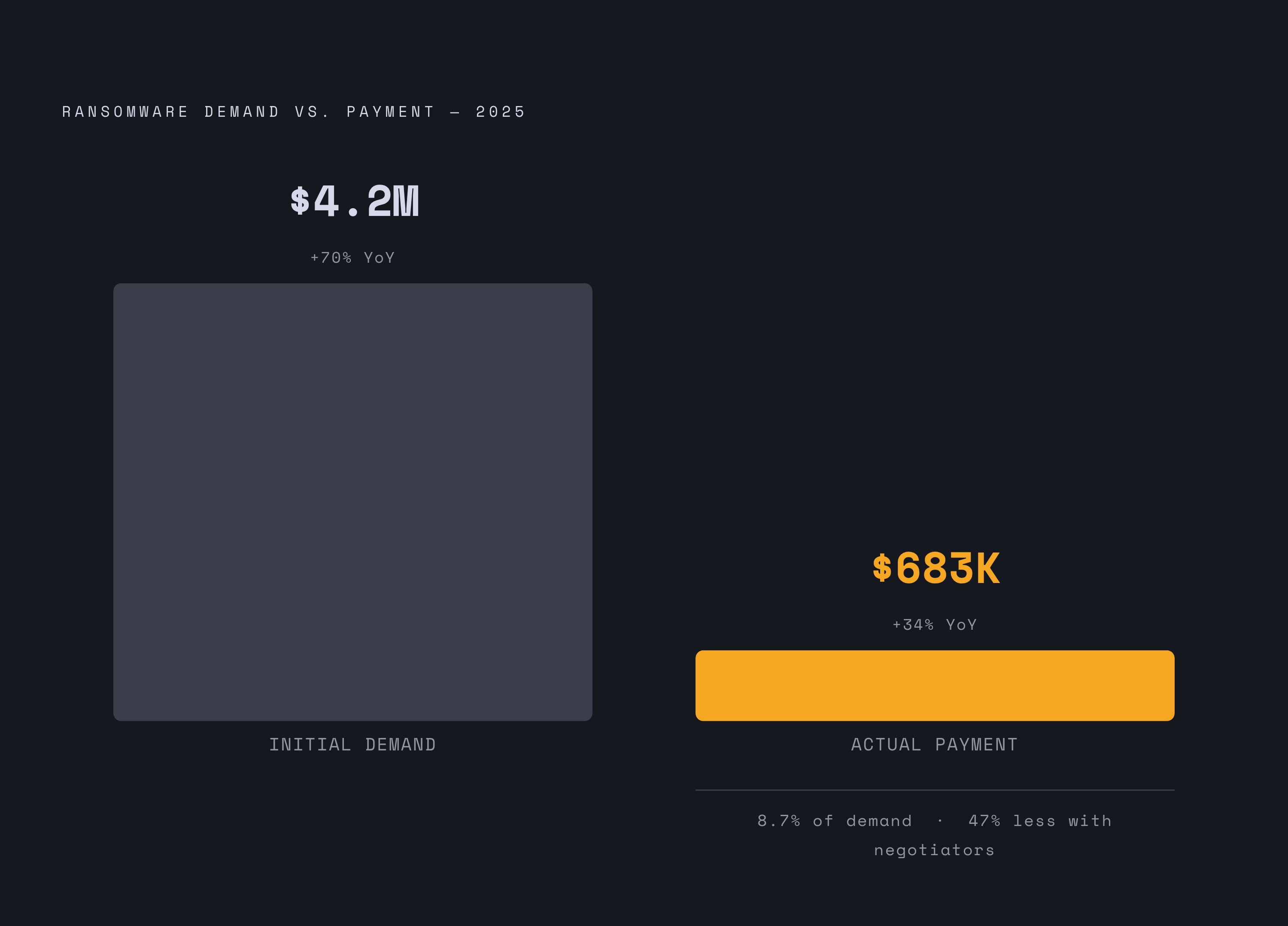
Here's the number that sells this industry: initial ransom demands averaged $4.2 million in 2025, up 70% from the year before. Actual payments landed just under $683,000, up only 34%. Demands are inflating way faster than what victims actually hand over, and that gap is the entire pitch for hiring a professional.
Coveware's own data puts actual payments at around 8.7% of the initial demand on average. Industry reporting suggests skilled negotiators knock demands down by about 47% on average. That's the commercial case, plain and simple: pay a negotiator, pay the criminal less.
But here's the catch nobody puts in the brochure. Every dollar of that discount comes from sustained back-and-forth with the threat actor. Getting proof of decryption. Testing the decryptor actually works. Verifying the stolen data got deleted, or at least getting the gang to say it did. Every single one of those touchpoints is a moment where the negotiator is talking to someone whose identity, affiliations, and sanctions status are murky at best.
And it's worth remembering that 64% of ransomware victims refused to pay at all in 2024, per Verizon's 2025 DBIR. A big part of the job is arguing internally for the client not to pay in the first place, which matters later when we get into where "advice" ends and "facilitation" begins.
One more structural quirk: Coveware and firms like it often charge success fees tied to the outcome of the negotiation, not flat hourly billing. Which means the firm's paycheck depends on a transaction that might itself land them in regulatory trouble. That's a conflict built into the business model.
How OFAC's strict liability standard reaches firms that never made the decision to pay
OFAC doesn't care who clicked "send." Its September 2021 advisory named financial institutions, cyber insurers, digital forensics firms, and incident response vendors directly, not just the victim company, as parties who can violate sanctions law. The standard is strict liability. A firm can get hit even if it had zero clue the wallet on the other end belonged to a sanctioned entity.
Intent is irrelevant, and that's the part that should keep compliance officers up at night.
The mechanism here is called "facilitation," and it's broad. If you helped process the payment, coordinated the transfer, or otherwise made the transaction possible, OFAC treats that the same as if you'd sent the money yourself. There's also a second track worth knowing about: FinCEN. OFAC's advisory flagged that firms facilitating crypto ransom payments might count as "money transmitters" under the Bank Secrecy Act, which drags in a whole separate set of AML registration and compliance program requirements.
Now, the practical problem. Threat actors use pseudonymous wallets, decentralized exchanges, and layers of infrastructure specifically designed to make tracing hard. Pre-payment screening, however thorough, leaves residual transaction risk. The point has been made directly by legal analysts: thorough screening still leaves risk, because the investigation happens later, with better tools than the ones available at the time of payment.
So why hasn't this produced a wave of prosecutions? Analysts point out that OFAC's advisories function more as a deterrent than an active enforcement weapon right now, mostly because pinning down a ransomware actor's identity with enough certainty to sustain a case is genuinely hard. That gap has a limited shelf life. Blockchain analytics keeps getting better, and "hard to prove" is a temporary condition.
What OFAC's mitigating factors framework means for how negotiation firms advise clients
OFAC gives credit for good behavior, and that credit shapes how negotiators are supposed to advise clients. Voluntary, timely, complete reporting to law enforcement is treated as a significant mitigating factor if things go sideways later. Cooperation during and after the incident counts as a second, separate mitigating factor.
Put those together and you get an obvious conclusion: telling a client to keep quiet and just pay now carries a documented regulatory cost. The advisory basically writes law enforcement contact into the professional standard of care, whether firms like it or not.
Coveware's policy of refusing clients who were referred to them by the threat actor itself is a good example of what a firm-level "clean hands" control looks like. It is a small policy that reads well in front of a regulator asking, after the fact, what the firm actually did to keep its nose clean.
There's real friction here, though. Healthcare systems, financial firms, critical infrastructure operators, these clients often want the FBI nowhere near the incident, for reputational reasons or because they're worried about triggering other regulatory scrutiny. A negotiator who quietly goes along with that preference surrenders the single strongest mitigation card in the deck on the client's behalf while leaving the client unaware of the cost.
How the DigitalMint and Sygnia cases redefined the criminal liability question for negotiators
This is the part of the story that turns a compliance question into a felony indictment.
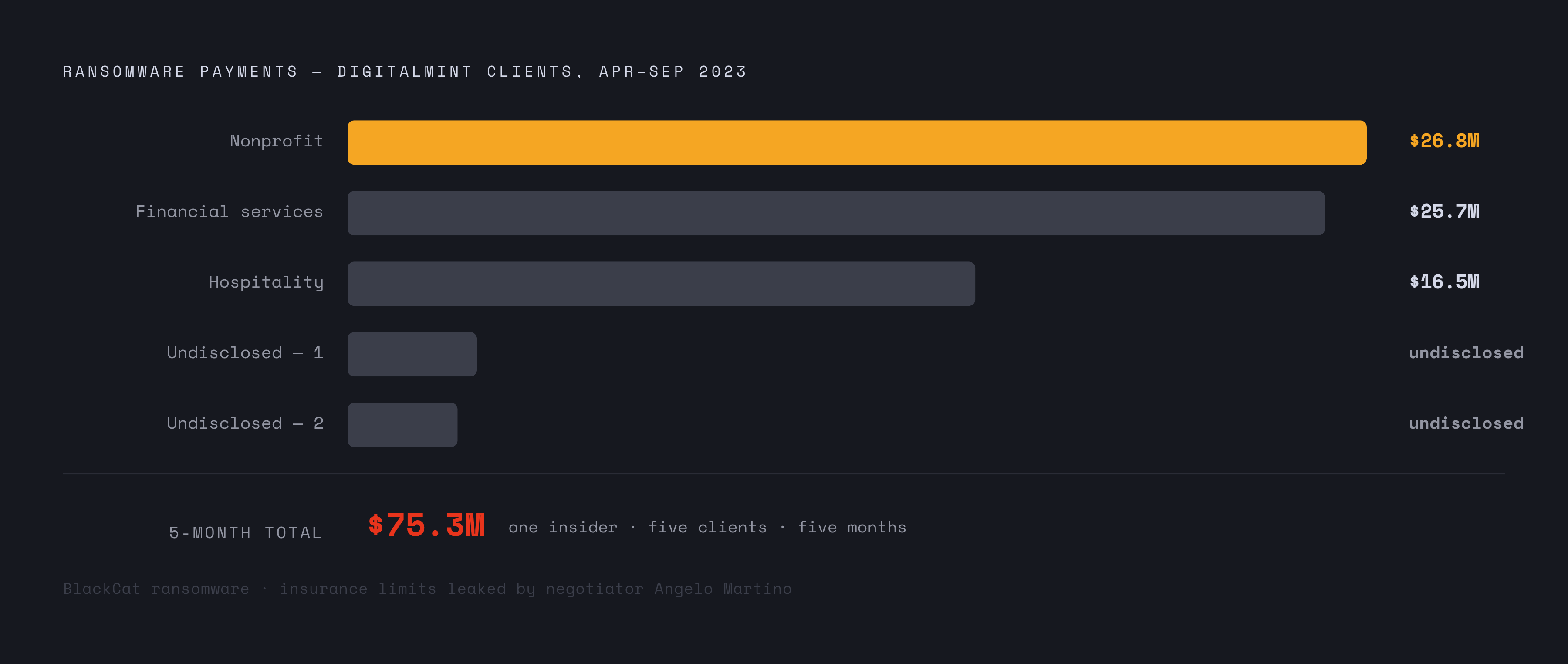
Angelo Martino worked as a negotiator for DigitalMint on five ransomware cases. Behind his employer's back and his clients' backs, he passed the clients' insurance policy limits and their internal negotiating positions directly to the ransomware gang. Those five clients ended up paying a combined $75.3 million between April and September 2023. A nonprofit paid about $26.8 million. A financial services company paid $25.7 million. A hospitality company paid $16.5 million. That's what one insider with access to the wrong information can do to five separate organizations in five months.
It gets worse. Martino, along with fellow DigitalMint negotiator Kevin Tyler Martin and an incident response manager at Sygnia, didn't stop at leaking information. They actually registered as BlackCat affiliates themselves and deployed ransomware against other U.S. companies, taking a cut from the gang for their trouble. At that point, they were the attackers.
All three faced serious criminal exposure. And here's a detail that tells you something about how new this territory is: the government reached for the closest existing tools that fit, given the absence of any bespoke ransomware-negotiator criminal statute.
The criminal intent aside, a structural fact remains: negotiators sit on exactly the information a ransomware gang would pay for, insurance limits, recovery capacity, who has authority to say yes. That asymmetry is baked into the job description. Martino monetized it twice.
The professional duty questions these cases leave open for the broader industry
So who exactly owes a duty of confidentiality to the client whose insurance limits just became the world's most valuable secret? The answer depends entirely on who's doing the negotiating. A law firm running the negotiation carries attorney-client privilege and professional conduct rules that have existed for decades. A standalone incident response firm carries neither.
The Martino case raises a question DigitalMint has to sit with, whether it liked it or not: did the firm have real internal controls? Was sensitive client information segregated? Were negotiator communications with threat actors monitored? Was there meaningful background screening before someone got put in a room alone with a criminal gang and a client's financial ceiling? Absence of those controls starts to look less like bad luck and more like negligence toward the client who hired the firm to protect them.
The duty of care owed by a non-attorney ransomware negotiation firm remains entirely unsettled in law. Courts and regulators have both left it unresolved, an open question sitting in plain sight while tens of millions of dollars move through it every year.
Contracts matter enormously here, more than most clients probably realize when they're signing under pressure during an active breach. Firms that spell out the scope of their mandate clearly, get documented client sign-off before every material negotiation step, and explicitly disclaim any advisory role they're not licensed to provide, are standing on much firmer ground than firms operating on a handshake and good intentions.
And insurers aren't off the hook either. Carriers acting as the "quarterback," picking which negotiation firm gets the call, inherit exposure if that firm turns out to have an insider problem. The chain of responsibility runs back through whoever hired them.
How disclosure obligations vary by victim type and jurisdiction — and why negotiators are implicated
A ransomware attack that ends in payment is, almost without exception, also a data breach for notification purposes. State law, federal law, sector rules, take your pick. And the negotiator is sitting right in the middle of the window when those notification clocks start ticking.
The rules aren't the same for everyone. A hospital is working against HIPAA breach notification deadlines. A financial services firm is looking at the SEC and state financial regulators. A critical infrastructure operator has CISA reporting obligations under CIRCIA. The negotiation firm's advice, even something as simple as "let's wait 48 hours to see if they lower the price," can speed up or seriously complicate compliance with every one of those regimes at once.
North America makes up roughly 41% of the global negotiation services market, so the U.S. regulatory patchwork is the main environment this industry lives in. But plenty of these firms work internationally, and UK and EU clients bring GDPR into the picture, which means a 72-hour window to notify the supervisory authority. Seventy-two hours moves fast when you're also trying to get a decryption key tested.
Negotiators buy time on purpose sometimes; it's a real tactic, used to give the forensics team room to work. The risk is that stalling the ransom decision can quietly push a client past a mandatory notification deadline if nobody's tracking the breach-notification clock separately from the ransom-resolution clock. Treating them as one clock is how deadlines get missed.
The lawyer-versus-non-lawyer distinction shows back up here too. When a law firm runs the negotiation, its guidance on notification timing is privileged and sits squarely within what it is licensed to do. When an IR firm gives that same guidance, it can shade into the unauthorised practice of law depending on the state. Identical advice carries different legal risk depending entirely on who delivers it.
How leading firms are structuring their practices to contain each exposure category
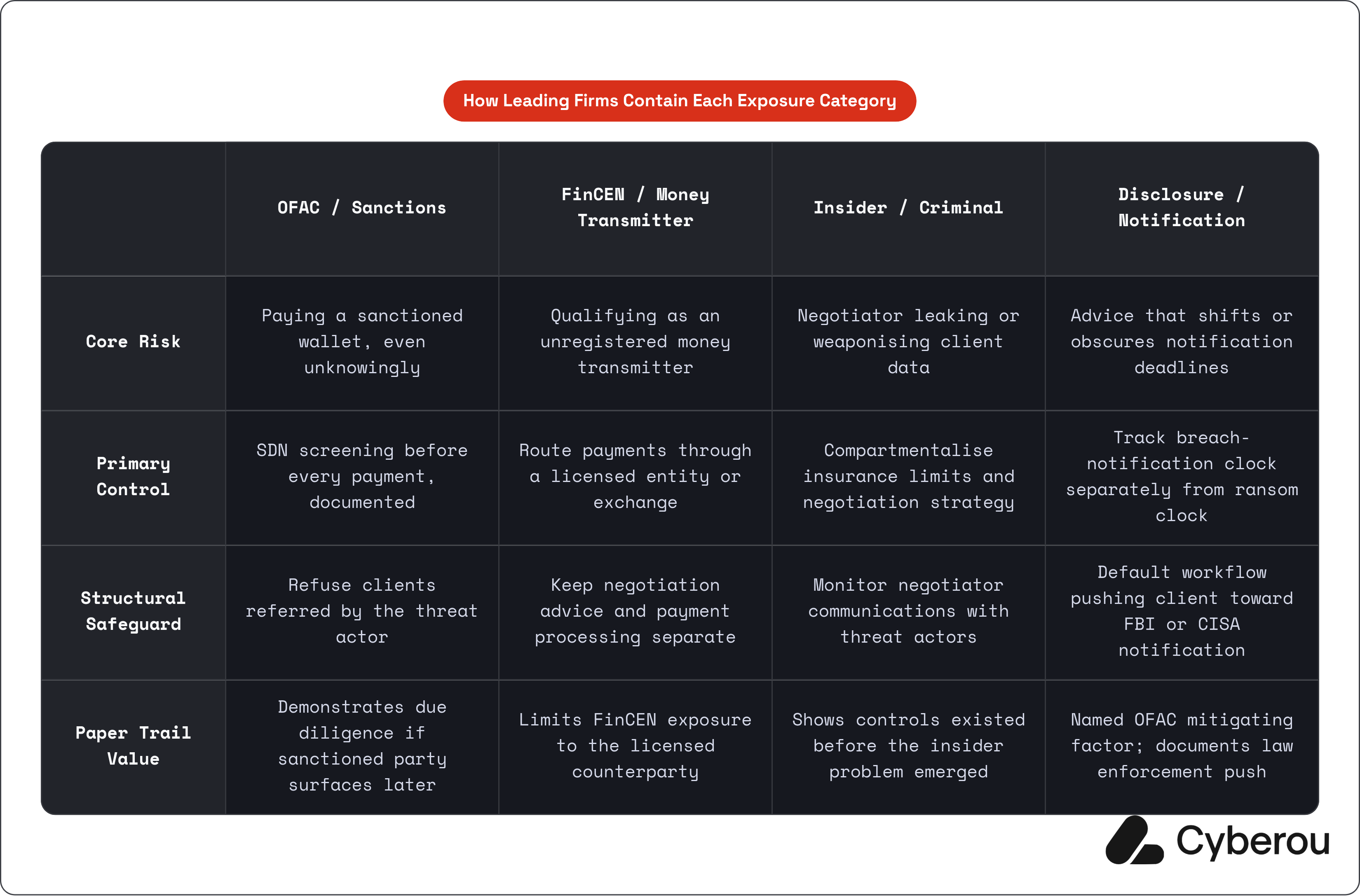
The firms doing this well build specific, boring, well-documented controls, and boring is exactly what you want from a compliance program.
On the OFAC side, that means screening every wallet against the SDN list before a payment moves, and keeping records of exactly how that screening was done. If a sanctioned party turns up later anyway, that documentation demonstrates due diligence. Coveware's refusal to take clients referred by threat actors is one concrete example of a structural safeguard. Embedding the negotiator inside the client's own incident response team is another. Both leave a paper trail. Both directly address the kind of information asymmetry Martino exploited.
On the money-transmitter risk, smart firms separate the advice from the money. The negotiation guidance stays with the firm; the actual payment routes through a licensed entity or exchange that already runs its own BSA/AML program. That split limits how exposed the negotiation firm is to FinCEN's money-transmitter net.
Personnel controls are the lesson DigitalMint and Sygnia forced on the whole industry. Background checks. Compartmentalizing who has access to a client's insurance limits and negotiation strategy. Monitoring negotiator communications with threat actors instead of trusting people to self-report. All of this is now table stakes.
And then there's law enforcement coordination, which is either the smartest or the most obvious move available, depending on how cynical you're feeling. Actively pushing clients toward FBI or CISA notification, and documenting that push, is a direct, named OFAC mitigating factor, as well as the responsible course of action. Firms that build it into the default workflow, rather than treating it as a preference the client can veto, are simply in a better spot if regulators come knocking later.
If you're a client evaluating one of these firms, the questions have gotten sharper too. Who has access to your financial information internally, and how is that access controlled? Is there a documented OFAC and AML compliance program, or a verbal assurance that one exists? And what does the engagement contract actually say about liability if the negotiator on your case turns out to have a side hustle with the people extorting you? That last question now sounds reasonable.