Dark Web Fentanyl Vendor Prosecutions
Federal investigators cracked dark web anonymity by weaponizing the very tools traffickers trusted.
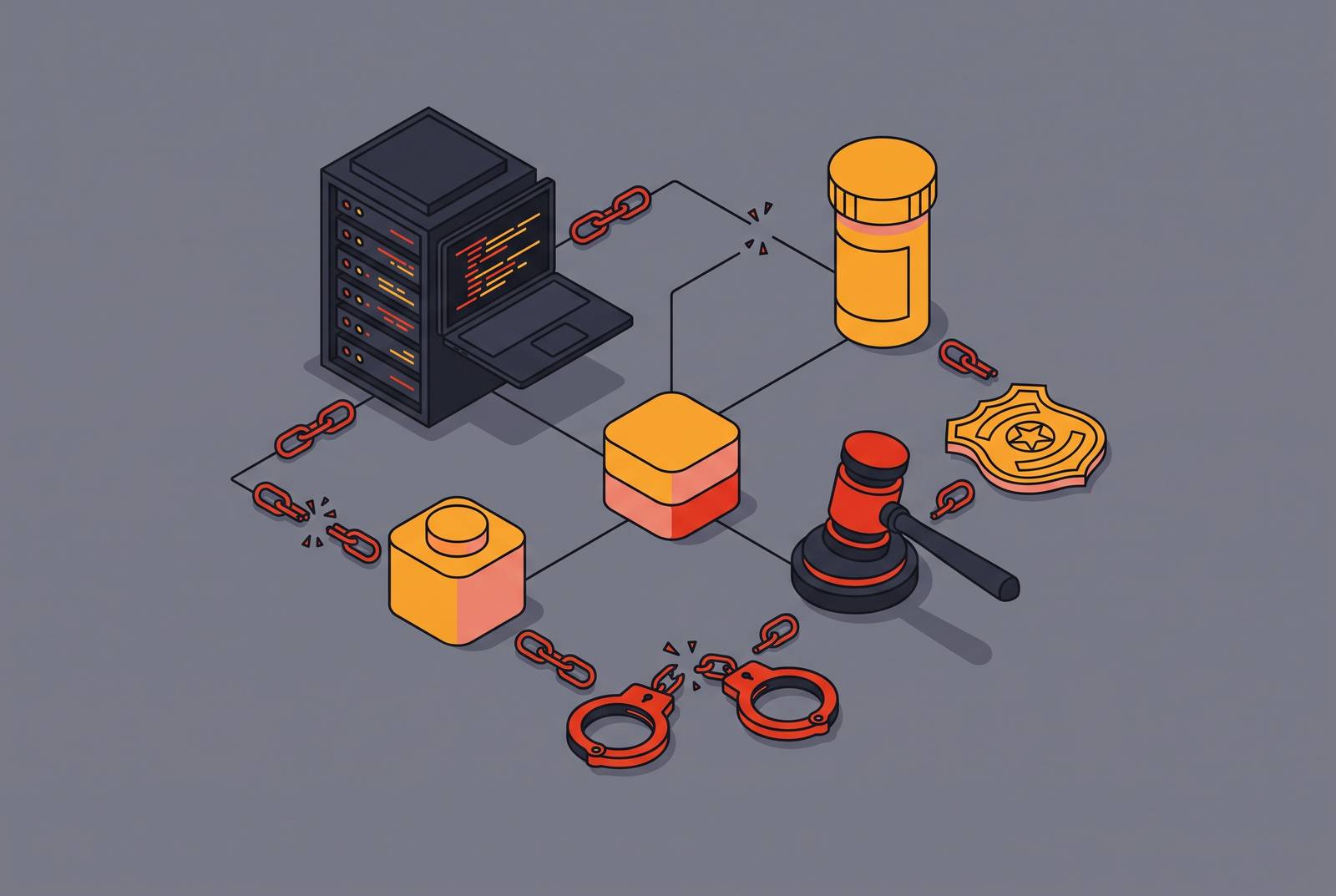
Fentanyl vendors moved their operations to the dark web because it promised anonymity: hidden storefronts, crypto payments, drugs mailed straight to a buyer's door. That promise is now falling apart in federal courtrooms, one lengthy federal sentence at a time. Investigators learned to use the exact same tools vendors trusted, and turned each one into a liability instead of a shield. It's that investigators learned to use the exact same tools vendors trusted, and turned each one into a liability instead of a shield.
How fentanyl moved to the dark web
The pitch was simple. Set up shop on a hidden marketplace reachable only through anonymized routing software, get paid in crypto, ship product through the regular postal system, and nobody can trace any of it back to a name or a face. For a while, that pitch worked well enough to build real empires.
Nemesis Market pulled in more than 30,000 active users and around 1,000 active vendors at any given time. Archetyp Market did even better, or worse, depending on where you're sitting: over 600,000 users worldwide and at least 250 million euros in total transaction volume across five-plus years, before it finally got shut down in June 2025.
Vendors leaned hard on the belief that layers of tech, Tor for browsing, crypto for payment, a made-up handle for an identity, added up to a kind of legal invisibility cloak. U.S. Attorney Boutros put it bluntly when announcing the sentence for one such vendor: traffickers "mistakenly believe that they are beyond the reach of federal law enforcement." That word, mistakenly, is doing a lot of work. It's the whole thesis of this piece in one sentence.
The JCODE model: how multi-agency intelligence fusion became the enforcement architecture
None of this enforcement wave happens without JCODE, the Joint Criminal Opioid and Darknet Enforcement initiative. Led by the FBI, JCODE ties together the DEA, an immigration and border enforcement agency's investigations arm, a tax agency's criminal investigation unit, a national postal service's. Inspection Service, and a defense department's intelligence arm into one coordinated machine aimed at dark web drug cases.
When a case crosses a border, and most of them do, USPIS has a permanent attaché posted at Europol. Europol's own cybercrime unit, the European Cybercrime Centre (EC3), builds out intelligence packages and feeds them to a national postal service's. and international agencies at the same time, rather than in some slow relay race.
The real engine behind all of it is what amounts to a compounding-interest model for intelligence. Each takedown doesn't just close a case, it opens ten more doors. As one investigator put it, the data from each subsequent takedown gives a clearer picture of the next target. Operation RapTor is the clearest proof of that: it was built directly on intelligence pulled from earlier takedowns of Nemesis, Tor2Door, Bohemia, and Kingdom Markets. Seized servers turned into road maps.
Operation RapTor and the scale enforcement has reached
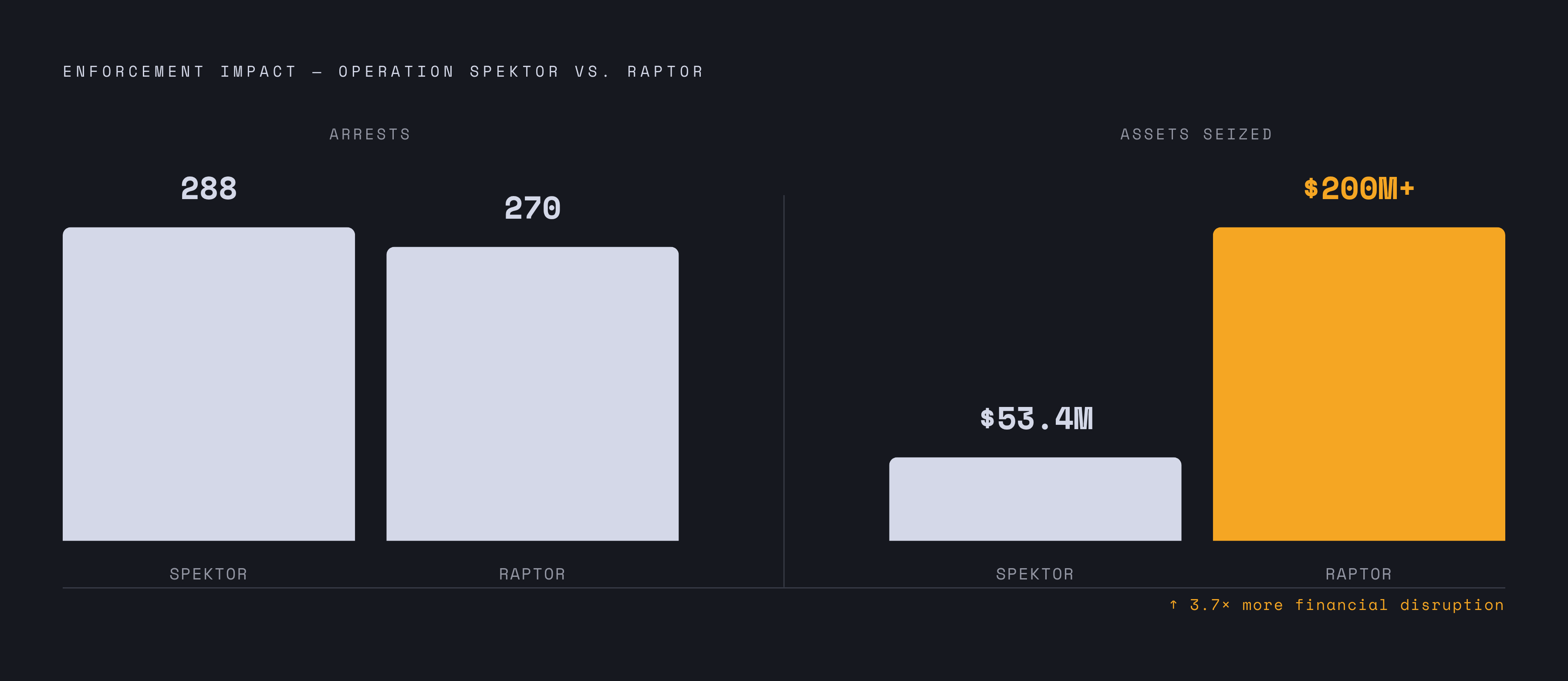
Operation RapTor, announced May 22, 2025, resulted in 270 arrests spread across ten countries and four continents, including Austria, Brazil, France, Germany, the Netherlands, South Korea, Spain, Switzerland, the UK, and the United States. That's not a task force, that's closer to a small international coalition.
The seizure numbers set a new bar for JCODE operations. More than $200 million in cash and digital assets, over two metric tons of drugs, 144 kilograms of fentanyl or fentanyl-laced narcotics, and more than 180 firearms taken off the street. Separately, DEA figures starting January 20, 2025 show roughly 44 million fentanyl pills seized, 4,500 pounds of fentanyl powder, nearly 65,000 pounds of methamphetamine, and more than 201,500 pounds of cocaine, alongside over 2,105 fentanyl-related arrests.
Stack that against RapTor's predecessor, Operation SpecTor, which produced 288 arrests and $53.4 million seized. RapTor brought in slightly fewer arrests but nearly four times the financial disruption. Arrests are one measure of success. Money is another, and it's arguably the one that actually hurts.
Rui-Siang Lin and Incognito Market: what a 30-year sentence reveals about how operators get caught
Rui-Siang Lin, known online as "Pharaoh," ran Incognito Market through March 2024. He was 24 years old and Taiwanese. On February 3, 2026, a federal judge sentenced him to 30 years in prison, calling it the most serious drug crime she'd seen in 27.5 years on the bench. It's a line from a judge marking a career benchmark, not a throwaway attempt to sound tough. That's a career benchmark.
The numbers behind Incognito Market explain why. More than 1,800 vendors, 400,000 customer accounts, over 640,000 transactions, and upwards of $105 million in drug sales, including fentanyl-laced pills tied to at least one fatal overdose.
Investigators didn't need some exotic zero-day exploit to find Lin, which should make every dark web operator's stomach turn. Blockchain analysis, undercover purchases, and domain registration records did the job. Lin registered the marketplace domain using his real name, his real phone number, and his real address. A man running one of the largest fentanyl markets on the internet got undone by the digital equivalent of leaving a forwarding address at the post office.
Darren Hughes and Nemesis Market: undercover buys as the entry point into a marketplace's vendor network
Darren Hughes got convicted by a federal jury in November 2025 and sentenced May 26, 2026 to more than 26 years. His downfall started with something almost comically low-tech: free samples.
Hughes advertised free meth samples through his storefront on Nemesis Market. An undercover agent reached out, got the free sample, and then went on to complete five separate controlled buys of meth and fentanyl pills in 2023, all paid for in crypto. It's the oldest trick in narcotics enforcement, just moved onto a Tor browser.
The digital case got backed up by something agents could actually hold in their hands. In June 2023, Redwood City police pulled Hughes over and found about 672 grams of meth, a loaded ghost gun, and narcotics paraphernalia in his vehicle. Nemesis itself processed roughly 400,000 orders between 2021 and 2024, including more than 17,000 opioid orders. Its administrator, known as Parsarad, got hit separately with OFAC sanctions in March 2025.
Smaller vendors, the same pattern: how the playbook scales down the supply chain
This isn't a strategy reserved for the biggest fish. It scales down to street-level vendors just as cleanly.
Take Holly Adams out of Palm Desert. Sentenced to 12 years on June 3, 2025, she sold counterfeit oxycodone pills pressed with fentanyl through the dark web and laundered the proceeds using cryptocurrency mixers and multiple wallets. She got arrested twice. After the first arrest, she went right back to selling, apparently unaware that federal agents were already watching. They let her keep going long enough to build a case that would stick.
The NCIDE Task Force is designed to sustain that kind of patience, pooling agencies over the long term. The NCIDE Task Force, which handles cases at the local and regional level, pulls together a tax agency's criminal investigation unit, an immigration and border enforcement agency's investigations arm, the FBI, a national postal inspection service, that inspection service's own oversight office, and the DEA. Same multi-agency blueprint as the global operations, just scaled to fit a smaller case.
Two more names from that same sentencing round round out the picture. Adan Ruiz, out of Orange County, got more than 17 years. Omar Navia, from South Los Angeles, got 15. Both supplied fentanyl-laced pills to a ring that sold more than 120,000 pills and around 20 pounds of methamphetamine to over 1,000 customers nationwide, coordinated through darknet markets. Prosecutors described it as one of the most sophisticated fentanyl distribution rings they had pursued.
Cryptocurrency tracing and operational security failures: the two technical levers that keep closing cases
Stripping away the geography and the dollar figures, nearly every one of these cases comes down to two things: following the money on-chain, and waiting for a mistake.
Blockchain analysis appears in essentially every major case. Lin's prosecution used it alongside domain records. Adams laundered money through mixers and multiple wallets, and IRS-CI traced it anyway. The whole approach comes down to one principle: follow the financial trail.
Crypto is pseudonymous, and it's permanently recorded on a public ledger anyone can read if they know how to look. It's pseudonymous, and it's permanently recorded on a public ledger anyone can read if they know how to look. Mixers and layered wallets slow investigators down, sure, but they don't stop anyone who has the on-chain data and the legal authority to subpoena an exchange. Meanwhile, operational security failures keep supplying the spark: Lin's real-name domain registration, Adams going right back to selling while under surveillance, Hughes handing out free samples to an undercover agent in plain sight. Digital investigation builds the probable cause. A physical search, a car stop, a hotel room, closes the case for good.
Attribution and anonymization in light of this enforcement wave
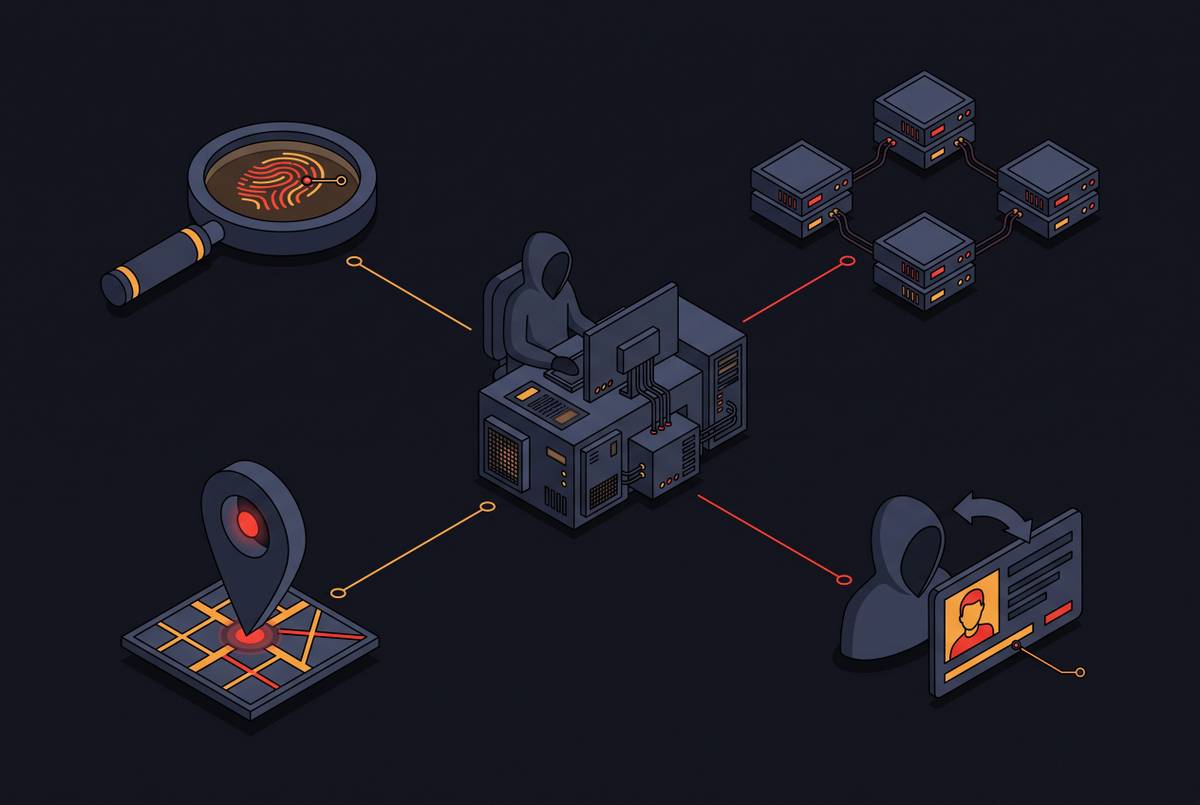
The lesson here reaches well past drug cases. Tor, crypto mixers, pseudonymous wallets, all of it shrinks the surface area of exposure. None of it erases it. One leftover artifact, a domain registration under a real name, a postal address, a shipping pattern that repeats one too many times, is enough to anchor an entire blockchain trail and network map to a real, physical person.
The methods investigators use here aren't far off from what threat intelligence teams already do in the private sector: chain-of-custody tracking on transactions, network graph analysis across accounts, cross-referencing physical evidence against digital trails. Same posture, different case file.
And the compounding-intelligence model, where each takedown sharpens the next one, is basically the same feedback loop enterprise security vendors build their pitch around. Prosecutors are running continuous, intelligence-driven operations here, not isolated one-off busts.
Whether platforms should be left running to gather evidence while people keep dying is a question that demands scrutiny. In the Incognito Market case, a confidential source reportedly handled an estimated 95% of the marketplace's transactions for close to two years, while overdoses tied to the platform kept happening. At what point does infiltration meant to gather intelligence start looking more like facilitation? Nobody's settled that question yet, and anyone thinking seriously about deception-based intelligence gathering, whether in narcotics enforcement or corporate threat intel, doesn't get to skip past it.
Sources
- Man sentenced to more than 26 years in prison for using the dark web to distribute narcotics | Internal Revenue Service
- Law Enforcement Seize Record Amounts of Illegal Drugs, Firearms, and Drug Trafficking Proceeds in International Operation Against Darknet Trafficking of Fentanyl and Opioids; 270 Arrested Across Four Continents
- nationaltoday.com
- en.wikipedia.org
- justice.gov
- bleepingcomputer.com
- securityweek.com