Dark Web Forum Administrator De-Anonymization Methods
How dark web admins get caught despite Tor encryption.
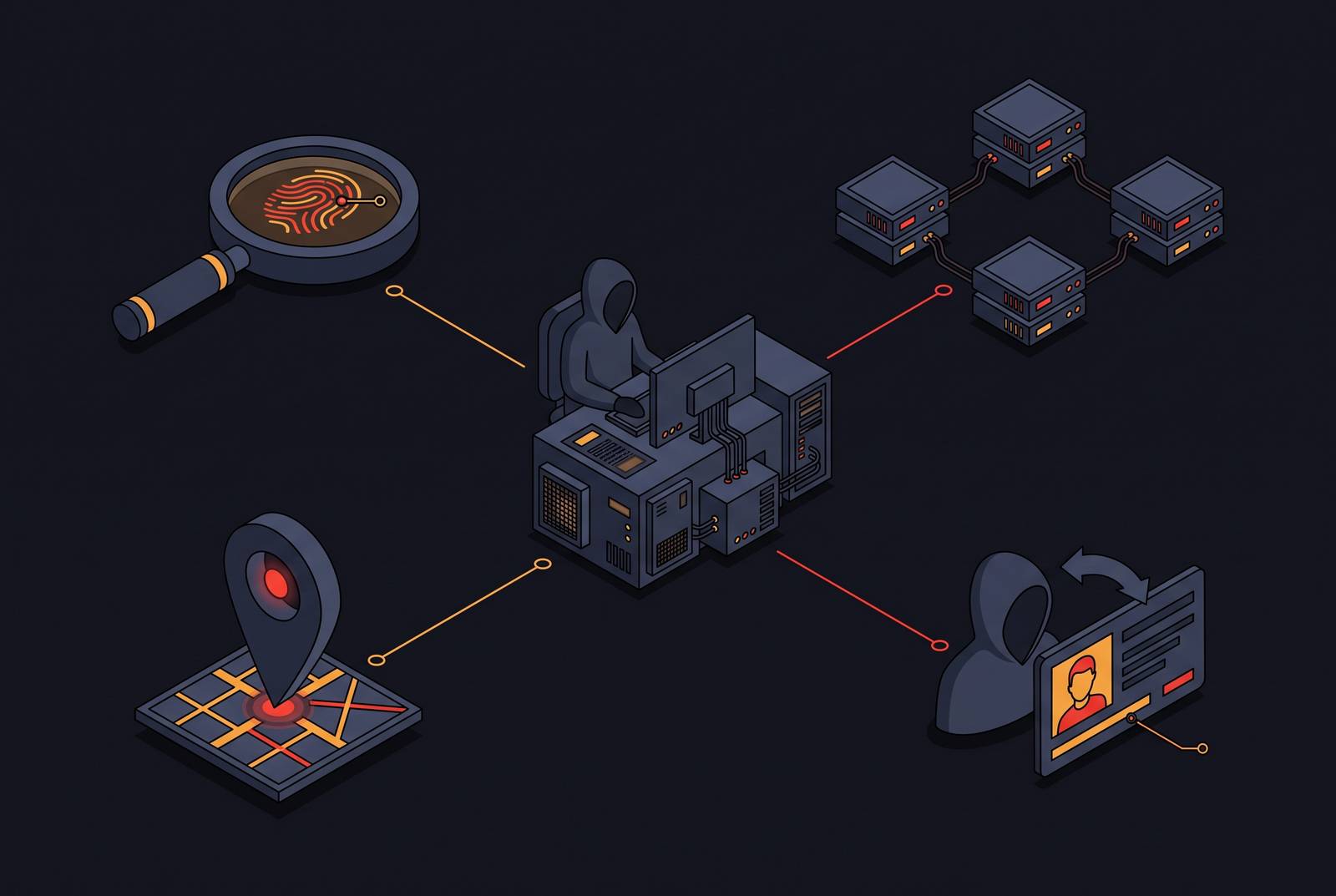
Dark web forum administrators get caught the same way most criminals do. They make one small mistake, and someone patient enough is watching when it happens. No single trick cracks Tor anonymity on its own. It takes a stack of methods layered together: OSINT, traffic analysis, blockchain tracing, old-fashioned informants, until the picture snaps into focus.
These forums are where ransomware crews recruit, where stolen credentials get auctioned off, where malware gets passed around and breaches get bragged about. In 2025 alone, 6,046 global data breach and leak incidents got recorded, and the forums feeding that number get watched, logged, and picked apart by investigators every day. LeakBase had over 142,000 registered members and 32,000 posts by December 2025, right before it got seized in March 2026. Every admin login on a site like that carries intelligence value attached to a body count.
How the anonymity stack works, and where it assumes perfect behavior
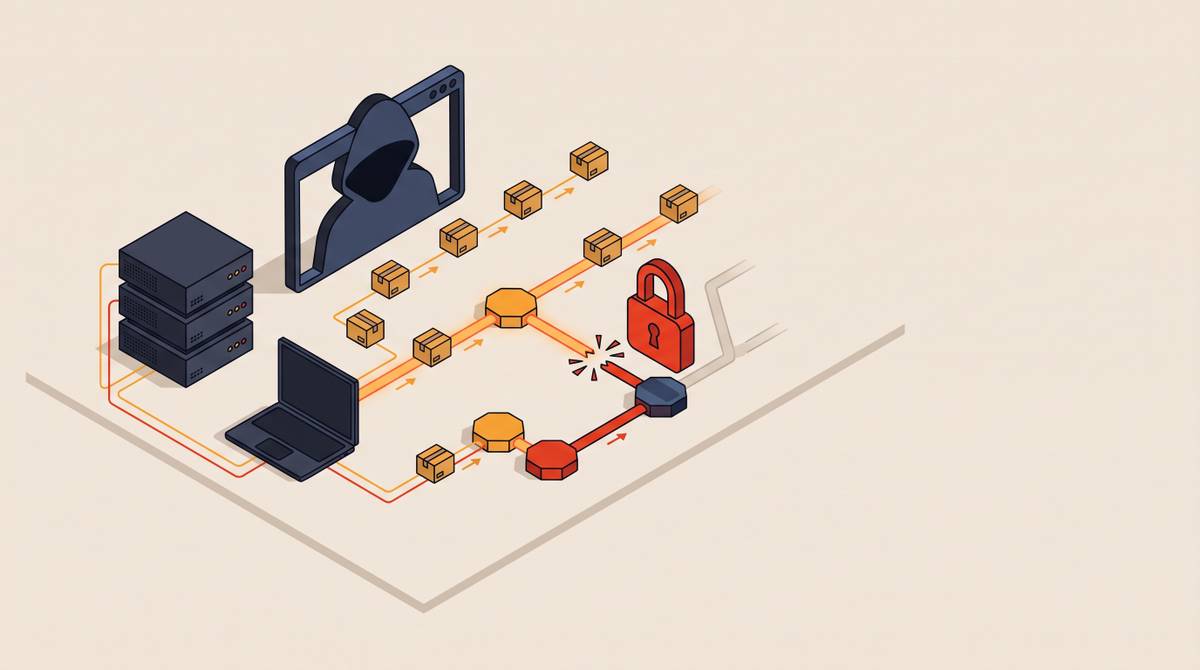
Tor wraps traffic in layers of encryption and bounces it through a chain of relays, so no single relay ever sees both where the traffic came from and where it's going. That's a clever piece of engineering, and it holds up fine, as long as everything around it holds too.
Nothing at the application layer can leak the real IP address. Nobody runs a traffic-confirmation attack against that specific circuit. And the person behind the keyboard never slips up and connects the handle to a real name. Three conditions, all true, all the time, for years on end. Ask any forum admin who's run a site for three straight years without a single OPSEC slip how that streak is going.
Think of the anonymity stack as four shields stacked on top of each other: network, application, operational, and financial. Keeping all four clean for months or years running is close to impossible, and investigators know it. They rarely punch through all four at once. Mostly, they wait for one shield to crack on its own, then pull the thread. Most people get this backwards: the network layer, the actual Tor encryption, is the shield that almost never cracks. It's the other three that fail, over and over, because they depend on humans behaving perfectly for years without a single lapse. Nobody manages that. Not once.
Operational security failures as the most common entry point
Forget the movie version where some elite hacker cracks military-grade encryption in a dark basement. Most dark web arrests trace back to an old email address, a reused password, or a careless post from years earlier that nobody thought to delete.
Ross Ulbricht, the Silk Road founder, got tied to his real identity partly through a job-recruitment forum post made under his pre-launch handle, "altoid," where he used his actual email address. That post sat around, indexed, for anyone patient enough to go digging. AlphaBay's administrator made a similarly plain mistake: his personal email address showed up in AlphaBay's welcome emails to new users and in its password recovery system. One overlooked config detail, and a market moving enormous volumes of illegal trade came apart at the seams.
The pattern holds across nearly every case on record. A real email address sits where it shouldn't. A username gets recycled one time too many. A setup file never gets scrubbed. A real email address, a reused username, or an unscrubbed setup file exposes someone eventually, because investigators are willing to look and patient enough to wait for the mistake.
Username and handle reuse as a repeatable attribution method
A username is stickier than most people realize. Real names change, get buried, get scrubbed. Handles don't, because people get attached to them, and they carry the same handle across forums, marketplaces, and social platforms for years without a second thought.
Investigators build attribution cases by stacking small signals on top of a handle match: similar bios, matching turns of phrase, registration dates that line up suspiciously close, links pointing to other accounts or personal sites, a consistent thread of interests running across profiles that otherwise look unrelated.
The BreachForums case, the Pompompurin investigation, shows how this plays out step by step. FBI Special Agent John Longmire's affidavit states that the FBI obtained IP addresses used to access RaidForums under that handle, and nine of them tied back to Conor Brian Fitzpatrick. The trail of evidence led back to Fitzpatrick. Handle reuse pointed to a predecessor forum's IP logs. Those logs led to an ISP subpoena. The subpoena led to confirmation. No single step did the job alone, but each one narrowed the field until there was nowhere left to hide.
What traffic correlation attacks on Tor require to work
Traffic correlation is the blunt-force option, and it costs what it sounds like it costs. Watch the timing and volume of traffic entering and exiting the Tor network. Control or observe enough relay points, and the math lets someone statistically link a specific user to a specific destination.
This isn't something a private researcher or a commercial threat intel firm spins up on a Tuesday afternoon. Running that kind of surveillance across enough of the Tor relay network takes infrastructure that has only shown up in nation-state law enforcement and intelligence operations. A private company doesn't have the relay footprint for it, full stop.
Running a high-traffic service also generates a traffic pattern that's distinctive over time, almost like a fingerprint. So even an admin with flawless OPSEC everywhere else ends up more exposed than an average user, just by pushing more data around day after day. Still, there's no publicly confirmed case where traffic correlation alone cracked an investigation. It appears bundled with other methods every time in tracking cases, which makes isolating its actual contribution close to impossible. That should tell you something about how overrated it is as a standalone weapon: it's the method everyone talks about and almost nobody can point to as the reason a specific person got caught.
Server misconfigurations that expose infrastructure despite Tor routing
Cisco Talos researcher Paul Eubanks documented three separate ways dark web infrastructure gives itself away, and none of them require breaking Tor's encryption.
The first is matching TLS certificate serial numbers between a site's dark web presence and its clear-web infrastructure, the same certificate sitting on both sides of the fence like a fingerprint left on two different doorknobs. The second is comparing browser favicons, those small icons sitting in the browser tab, between the.onion version of a site and its clear-web counterpart. A match there is a link investigators can chase down immediately. The third is broader: what Eubanks called "catastrophic security errors," misconfigurations that quietly undercut whatever anonymity the server operator thought they had locked down.
None of these methods touch the Tor protocol. They exploit the fact that running a website involves dozens of small technical decisions, and it only takes one careless one to leave a trail behind.
Blockchain forensics and the limits of financial anonymity
Money leaves a trail, and Bitcoin's trail is more visible than most people assume. Bitcoin transactions are pseudonymous. Every transaction sits on a public ledger forever, and clustering analysis lets investigators group multiple addresses together as belonging to the same actor. Commercial blockchain intelligence platforms have turned that clustering into a standard, everyday tool for tracing stolen or laundered funds.
That ceiling gets hit fast when Monero enters the picture, though. Archetyp Market ran exclusively on Monero, which is designed to resist the kind of transaction tracing that makes Bitcoin more vulnerable to blockchain forensics. Archetyp still went down, with investigators drawing on other layers of the case to take it apart. Picking the right cryptocurrency makes the financial trail go dark, but that only closes one door. It forces investigators through another layer instead.
OSINT methods that exploit language, email addresses, and breach data
People write the way they talk, and that habit doesn't change just because they're posting anonymously. Forum administrators rack up thousands of posts over the years, and those posts carry unique phrases, idioms, and stock sayings that can get compared across platforms, even across different languages, to flag a match.
Email pivoting runs on similar logic. An email address tied to an anonymous service might also appear on a forum sign-up, a social media account, or a newsletter list. That overlap becomes a pivot point connecting the anonymous identity to a real one.
Breach data adds another layer. The 2021/2022 leak of roughly 10 GB of data from SuperVPN, GeckoVPN, and ChatVPN included full names, unique device identifiers, and mobile IMSI numbers. Investigators have used that data to tie anonymous personas to real people. None of this is a settled legal question, though. It varies by jurisdiction, and it comes with real admissibility limits in court. Breach data is a genuine investigative tool, but nobody should call it a clean one.
Undercover operations, informants, and seized databases as intelligence platforms
Old-school police work still works, and the dark web hasn't changed that fact one bit. The medium's different. The tradecraft, running informants, going undercover, isn't.
Hansa Market is the textbook example. After law enforcement seized the market, they didn't shut it down right away. They ran it covertly instead, quietly logging over 38,000 transactions and a large volume of user messages before finally pulling the plug. That's an intelligence haul most agencies would trade a lot to get their hands on.
Seized databases are just as valuable on their own. LeakBase's seizure on March 4, 2026 (Operation Leak, a 14-country action run by the FBI and Europol) captured the site's entire database, private messages and IP logs included. The result: 13 arrests and coordinated enforcement actions targeting 37 of the platform's most active users. Network infiltration and vulnerability exploitation get used too, though both raise legal and evidence admissibility questions that policy researchers and defense attorneys are still arguing over, and probably will be for a while yet.
How investigators combine these methods: the Flare TeamPCP case
Flare's TeamPCP investigation, with arrests disclosed in 2026, is the most current publicly documented example of private-sector de-anonymization work. It shows the whole layered approach running in real time rather than sitting as theory in a slide deck.
TeamPCP started in late 2025 going after opportunistic cloud exploits: React2Shell-vulnerable applications, misconfigured Docker APIs, Kubernetes clusters, Ray dashboards, Redis servers left wide open to the internet. By early 2026, the group had pivoted toward software supply chain attacks. Flare's analysis fingerprinted Docker compromises across multiple campaigns, and the group's React2Shell campaign ran a control-server dashboard tracking compromised servers across multiple targets in a compressed timeframe, an assembly line rather than a lone hacker's work. That's an assembly line, not a lone hacker. That's an assembly line.
Flare's Emerging Threats Team walked through how they de-anonymized one alleged operator, tracing the handle DeadCatx3 through a forensic chain that eventually landed on a named individual. No single clue did the job. It was the accumulation, handle history, infrastructure fingerprints, cross-referenced timing, that closed the loop.
What the current forum disruption cycle reveals about investigative leverage
Looking at the 2025-2026 enforcement wave as a whole makes the pattern hard to miss. Operation Talent seized multiple clearnet cracking forums and their domains, Cracked.io and Nulled.to among the most notable. Ukrainian authorities arrested the XSS administrator. US law enforcement seized RAMP. The FBI and Europol took down LeakBase across 14 countries in Operation Leak. Archetyp Market got dismantled in Operation Deep Sentinel.
BreachForums' own trajectory tells the story in miniature. A forum gets seized, a successor pops up shortly after, and investigators go right back to work armed with everything learned from the last one. Each seizure hands over private messages, IP logs, and years of behavioral data on the people running the show. That's the real leverage at play, and it compounds: every forum taken down feeds the next investigation a little more raw material. The admins replacing the last batch are inheriting a playing field that gets less forgiving with every single cycle. They're inheriting a playing field that gets less forgiving with every single cycle, and eventually, the math stops working in their favor.