Silk Road Prosecution and Ross Ulbricht Case
A presidential pardon reopens questions about evidence, corruption, and who really ran Silk Road.

Silk Road wasn't some sketchy back-alley website. It was a fully built e-commerce platform, complete with seller ratings and customer support, that happened to run on drugs instead of dish soap. The case that took it down is still the reference point for how law enforcement thinks about anonymity, crypto tracing, and catching bad actors online, and eleven years later, a presidential pardon just reopened every question people thought was settled.
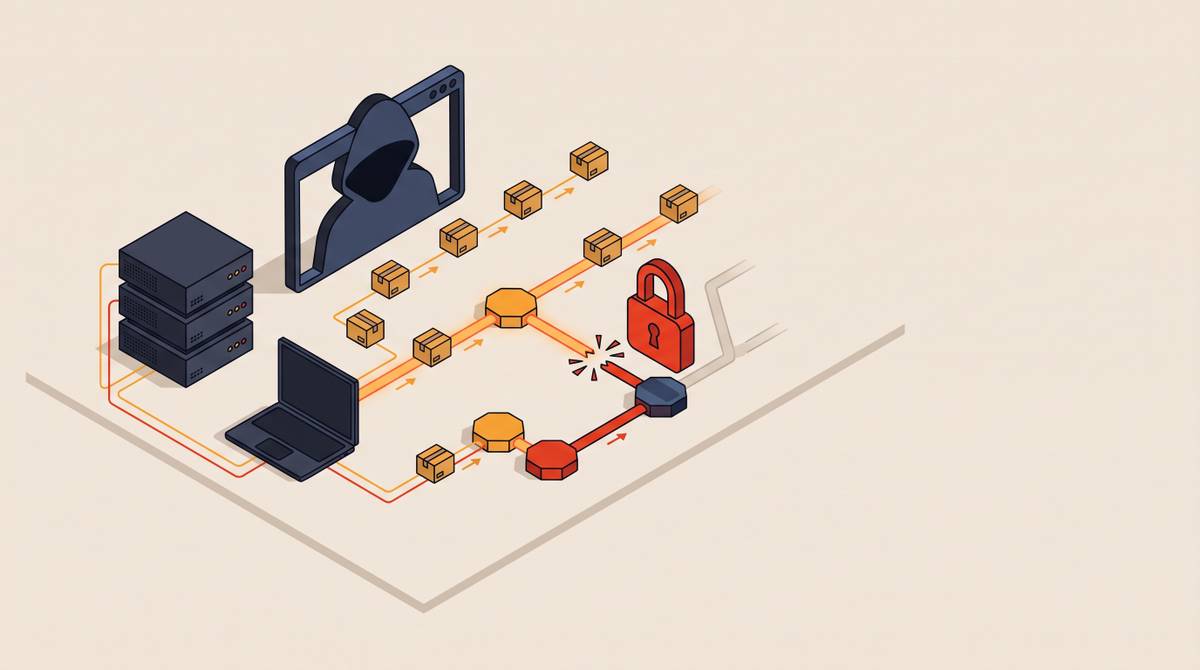
Ross Ulbricht founded the site in 2011 under the handle Dread Pirate Roberts. The pitch was simple on paper: run a Tor hidden service so nobody can find the server, price everything in Bitcoin so nobody can trace the money, and let the free market handle the rest. By the time the FBI shut it down in 2013, more than 100,000 users and vendors in over 10 countries had passed through nearly 13,000 controlled-substance listings. Prosecutors tallied 9,519,664 bitcoins transacted between February 2011 and July 2013, over $200 million in trades. This wasn't a guy selling weed out of a chatroom. It was infrastructure, with a wiki and paid staff, built like a company that just happened to be illegal.
Where the operational security held, and where it catastrophically failed
Tor held. Bitcoin's pseudonymity held. Nobody cracked the encryption or found some backdoor into the network. The government didn't break the crypto, it went around the human being running it.
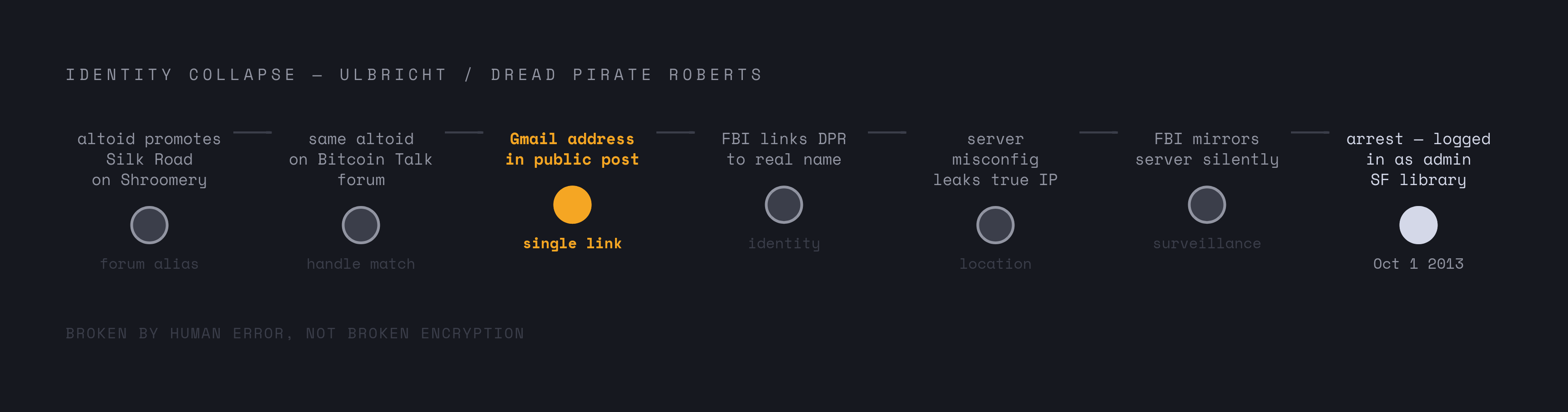
Ulbricht's downfall traces back to a username. Years before his arrest, he'd posted on a mushroom-growing forum called Shroomery.org under the handle "altoid," promoting a new site called Silk Road before anyone had heard of it. He used that same handle on a public Bitcoin forum, and on that post, he left his actual Gmail address. One thread. One handle reused across two forums. That's the connective tissue that let the FBI tie Dread Pirate Roberts back to a real name.
There's also the server leak. A misconfiguration on the Silk Road login page let the server's true IP address slip out, sitting in a data center in a foreign country. Investigators found it, mirrored the server quietly, and never tipped off the admin that anyone was watching. And then there's the arrest itself, which reads like something out of a heist movie gone wrong for the guy running the heist: FBI agents grabbed Ulbricht inside a San Francisco public library on October 1, 2013, while he was logged in as site administrator. They got live backend access to the marketplace, mid-session, no time to wipe anything.
None of this happened because Tor failed. IRS Special Agent Gary Alford found the thread that mattered by doing something almost embarrassingly simple: he searched public search engines, on the theory that whoever built Silk Road probably advertised it somewhere on the open web before it existed only in the shadows. That search is the entire case in miniature. Sophisticated anonymization architecture, cracked open by a search engine query and one reused username. The lesson for anyone building or breaking this kind of system hasn't changed since: the technology can be airtight, but the human using it still has to remember not to use the same screen name twice.
The forensic methods investigators developed to build the attribution case
Once agents had Ulbricht's laptop, the case became a different kind of puzzle. Searches of the laptop and his home turned up digital evidence linking Ulbricht directly to the site's operation and finances. Blockchain analysis tied the Bitcoin found on that laptop back to Silk Road's financial activity. The on-chain trail matched the physical evidence. Two completely different types of proof, pointing at the same conclusion.
Investigators dug through browser history and system artifacts, then cross-referenced wallet data to map out transaction patterns over time. Standard practice for this class of case now involves imaging the drive, verifying hashes, digging through registry and browser artifacts, running keyword searches, and layering blockchain forensics on top. Forensic software of that kind remains a staple in digital forensics labs today.
No single piece of evidence carried the case. Identity, server infrastructure, platform access, laptop artifacts, financial history: attribution came from stacking every layer on top of the others, checking that the timeline lined up and that nothing was collected in a way that would fall apart in court. That approach, more than any single tool, is the real legacy here. Investigators couldn't just follow cash anymore. They had to build entirely new ways to trace money across a public ledger that anyone could see but nobody, at the time, really knew how to read. That gap drove the development of the blockchain intelligence capabilities that investigators rely on today. At arrest, the FBI seized 144,000 Bitcoin along with data tying together thousands of accounts, vendors, and trades. Total seizures connected to Silk Road had crossed $1 billion in digital currency by November 2020, the FBI reported.
The investigation's internal corruption and evidence integrity
Two of the federal agents working the case were criminals themselves. DEA Special Agent Carl Mark Force IV and Secret Service Agent Shaun Bridges were both convicted for crimes including money laundering, extortion, and obstructing justice, all tied to the very investigation they were supposed to be running straight.
This wasn't simple theft on the side. These were agents with access to the case actively bending it from the inside, which raises an obvious problem for anyone who cares about evidence actually meaning what it claims to mean. Ulbricht's defense team tried to argue that "Dread Pirate Roberts" might have been operated by more than one person at different points, and tried to introduce evidence pointing at alternative suspects. The court blocked it. That question was never fully litigated, and it still isn't.
Then there's the murder-for-hire allegations: prosecutors said Ulbricht paid roughly $730,000 to have contracts taken out on at least five people. No killings were ever confirmed to have happened. Those allegations showed up at sentencing, weighing heavily on the outcome, but Ulbricht was never actually charged with them in the New York trial. A separate Maryland indictment for attempted witness murder got quietly dropped later. And the case's reach didn't stop at the courtroom: in 2015, after conviction, Reason magazine got hit with a subpoena demanding records on commenters who'd criticized the sentencing judge, followed by a gag order that eventually got vacated. That's a strange place for a drug marketplace case to end up, tangled in press freedom fights, but that's what happened.
For anyone doing this kind of investigative work today, the takeaway is blunt: a threat doesn't have to come from outside the investigation. Chain-of-custody discipline and oversight across agencies exist precisely because the people running the case can, and in this instance did, become the problem.
The legal precedents the prosecution established
Ulbricht wasn't just convicted for selling drugs himself. He was convicted as the operator of the system that let other people sell drugs, and that distinction is the whole ballgame. Together, those charges built something new: platform operator liability, the idea that building and running the infrastructure can get you held responsible for what happens on top of it, whether or not you personally handled the product.
The Fourth Amendment fight mattered just as much. In 2017, the Second Circuit ruled in United States v. Ulbricht (858 F.3d 71) that Ulbricht had no legitimate privacy interest in the routing information tied to his IP address, leaning on the 1979 case Smith v. Maryland and its third-party doctrine. Translation: routing your traffic through Tor doesn't put your IP address in some legally protected bubble. That ruling settled, as a matter of law rather than debate, that Tor hidden markets can be prosecuted.
Regulators moved fast, too. In 2013, FinCEN reclassified virtual currency exchangers as money services businesses under the Bank Secrecy Act, meaning AML and KYC rules now applied to them directly, a framework that got reinforced later by expanded digital-asset tax reporting requirements in the 2021 Infrastructure Investment and Jobs Act. The ripple went international: the EU's Fifth Anti-Money Laundering Directive in 2018 required the same kind of AML and KYC compliance from crypto exchanges and custodial wallet providers. Blockchain analytics became increasingly central to how financial regulators and law enforcement pursue sanctions enforcement. And the sentence itself, handed down May 29, 2015, set a severity floor that darknet prosecutions since have measured themselves against: conviction on seven counts, double life plus 40 years with no parole, and $183 million in restitution.
The 2025 pardon and the unresolved questions it reopened
On January 21, 2025, President Trump gave Ulbricht a full, unconditional pardon. After 11 years serving two concurrent life sentences, he walked out. Trump had first floated this at the 2024 Libertarian National Convention, promising a commutation that later got upgraded to a full pardon, and the White House framed the decision around government overreach, not innocence. That distinction matters: nobody in the administration argued Ulbricht didn't do it.
The pushback came fast. Senator Catherine Cortez Masto called it "a slap in the face to the families who've lost loved ones to his crimes." Fair or not, the pardon doesn't touch the conviction itself, and it doesn't touch the legal precedent. United States v. Ulbricht from the Second Circuit is still good law. The Fourth Amendment ruling, the platform liability theory, all of it stands exactly where it stood before Ulbricht walked free.
There's a strange postscript involving Bitcoin. Back in 2013, a hacker stole 50,676 Bitcoin from Silk Road. In 2021, Ulbricht agreed to give up any claim to those coins. By 2025, that stash was worth nearly $5.35 billion. The government's ability to trace and eventually seize coins stolen more than a decade earlier says a lot about how far blockchain forensics has come since 2013, when nobody had the tools to do this kind of tracing.
The pardon didn't resolve the agent corruption, the defense evidence that never got heard, or the murder charges that got dropped rather than argued out. Those questions are exactly as open now as they were before Ulbricht's release, and the pardon, if anything, just reminded people they were never actually closed. For security practitioners, none of that changes the architecture built on top of this case. The investigative playbook and the regulatory framework are locked in regardless of what happens to any one person's sentence.
The darknet market ecosystem's evolution after Silk Road and current enforcement data
Silk Road 2.0 went live the month after the original seizure, run by former administrators, and it lasted about a year before Operation Onymous shut it down too. The pattern since has been consistent: a market gets big, gets seized, and something new fills the gap. AlphaBay fell in 2017. Hydra fell in 2022. In 2021, coordinated international operations brought arrests across the US, Europe, and Australia. Further coordinated operations followed, with arrests and significant cash and crypto seizures. Enforcement actions continued into 2025, with coordinated takedowns spanning multiple countries and substantial seizures of drugs and assets.
Darknet market flows on-chain still added up to nearly $2.6 billion in 2025, Chainalysis reported. Reading that next to the arrest numbers makes the picture clearer: this ecosystem isn't getting dismantled, it's getting reshaped, market by market, seizure by seizure. There's one genuinely encouraging thread in the data, though. Fentanyl-related on-chain flows have dropped sharply in recent Chainalysis figures, tracking alongside fewer fentanyl interdictions and a drop in opioid overdose deaths. Blockchain data isn't just a law enforcement tool at that point, it's functioning as a public health signal.
None of this happens without coordination that didn't exist in 2013. Roughly 16 foreign nations now work joint operations under EUROPOL's European Cybercrime Centre and Eurojust, a structure that traces directly back to the multi-agency cooperation the Silk Road case forced into existence. And the entire blockchain intelligence sector, the specialized software that traces funds across mixed addresses and jumbled wallets at scale, exists because investigators working the Ulbricht case ran into forensic gaps nobody had solved yet. Security teams doing threat intelligence work today, including analysts at firms like Cyberou, build directly on that same playbook: pairing endpoint forensics with on-chain transaction analysis to figure out how a threat actor is funded and where their infrastructure actually lives.
The core lesson hasn't moved an inch since 2013. Anonymization technology is only as strong as the person operating it, and every forensic technique and regulatory rule built in response to that one failure has permanently changed how privacy, crypto, and law enforcement sit next to each other online.