Dark Web Law Enforcement Takedown Operations
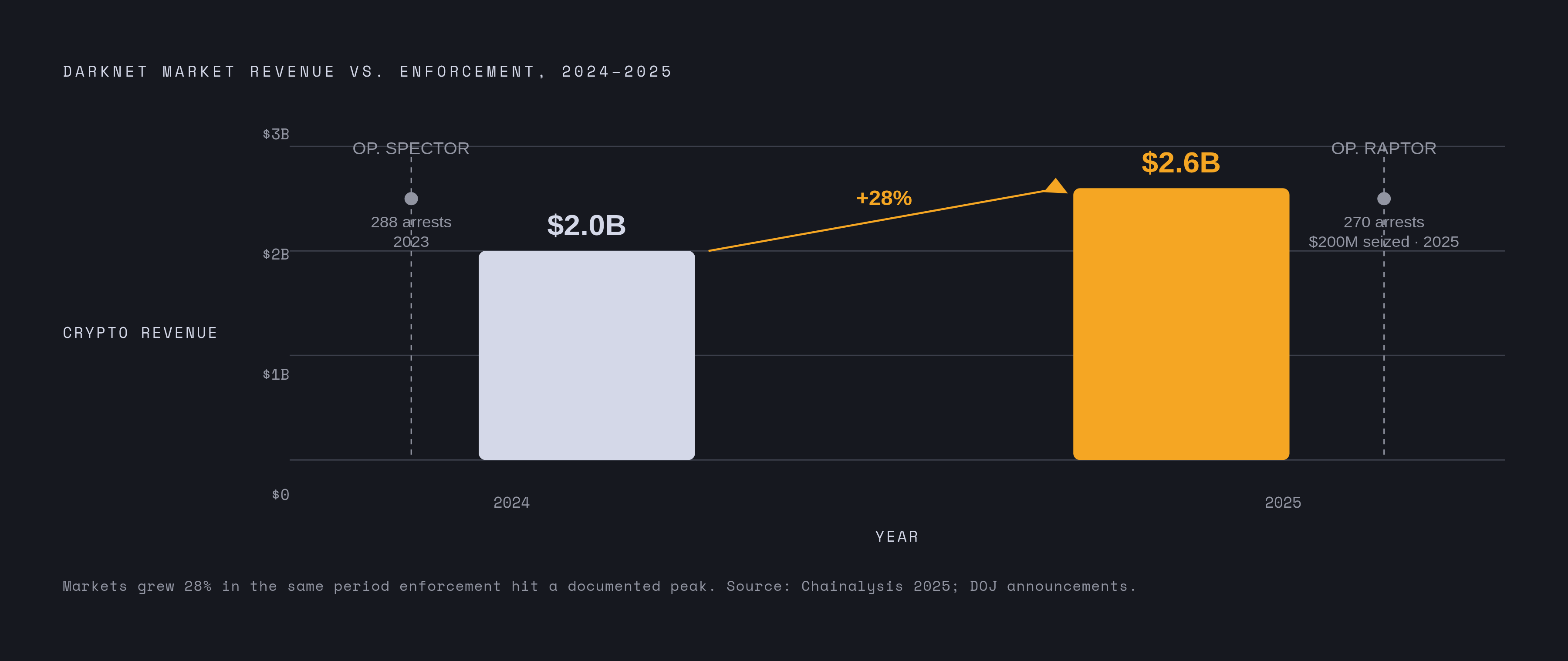
Darknet markets grew 28% in 2025 despite record law enforcement takedowns.
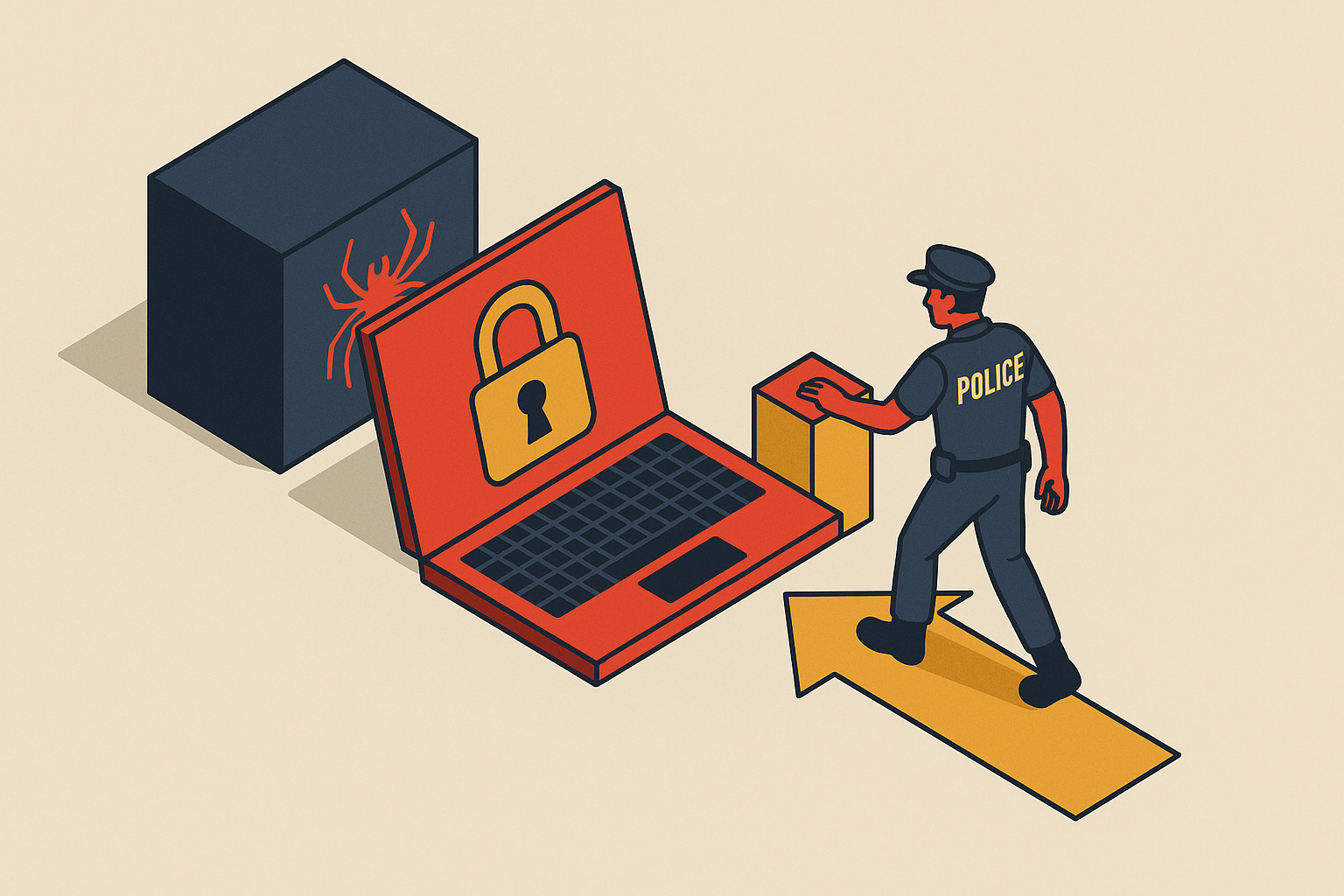
Roughly 8,000 Tor relays keep the network running as of July 2025, serving about 2.5 million people a day. Only 6.7% of them ever touch a hidden.onion service, which puts the real dark web crowd at around 167,500 users daily. That's a small slice of the internet, but it's carrying a stunning amount of weight: over 140 million stolen credit card records have appeared for sale, and a stolen Social Security number now goes for as little as one to six bucks. Darknet markets pulled in about $2.6 billion in on-chain crypto in 2025, up from $2.0 billion the year before, one of the few corners of illicit crypto that grew even as law enforcement hit it harder than ever. That's the tension worth sitting with: the harder agencies push, the more this economy seems to shrug and keep expanding.
For anyone doing security work, this isn't trivia. Stolen credentials, ransomware kits, phishing packages, DDoS-for-hire, it all moves through this ecosystem at some point. Knowing how the police actually go after it tells you something real about how much risk sticks around after the headlines fade.
How dark web marketplaces are actually built — and why that architecture matters for enforcement
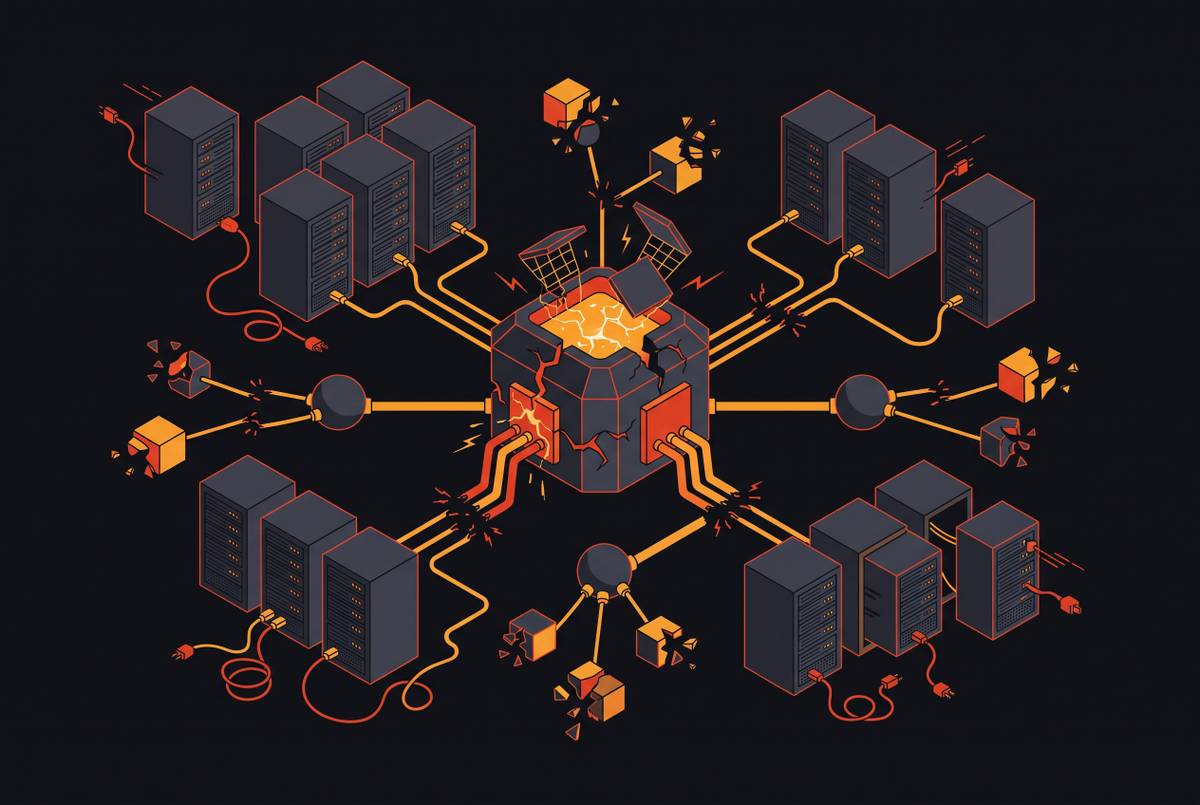
A dark web marketplace isn't some flat, anonymous bazaar. It's got layers, almost like a company org chart, if the company sold stolen SSNs instead of software subscriptions. There's an admin layer running the show, moderators and escrow staff keeping trades honest (or honest enough), vendor tiers ranked by volume and reputation, and affiliate or reseller panels underneath that. Each layer is its own door in, and law enforcement treats each one as a separate target.
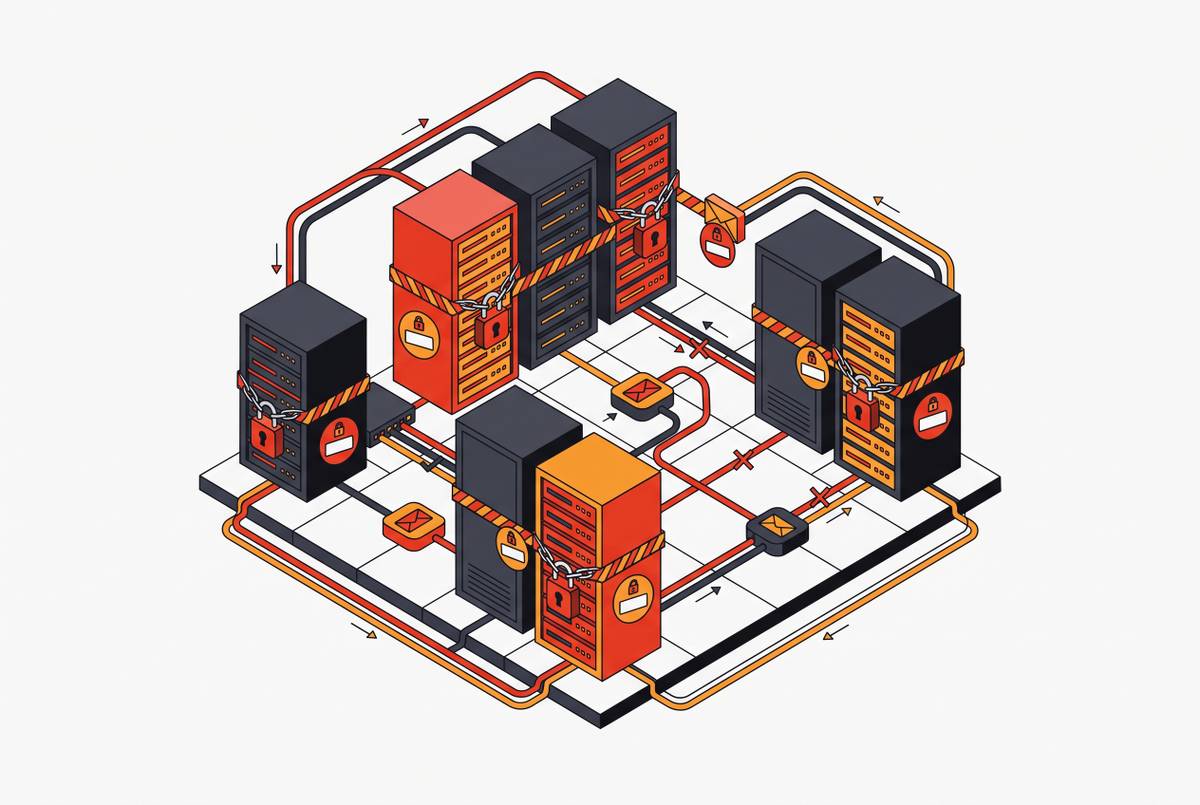
The infrastructure is spread out on purpose. Servers sit in different countries, hosting often runs through so-called bulletproof providers who don't ask questions, and.onion addresses get rotated so no single server becomes a single point of failure. Payment runs on crypto, mostly Bitcoin, though Monero shows up when people want stronger privacy. Both leave a trail; it's just a matter of how much digging blockchain analytics has to do to find it.
Operators harden these sites the way you'd expect: multi-signature escrow so no one person can run off with the funds, PGP-encrypted messages, no-JavaScript policies to block browser fingerprinting, vendor bonds that make new sellers put money on the line before they can list anything. It sounds buttoned-up, and for a while it is.
Here's the catch built into the whole model, though: these platforms hoard data. Transaction logs, user accounts, chat histories, they all pile up as the market runs, because the site needs that data to function. The moment a server gets seized, that pile doesn't vanish. It just changes hands. Nemesis Market ran with roughly 26,000 listings and 700 vendors before it fell. Archetyp had over 600,000 registered users and moved more than €250 million in transactions. Both left behind exactly the kind of records that give law enforcement a substantial intelligence source well after the initial seizure.
The technical methods agencies use to locate and penetrate dark web operations
Tor deanonymization is a live operational technique. Timing correlation attacks, guard node analysis, traffic confirmation, these techniques get used in real cases to narrow down where a server is physically sitting. From there, agents go undercover, posing as vendors or buyers inside a marketplace, and in documented cases they've climbed all the way up to moderator access.
Tracing bulletproof hosting is its own art form. In Operation Cronos, the Dutch High Tech Crime Unit traced hosting infrastructure starting from infection reports, and that thread eventually pulled the FBI in. Formal legal tools got used to pursue bulletproof hosts once investigators had a lead worth chasing.
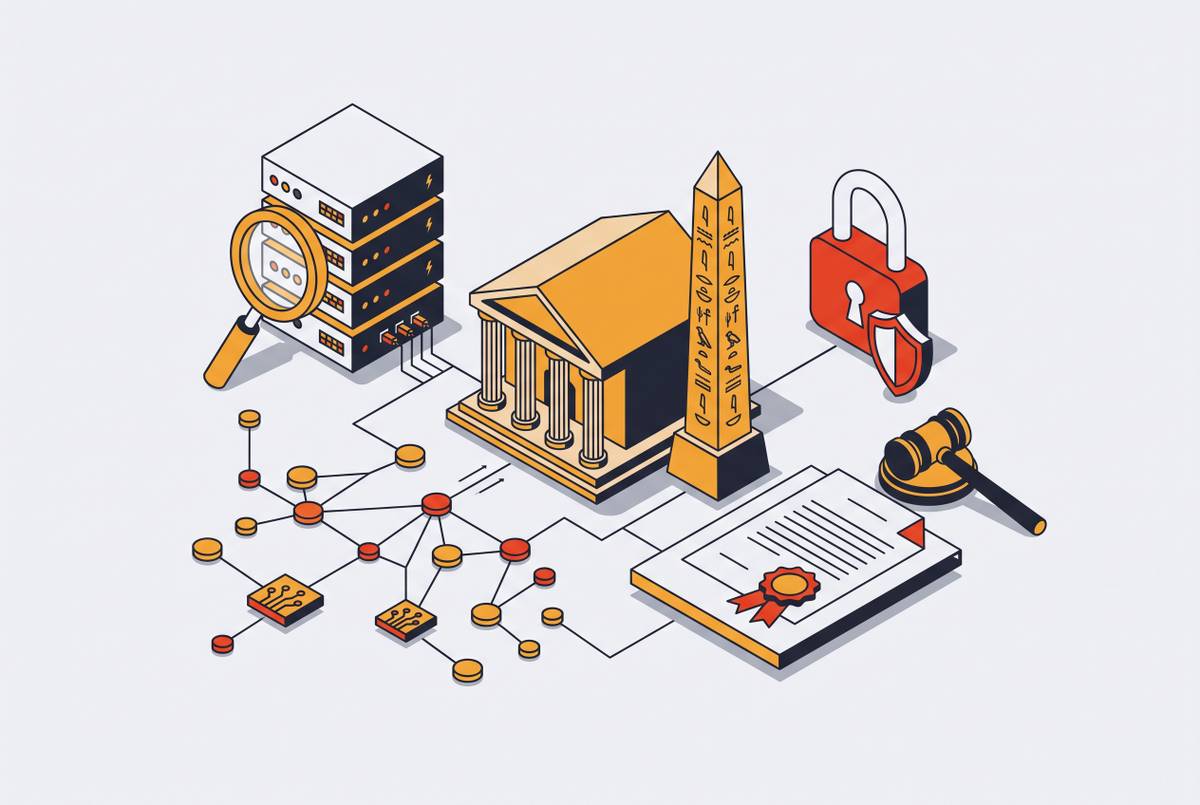
Blockchain analytics does a lot of the heavy lifting too. Bitcoin flows from ransom payments or marketplace sales can be traced back to exchange accounts, and exchanges usually have KYC data sitting right there waiting to be subpoenaed. Monero is tougher to crack, and the mixing services people use to obscure Monero transactions become investigative targets in their own right. In Operation RapTor, blockchain intelligence played a role in identifying suspects tied to darknet platforms.
Reused usernames, PGP keys shared across different platforms, shipping addresses that tie back to a real name, human error beats technical countermeasures pretty much every time.
Some of the clearest examples of deception operations at scale involve police secretly taking over a marketplace while a related site gets seized in public view. Users who flee a seized market and migrate to what appears to be a safe alternative can find themselves walking into a platform already under law enforcement control, producing a second wave of arrests nobody saw coming. None of it works without tight timing, either: without simultaneous moves on the ground, targets can hop jurisdictions or start deleting evidence.
How intelligence from one takedown seeds the operations that follow
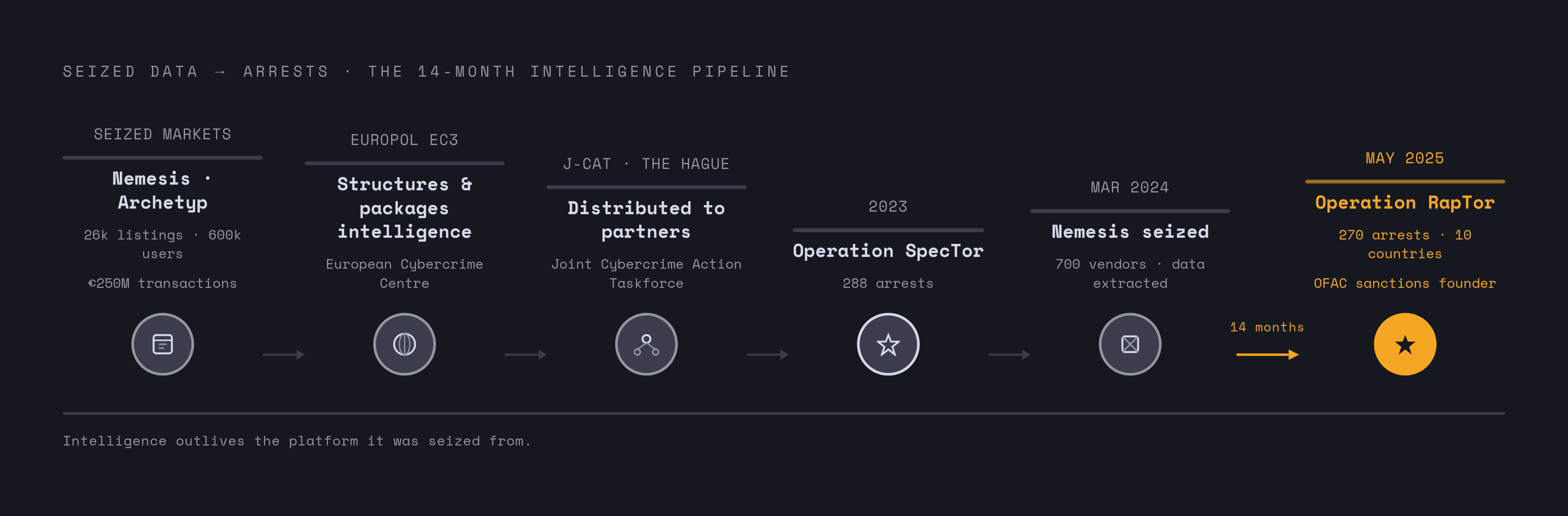
Operation SpecTor in 2023 led to 288 arrests. That case fed directly into Operation RapTor in May 2025, which produced 270 arrests across 10 countries and over $200 million seized. Suspects in RapTor got identified using data pulled from earlier marketplace seizures. One operation's leftovers become the next operation's starting point.
Europol's European Cybercrime Centre runs the plumbing behind this. It compiles intelligence from seized platforms into structured packages and distributes them through the Joint Cybercrime Action Taskforce, based at The Hague, out to national authorities. This is a formal pipeline, not a group chat between agencies that happen to like each other.
Operation Cronos went even deeper. Investigators got access to internal chat logs, decryption keys, and affiliate partnership records. The operation seized 34 servers, shut down 14,000 rogue accounts, and froze 200 cryptocurrency accounts. And Operation RapTor marked the first time OFAC took part in JCODE, sanctioning Nemesis Market's Iranian founder, Behrouz Parsarad. Financial sanctions are now built into the enforcement pipeline.
What that means for defenders: data from a seized market keeps moving through law enforcement channels for years. Exposure on a platform that got shut down 18 months ago can still produce an arrest, or a notification, today.
The psychological warfare layer agencies have added to technical operations
Operation Cronos is the clearest case of law enforcement fighting fire with fire. Agencies released LockBit's internal information on a countdown timer, the exact same tactic ransomware gangs use to threaten victims before leaking their stolen data. It's the attacker's own trick, aimed right back at them.
Publishing internal chats, affiliate identities, and screenshots of backend panels preserves evidence and humiliates the brand in front of the very people who trusted it. LockBit had extorted roughly $500 million from more than 2,500 victims before Cronos. Tearing that operation apart in public was about stopping LockBit and making the next group think twice before recruiting affiliates under a damaged name.
The Hansa honeypot worked the same psychological angle. Users who thought they'd found safe harbor after AlphaBay collapsed were, in fact, being watched the entire time. Announcing that after the fact was a message to everyone left in the ecosystem: trust nothing.
The fallout from a major operation tends to ripple through the ecosystem in the months that follow, with participants growing more cautious about where they operate and how they move money. It's a real behavioral shift, even if it doesn't last.
What takedowns actually disrupt — and what they reliably do not
Hydra is the case that puts everything in perspective. It had processed roughly $5.2 billion in total and accounted for an estimated 75 to 80% of global darknet market crypto transactions in 2021. It's the biggest single takedown by volume that's ever happened.
And yet, market flows recovered and kept climbing from there. Darknet markets grew by 28% in 2025, right alongside record levels of enforcement activity. That recovery arc is the number every practitioner should hold onto.
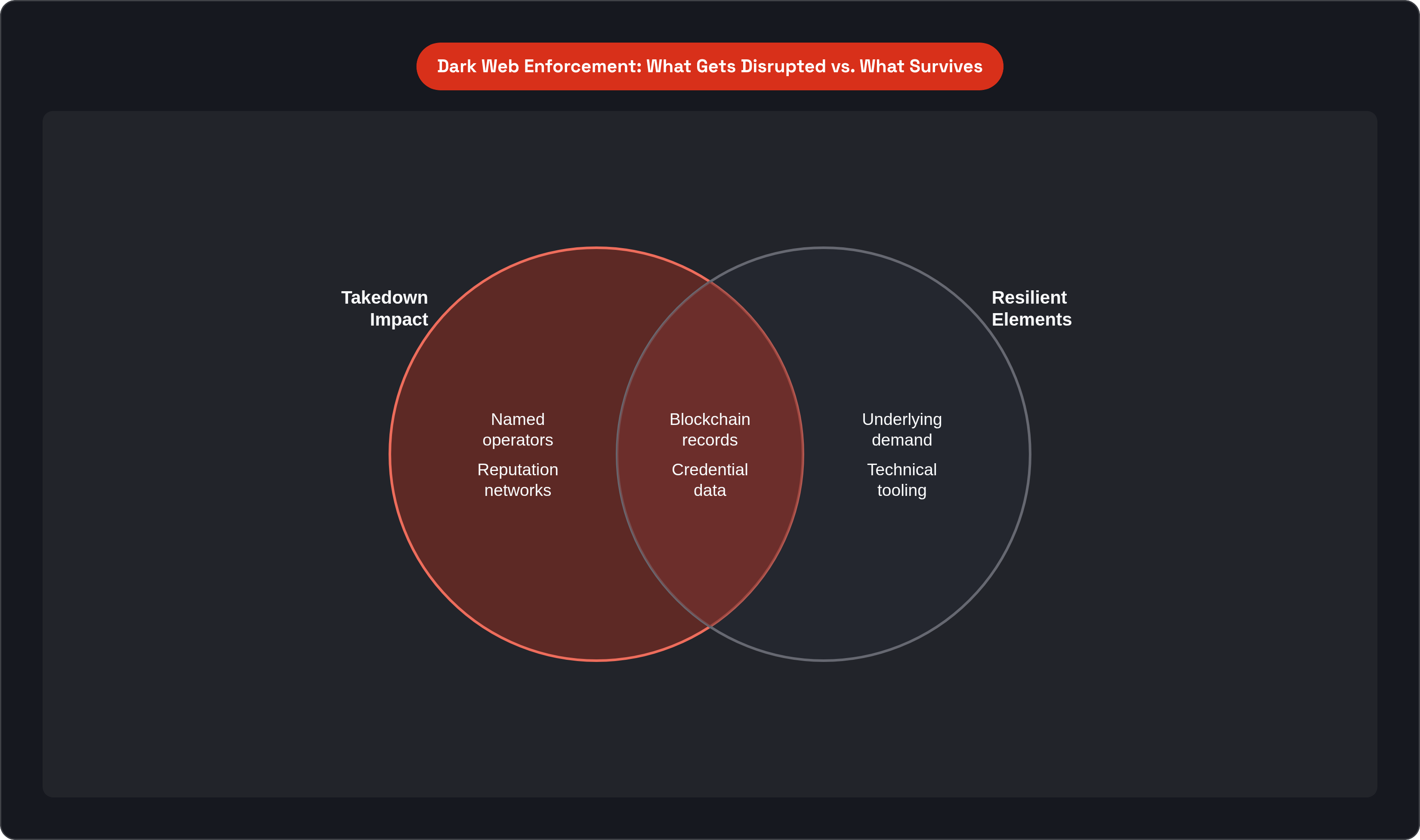
What actually gets disrupted is real, just narrower than the headlines suggest: specific infrastructure, named operators, the trust networks vendors and buyers built up over time, reputation scores that took years to earn. Rebuilding those takes time. The demand itself, the technical know-how, the tooling, and the crypto rails everyone's still using to move money all survive intact.
Nemesis Market is the case that shows the lag most clearly. It got taken down in March 2024. Its founder wasn't sanctioned by OFAC until May 2025, as part of RapTor. Infrastructure gone, operator still walking around free for well over a year. For anyone doing security work, the signal is simple: takedowns shrink the immediate supply of certain services and stolen credentials, but they don't lower the baseline threat level. Monitoring posture shouldn't relax just because a big operation made the news.
What the operational mechanics of takedowns reveal about attacker infrastructure that defenders can use
Every takedown press release is a free technical brief. Server locations, hosting providers, cryptocurrency wallets, communication tools, the architecture of affiliate panels, it's all sitting there in court documents and public statements.
Operation Archetyp, run in June 2025 across six countries with roughly 300 officers deployed, produced detailed forensic evidence on how a marketplace with over 600,000 users kept running for more than five years straight. That kind of longevity is a case study in how resilient criminal infrastructure can actually get.
Blockchain analytics disclosures from operations like RapTor and Cronos show which tracing methods are mature enough to rely on operationally, which matters for anyone advising on crypto risk or ransomware negotiation strategy. Covert marketplace infiltrations show that compromised infrastructure keeps looking completely normal from the outside. Defenders watching threat actor forums should assume the same could be true of what they're looking at right now.
The cascading intelligence model means credential sets, vendor identities, and infrastructure data from shuttered markets stay in law enforcement's hands long after the seizure. A notification from an agency referencing an old takedown is a signal worth acting on. Research-driven cybersecurity outlets, including Cyberou, tend to treat these operations the same way, reading them as technical disclosures rather than just news events, because that's where a different class of infrastructure intelligence actually lives. No threat feed packages it quite like a court filing does.