Trickbot Developer Prosecutions and Sanctions
Two convictions show why prosecuting cybercriminals remains nearly impossible.
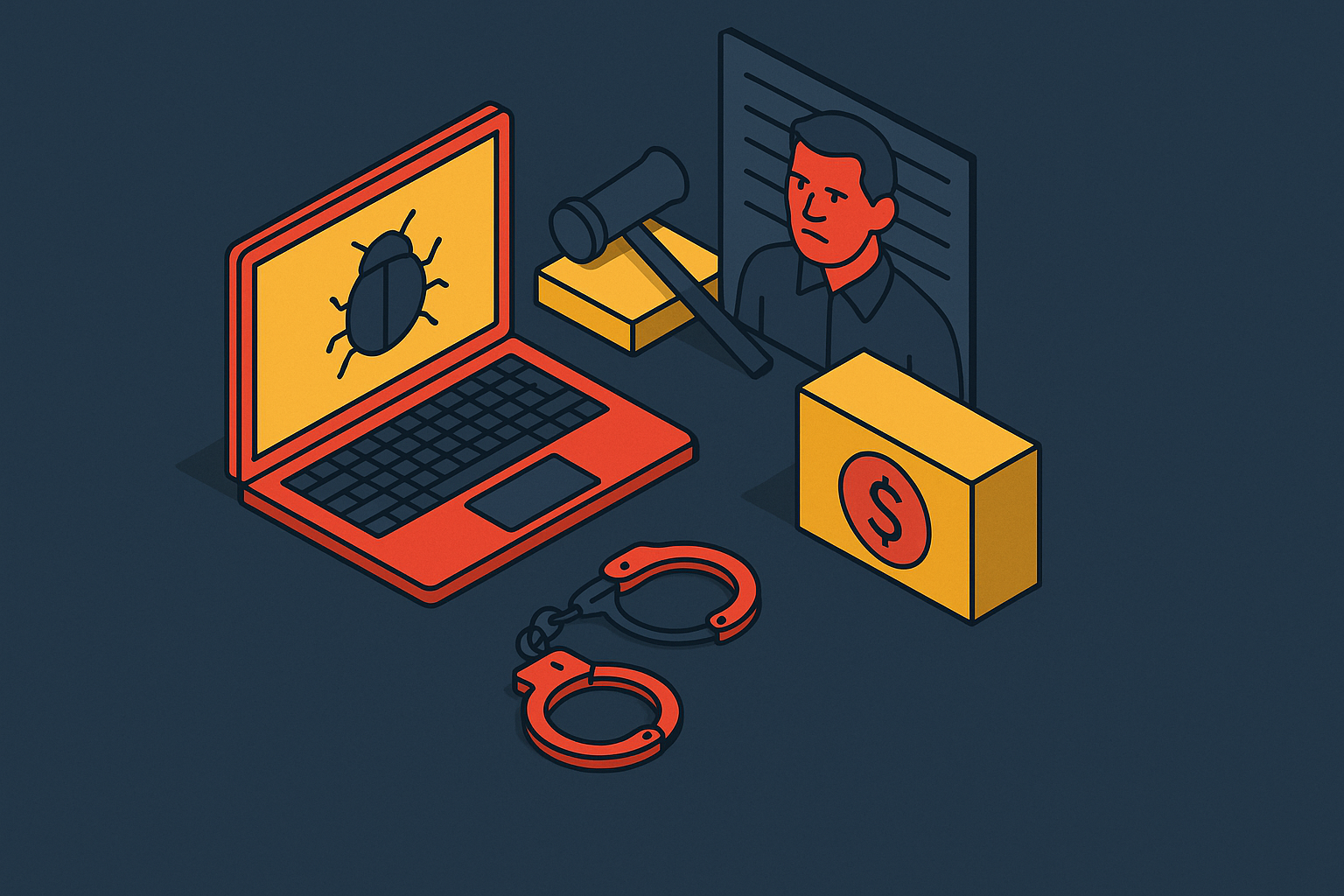
Trickbot started in 2016 as a spin-off of the Dyre banking trojan, and it borrowed Dyre's credential-stealing code wholesale, no shame about it. Six years later it had grown into a ransomware supply chain that hit hospitals, schools, and hundreds of businesses across two continents, run by a crew organized enough to have an actual HR department. Western governments went after the people behind it, and what that fight turned up says a lot about the real limits of holding cybercriminals accountable, and most of it makes for uncomfortable reading.
The scale of harm Trickbot and its ransomware successors caused
Start with the number: $180 million. That's the extortion total US and UK sanctions actions pin on Trickbot and Conti members combined, and it's the figure that explains why two governments spent years building cases against a group most people have never heard of.
Conti, the ransomware operation that grew out of Trickbot's infrastructure, hit more than 900 victims worldwide, spread across 47 US states and roughly 31 other countries. In the UK, 149 individuals and businesses got hit; Conti and Ryuk (a related strain) extorted an estimated £27 million combined there, £10 million from 104 Conti victims, £17 million from 45 Ryuk victims.
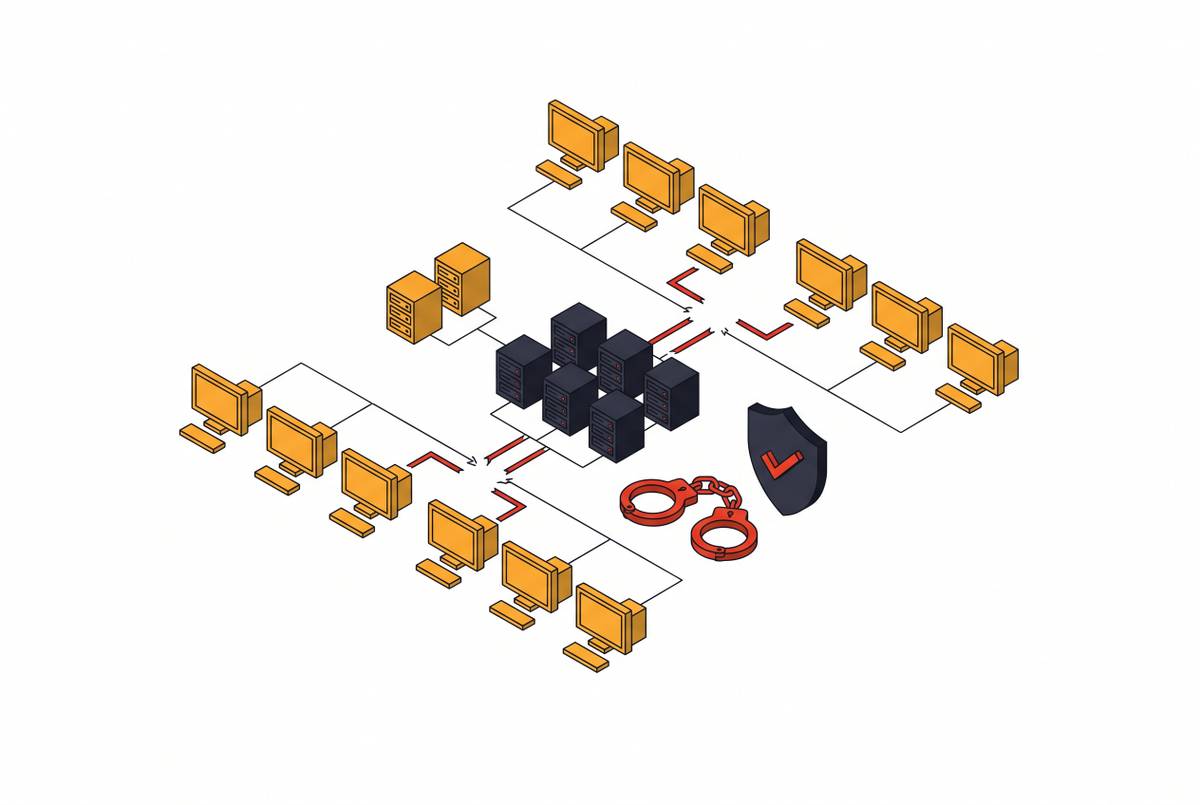
Germany's federal police, the BKA, clocked the group's headcount above 100 at various points, describing a hierarchical, profit-driven operation that looked a lot more like a mid-sized company than anything out of a heist movie. The timing was deliberate: the group ramped up ransomware campaigns against US hospitals in 2020, deploying against three Minnesota medical facilities during COVID and forcing ambulances to divert elsewhere. Hit hospitals mid-pandemic and the group turned a fraud case into a national security conversation, and prosecutors knew exactly what that meant.
How the group was structured, and what the indictments revealed about its internal organisation
Most cybercrime indictments name a handful of people and call it done, but the Trickbot documents mapped roles as well as names.
The February 2023 sanctions round reads almost like an org chart. Mikhail Iskritskiy ran money laundering and fraud projects, while Dmitry Pleshevskiy handled web injects (he wrote the malicious code planted on legitimate-looking sites). Ivan Vakhromeyev worked as a manager, and Valery Sedletski kept the servers running. By September the roster grew: Maksim Khaliullin covered HR and bought virtual servers, Mikhail Tsarev oversaw HR and finance, and Dmitry Putilin managed infrastructure purchasing.
The picture that emerges is procurement, HR, finance, and code, the same departments any mid-size company runs, except this one shipped ransomware instead of software updates.
That kind of specificity comes from years of grinding intelligence work, cross-checked against leaked material. Germany's BKA separately named Vitaly Kovalev (online handles: Stern, Bentley) as the group's likely founder. He's the same man the US charged with bank fraud tied to conduct that predates Trickbot entirely. Leaked Conti chat logs and the TrickLeaks disclosures backed up much of this org chart independently, giving researchers and prosecutors two separate paper trails pointing at the same structure.
The February and September 2023 sanctions rounds and what they were designed to do
On February 9, 2023, the US Treasury's OFAC and the UK's Foreign Office, National Crime Agency, and Treasury jointly sanctioned seven Trickbot-linked individuals, the first time the UK had ever done anything like it. On September 7, a second round added 11 more names, and the DOJ unsealed indictments against nine people tied to the Trickbot and Conti schemes that same day.
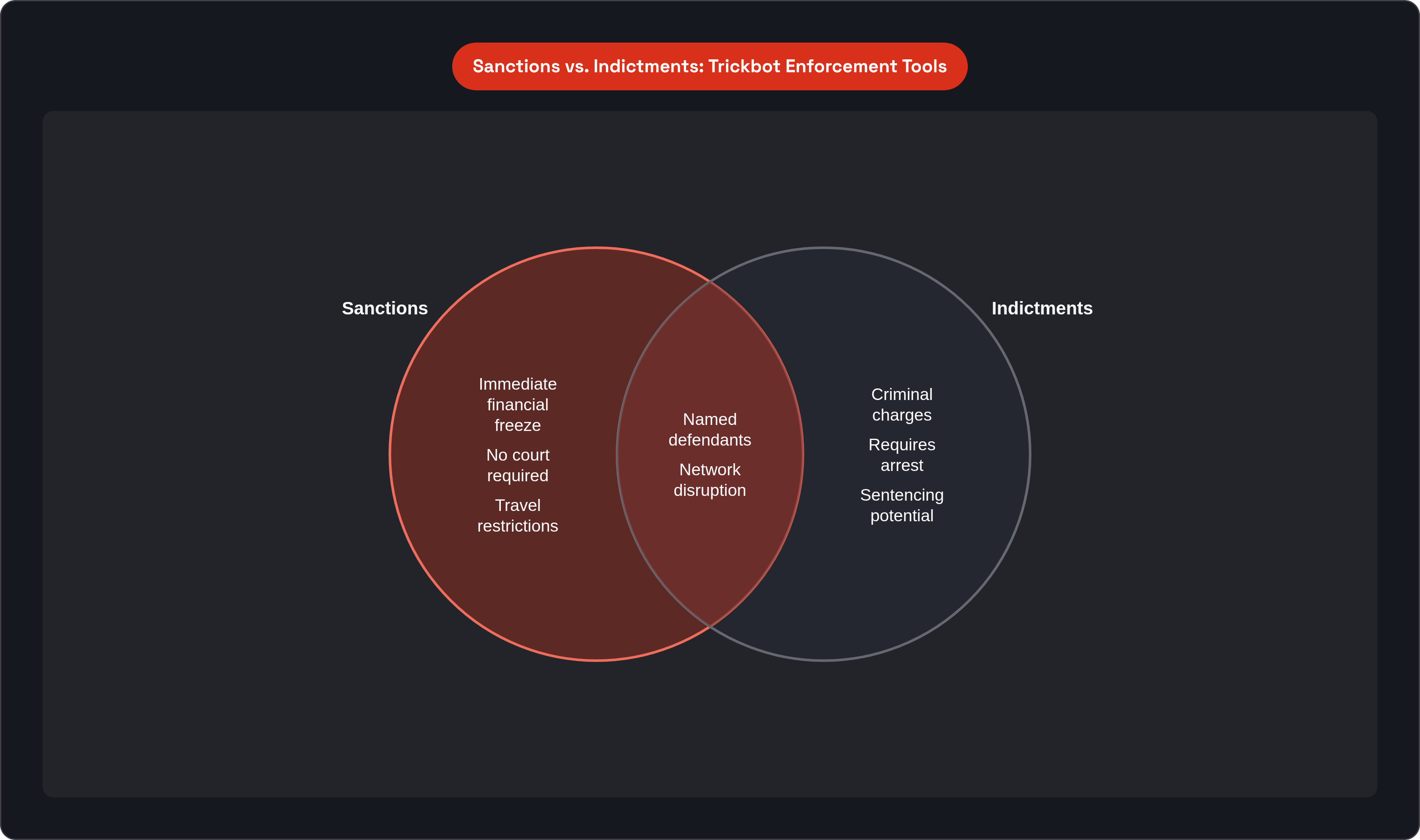
An indictment says: we will arrest and try you if we ever get the chance. A sanction works through a different mechanism: no bank, exchange, or business anywhere under US or UK financial law can touch your money without risking legal exposure of its own. Sanctions bite regardless of whether the person ever sees a courtroom, and that matters enormously when your suspects are sitting in a country that refuses extradition.
The September round dropped a detail that changed the whole framing: some Trickbot members, it noted, had ties to Russian intelligence services. Prosecutors weigh that kind of detail carefully before putting it in a press release. Pairing sanctions with indictments on the same day builds a two-track squeeze, financial on one side, criminal on the other, both aimed at the same network at once. Kovalev's indictment, unsealed that February, leaned on bank fraud conduct from 2009 to 2010, years before Trickbot existed. That's just where the paper trail happened to be cleanest.
The Alla Witte and Vladimir Dunaev prosecutions as the two cases that reached sentencing
Of everyone named across these actions, exactly two cases made it all the way to sentencing, out of dozens of names.
Alla Witte, a Latvian national who worked as a Trickbot malware developer, pleaded guilty to conspiracy to commit computer fraud and got 32 months. It was a quiet case, resolved fast, notable mostly for the fact that it happened at all.
Vladimir Dunaev, known online as FFX, is the more interesting one. He built out Trickbot's browser injection component after getting recruited in 2016 through a test that asked him to simulate a SOCKS server and modify Firefox, a technical screening process that honestly wouldn't feel out of place at a legitimate software shop. His arrest came down to bad timing more than good detective work: stranded in South Korea by COVID travel restrictions, carrying an expired Russian passport, he got picked up in September 2021 trying to leave and was extradited to the US that October. He pleaded guilty in November 2023 and got sentenced to 5 years and 4 months, longer than Witte's term, reflecting a more senior technical role. In the Northern District of Ohio alone, 10 victims, including Avon schools and a North Canton real-estate company, lost more than $3.4 million to ransomware Dunaev helped build the tools for.
Two convictions out of dozens of named defendants, both of which took years of pre-arrest legwork, and one of which only happened because a pandemic grounded a flight. Luck did more of the heavy lifting here than most people would guess.
Why most named defendants remain beyond reach, and what that reveals about the limits of cyber enforcement
Most of the people named across these indictments are Russian nationals believed to be living in Russia, where there is no extradition treaty with the US or UK, and a long history of declining to prosecute its own citizens for cybercrime against Western targets. There's your wall.
Kovalev, the man Germany's BKA identified as Trickbot's probable founder, is believed to be in Russia right now, and nobody in Western law enforcement seems to know exactly where, let alone has him in custody. Leaked BlackBasta chats alleged a connection between Kovalev and the FSB. If that holds up, parts of this network may have operated with a degree of state tolerance, which turns the problem into something a lot thornier than "extradition takes a while."
Under those conditions, sanctions and indictments function less as punishment in any traditional sense and more as containment: travel restrictions, frozen financial access, legal toxicity for anyone in a Western jurisdiction who tries to do business with a named individual. Handcuffs remain the exception for most of these names; Dunaev's arrest is the outlier, and it took a global pandemic stranding him outside Russia for over a year before US authorities got a shot at him. DOJ needs a strategy that works without waiting for a pandemic to strand a suspect in Seoul.
What the Trickbot enforcement record tells practitioners about how Western governments build and use these cases
These documents matter for reasons entirely separate from custody. They're one of the most detailed public accounts anywhere of how a real, functioning cybercriminal organization actually ran itself, day to day, role by role.
For threat researchers, that's intelligence, not legal trivia. The indictments and sanctions releases describe adversary tactics and procedures at a level of detail that exceeds most vendor threat reports: who wrote which evasion code, who recruited whom, who bought which servers. The sequencing tells its own story too. Sanctions first, indictments running alongside, convictions landing years later, if at all, because governments are using these tools to slow the operation down and make the next recruit think twice, with punishment for those already caught a secondary objective.
The TrickLeaks disclosures and the leaked Conti chat logs fed journalists and prosecutors at the same time, and open-source digging mattered at least as much as traditional law enforcement legwork, maybe more. Security teams tracking BazarBackdoor's descendants or the Conti successor groups (Royal, Black Basta, ZEON) should treat these court filings as primary source material. Cyberou, a cybersecurity content studio that grounds its work in live threat intelligence, is one example of how that kind of primary-source digging gets translated for practitioner audiences. Coders, launderers, infrastructure buyers, web inject specialists, HR people running recruitment pipelines for a criminal enterprise: that's the level of detail worth mining, whether the goal is building an adversary profile or explaining to a client why this group behaved like a company.
The gap between naming someone and arresting them will persist for the foreseeable future, and clarity on that point saves everyone time. Given that, the realistic goal for the next few years centers on disruption: takedowns, sanctions, infrastructure seizures, the stuff that doesn't need Russia's cooperation to actually work.