Organized Cybercrime Syndicate Structures
Cybercriminals have built franchise operations with middle management, help desks, and legal teams.
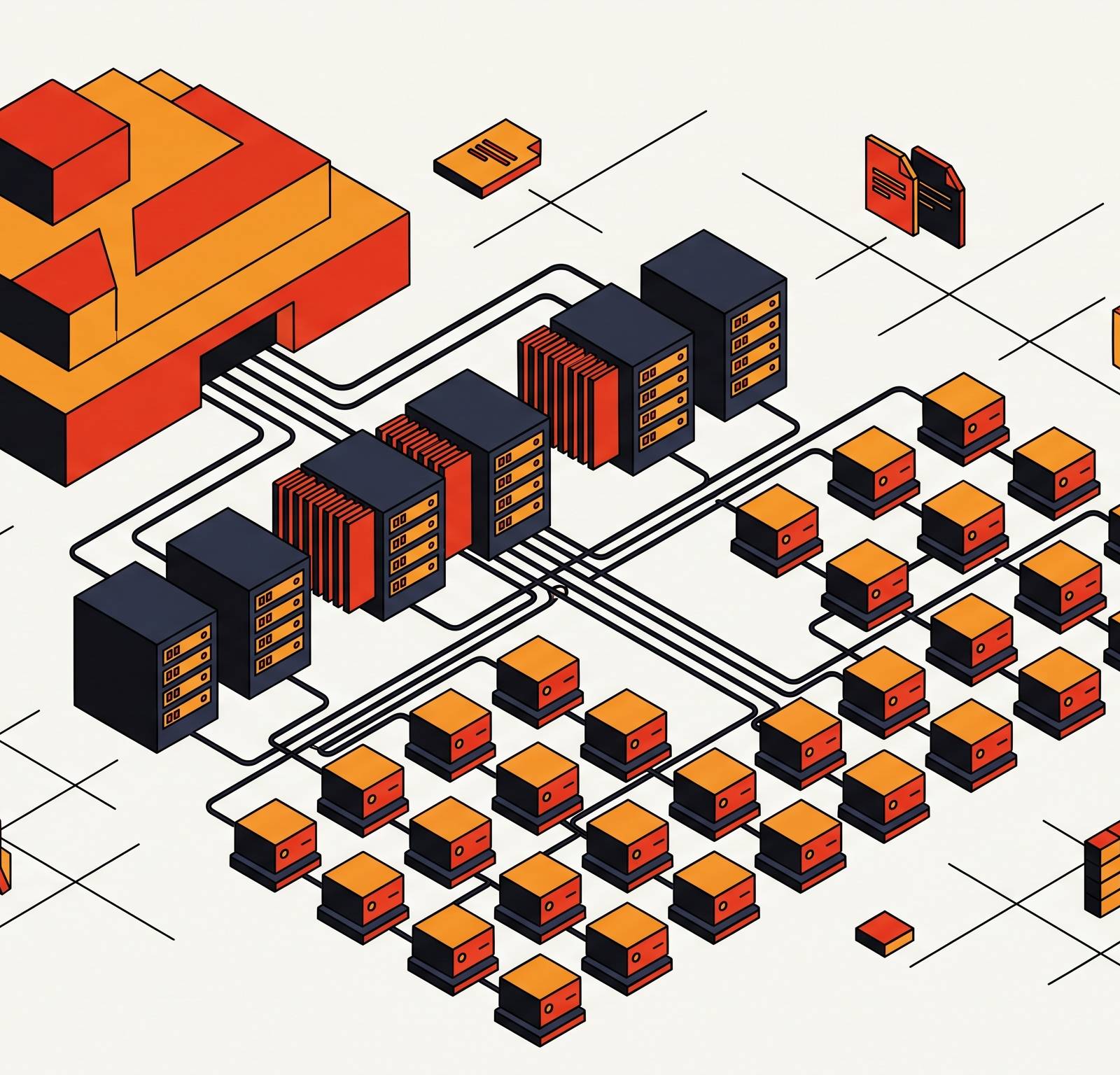
Picture a mid-sized company. Leadership sets strategy. A technical team builds the product. Sales moves the goods. Customer service handles complaints. Swap "product" for "ransomware" and "complaints" for "extortion demands," and you are looking at a modern cybercrime syndicate. Think mundane org chart on a whiteboard, not Ocean's Eleven.
These groups run on clearly defined roles:
Leaders handle target selection, control the finances, and have final say on operations.
Technical experts build and deploy the malware, find the vulnerabilities, and carry out the intrusions.
Money mules move funds across jurisdictions and launder the proceeds.
Resellers and brokers trade stolen data and network access on dark web markets.
Negotiators and help-desk staff communicate directly with victims during extortion.
Sit with that last one for a second. A help desk. For extortion. There are actual people whose entire job is walking victims through the payment process, answering questions, keeping the transaction moving. That tells you more about how far the professionalisation has gone than almost any statistic you could cite.
Beyond the roles, these groups run internal training programmes, affiliate schemes, and service agreements with contracted specialists. There are performance expectations. There is onboarding. Compliance mechanisms. If this all sounds familiar, it should.
So when defenders treat an attack as a spontaneous, one-off act by a lone threat actor, they are missing the entire planning layer behind it. The intrusion that triggered your 2am alert was probably the tail end of a multi-week operation involving multiple specialised roles, managed by someone who was never once at a keyboard.
How Ransomware-as-a-Service Turned a Criminal Capability Into a Franchise Model
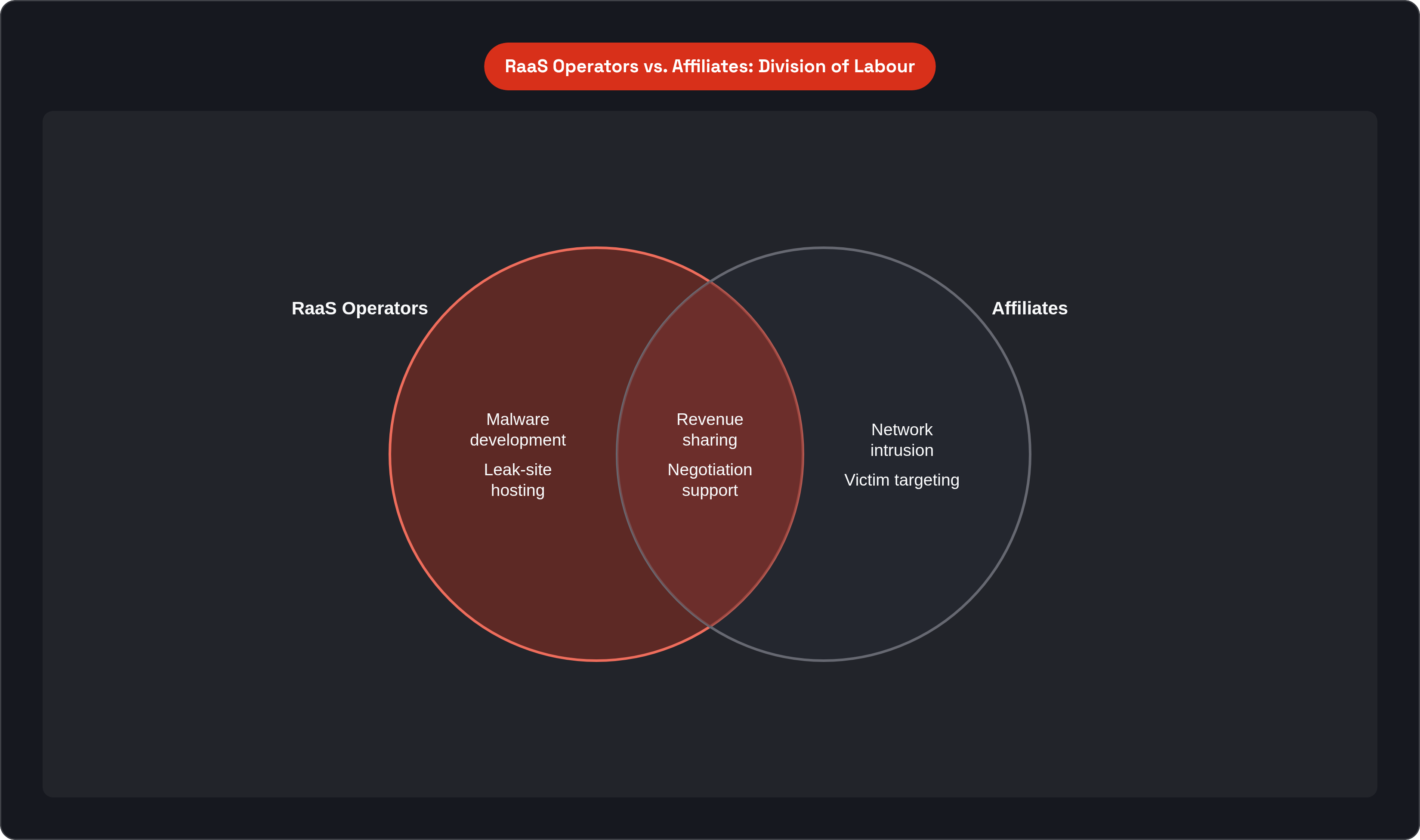
The most consequential structural shift in organised cybercrime over the last several years is ransomware-as-a-service. Think about franchising, because that is genuinely what it is.
A RaaS operator supplies the malware, the infrastructure, the negotiation support, and the leak-site hosting. They run the back-end. Affiliates handle the intrusion and pay a revenue share back to the platform. Traditional models gave affiliates as little as 10% of ransom proceeds.
RansomHub flipped this. Their model lets affiliates keep up to 90%, with the platform enforcing compliance through permanent bans for policy violations. That disciplinary mechanism mirrors how legitimate marketplace operators govern their platforms. Which is either impressive or deeply annoying, depending on your perspective.
The 2024 numbers show how well the model works. Intel 471 recorded 4,205 ransomware and extortion breach events. LockBit was the most active group at 407 victims. RansomHub came in second at 395. By Q3 2025, 85 distinct extortion groups were active. The franchise model lowered the barrier to entry, so the number of operators multiplied.
Qilin is the case study in how far this logic runs. In June 2025, the group announced a legal department. Its job: compile evidence of regulatory violations committed by victims and use it as additional leverage. They also run a call centre operating in seven languages, specifically designed to pressure victims' clients and partners. Legal and PR functions, inside a criminal organisation. In 2025, Qilin carried out over 1,000 attacks, a 408% increase. That growth did not come from massively expanding a core team. It came from the turnkey RaaS model doing what franchise models do.
Two other things defenders consistently underestimate:
Data theft now occurs in roughly 76% of ransomware attacks. Double and triple extortion has become standard: encrypt the data, steal it, then threaten to release it or notify regulators. The business model has diversified its revenue streams the way any mature business eventually does.
Groups that look "defunct" rarely disappear. They rebrand. LockBit, BlackMatter, REvil. The name changes. The talent, the tooling, and the affiliate relationships carry over. Dismantling a named group leaves its underlying capacity intact.
The Underground Supply Chain That Feeds Each Attack
Before a ransomware affiliate can deploy anything, someone has to get them inside the target network. That is what initial access brokers do, and they do exactly that one thing.
IABs gain unauthorised entry into systems and sell that access to others. They find the unlocked window, charge for the address, and move on to the next one. Running ransomware or negotiating with victims is someone else's job. Clean division of labour.
In 2024, 86% of IAB listings were priced under $3,000. Fifty-eight percent cost less than $1,000. The market has moved toward volume and commoditisation. Access to a corporate network, in many cases, costs less than a monthly software subscription. That should bother people more than it does.
The cycle times are measurable. Access typically sells within one to three days of being listed. Victims appear on ransomware leak sites somewhere between 23 and 36 days after that initial access was sold. There is a pipeline, and it runs on schedule.
Exploit listings price differently. Per SocRadar's 2024 annual dark web report, prices range from $100 to over $200,000 depending on impact and exclusivity. A zero-day for a widely deployed enterprise platform commands a premium. A reliable remote code execution bug for niche software costs less. Supply, demand, tiered pricing. Standard market behaviour, just with worse consequences.
By the time your security operations team detects an incident, the access that enabled it may have been bought and sold weeks earlier through a structured commercial channel you were not watching. You are catching the end of a process that started a month ago.
IABs are load-bearing infrastructure. Remove them and RaaS operators face a genuine capability gap.
The Forum and Platform Infrastructure That Holds the Ecosystem Together
Dark web forums are the connective tissue of the whole operation. Despite years of sustained law enforcement pressure, platforms including Exploit, BreachForums, XSS, DarkForums, and RAMP remain central nodes through 2025. They get seized. They come back. Seized again. Back again.
This resilience is structural. BreachForums, per US Department of Justice filings, hosted over 888 datasets containing more than 14 billion records. XSS had over 50,000 registered users and generated millions of euros in illicit revenue before French authorities arrested its suspected administrator in July 2025. A 2025 peer-reviewed study identified more than 1,700 active sub-communities on the dark web forum Dread alone. That level of specialisation mirrors the vertical structure of a legitimate industry.
What keeps these forums functional is trust enforcement. Exploit, XSS, and similar platforms operate formalised escrow systems and handle dispute resolution between parties who cannot exactly take each other to small claims court. If a buyer claims an IAB listing was inaccurate, there is a process. That infrastructure of trust is what makes high-volume commerce possible, same as any marketplace.
Then there is Telegram, which has become something else entirely. Telegram-based guarantee services, including Huione Guarantee and Xinbi Guarantee, processed more than $53 billion in on-chain flows in 2025, up from $6 billion in 2022, per Chainalysis. Telegram runs alongside traditional dark web forums as a parallel financial and coordination layer, with a much lower barrier to access.
Nine of the top 15 most active threat actors in 2024 and 2025 had direct ties to BreachForums, per BroadChannel. That concentration tells you two things at once. It explains why platform takedowns have real strategic disruption potential. It also explains why forums reconstitute so reliably after seizures. The operators and core users have enormous incentives to rebuild, so they do.
How Southeast Asian Transnational Syndicates Industrialised the Model at Physical Scale
Everything described so far lives in digital infrastructure. Southeast Asian transnational syndicates built something different. They built physical infrastructure, and that distinction matters more than it might sound.
Syndicates predominantly rooted in Chinese criminal organisations operate industrial-scale fraud compounds in Special Economic Zones in Myanmar, Cambodia, and Laos. These are not server rooms. These are campuses. Buildings. Workers. Shifts. Per UNODC's 2025 "Inflection Point" report, annual profits from these operations approach $40 billion. The regional economic cost to Southeast Asia sits between $88 billion and $114 billion in 2025.
The network structure runs across continents. East Asian criminal groups provide the operational framework. South Asian networks handle trafficking and recruitment. West African fraud networks contribute expertise in specific scam typologies. Non-state armed groups provide physical security and territorial control. This is a genuine multi-continent supply chain for labour, money, and operational reach, assembled with an intentionality that most legitimate organisations would struggle to replicate.
The HR function operates through coercion. Workers are recruited through fake job listings, often for roles in hospitality or technology that sound perfectly reasonable, then held inside the compounds. Human trafficking is a structural input here.
Technology adoption inside these compounds is fast and operationally integrated. AI-generated deepfake content tied to fraud in Southeast Asia surged 600% in early 2024, per UNODC. This is deployment at scale, and deployment at scale is far less reassuring than experimentation.
The Telegram-based guarantee services mentioned earlier are the financial infrastructure connecting these physical compounds to global criminal markets. The same channels that service purely digital criminal operations run the money from physical ones too.
What makes these groups particularly difficult to disrupt is that the tactics that work against distributed digital infrastructure, taking down a server, seizing a domain, arresting a remote administrator, fail entirely against physical compounds operating under the protection of non-state armed groups in jurisdictions with limited cooperation frameworks. Law enforcement faces jurisdictional, diplomatic, and physical access barriers simultaneously. The model was built with those barriers in mind.
What the Structural Logic Means for How Defenders and Vendors Should Think About Threats
Understanding structure determines whether your security programme is built to catch opportunists or interrupt a coordinated, resourced, multi-role operation. Those are different problems and they require different answers. If you have been building for one while facing the other, now is a reasonable time to notice that.
A few things follow directly from the structure:
Attacks are supply chain outputs. IAB access acquisition, forum-based resale, RaaS affiliate deployment, negotiation, laundering. Each stage is distinct. Each is a potential intervention point. If your entire programme focuses on the deployment stage, you are working with the smallest possible window.
Attribution to a named group misleads. Because rebranding is standard practice, understanding the underlying roles, tooling, and affiliate relationships that will survive the next name change matters far more than knowing an attack came from "Group X". The logo will rotate while the capabilities endure.
The post-compromise phase is now as structured as the intrusion phase. Qilin's legal department. Multi-language call centres. Professional negotiators. Your incident response plan needs to account for the fact that on the other side of a ransomware event is a structured operation with its own playbook for applying pressure, one that has probably run that playbook dozens of times before it reached you.
Vendors need to map their products against syndicate roles, not generic "threat actors." Which specific role does your product disrupt, and at which stage? A detection tool catching lateral movement is disrupting the technical expert layer. A threat intelligence feed tracking IAB listings is disrupting the supply chain before access is ever delivered. The specificity matters, for honest product positioning and for understanding where gaps actually exist.
The $75 million ransomware payout to a Fortune 50 firm in 2024 and the $1.5 billion Bybit hack attributed to Lazarus Group in 2025 are worth sitting with. No organisation is outside the operational reach of structured syndicates. The structure will keep growing in complexity. The syndicates have spent years building it with considerable care, and the gap between their organisational sophistication and most defensive programmes is, to put it charitably, a work in progress.