NBI Cybercrime Division Cases and Jurisdiction
The NBI-CCD investigates cybercrimes under strict jurisdictional rules and warrant requirements.

Republic Act No. 10175, the Cybercrime Prevention Act of 2012, did not just list crimes and move on. It did three things in one statute: defined the offences, built the investigative machinery (including the warrant system and the DOJ Office of Cybercrime), and connected the Philippines to international cooperation frameworks.
That third piece became real on May 23, 2018, when the Philippines formally became a State Party to the Budapest Convention. That accession is what makes structured cross-border case coordination possible. Formal channels only.
Section 10 is where the NBI-CCD's mandate actually lives. It assigns both the NBI and the PNP responsibility for enforcement and requires each to maintain a dedicated cybercrime unit. It is also the section that caused years of genuine confusion about who has to investigate a case before a prosecutor can touch it.
The law functions as both the ceiling and the floor. It defines what the division is allowed to investigate and what tools it can use. Cases have been filed and dismissed because of a requirement the law never actually imposed. That is not a hypothetical. That happened.
The offence categories the division investigates
The range is wider than most people expect:
- Illegal access (hacking)
- Identity theft
- Online fraud and investment scams
- Phishing and bank account compromise
- Cyber libel
- Online child sexual exploitation material
Beyond case intake, the division handles digital forensics, data preservation, and evidence authentication. They are part of the same investigation pipeline, often running in parallel.
Website takedowns are possible where court orders are in place. Cases under RA 10175 also frequently stack alongside other statutes. The February 2026 Clark Freeport operation, where 14 suspects were arrested running a scam hub targeting retirees, resulted in charges under both RA 10175 and the Anti-Financial Account Scamming Act (RA 12010). That kind of stacking is not unusual. Cybercrime cases almost always brush against other laws.
One distinction that consistently trips people up: cyber libel requires a private complainant. The division cannot initiate those cases on its own. Online scams, by contrast, can be initiated by law enforcement on public interest grounds. Same statute. Completely different procedural entry points.
How jurisdiction is actually divided between the NBI-CCD and the PNP Anti-Cybercrime Group
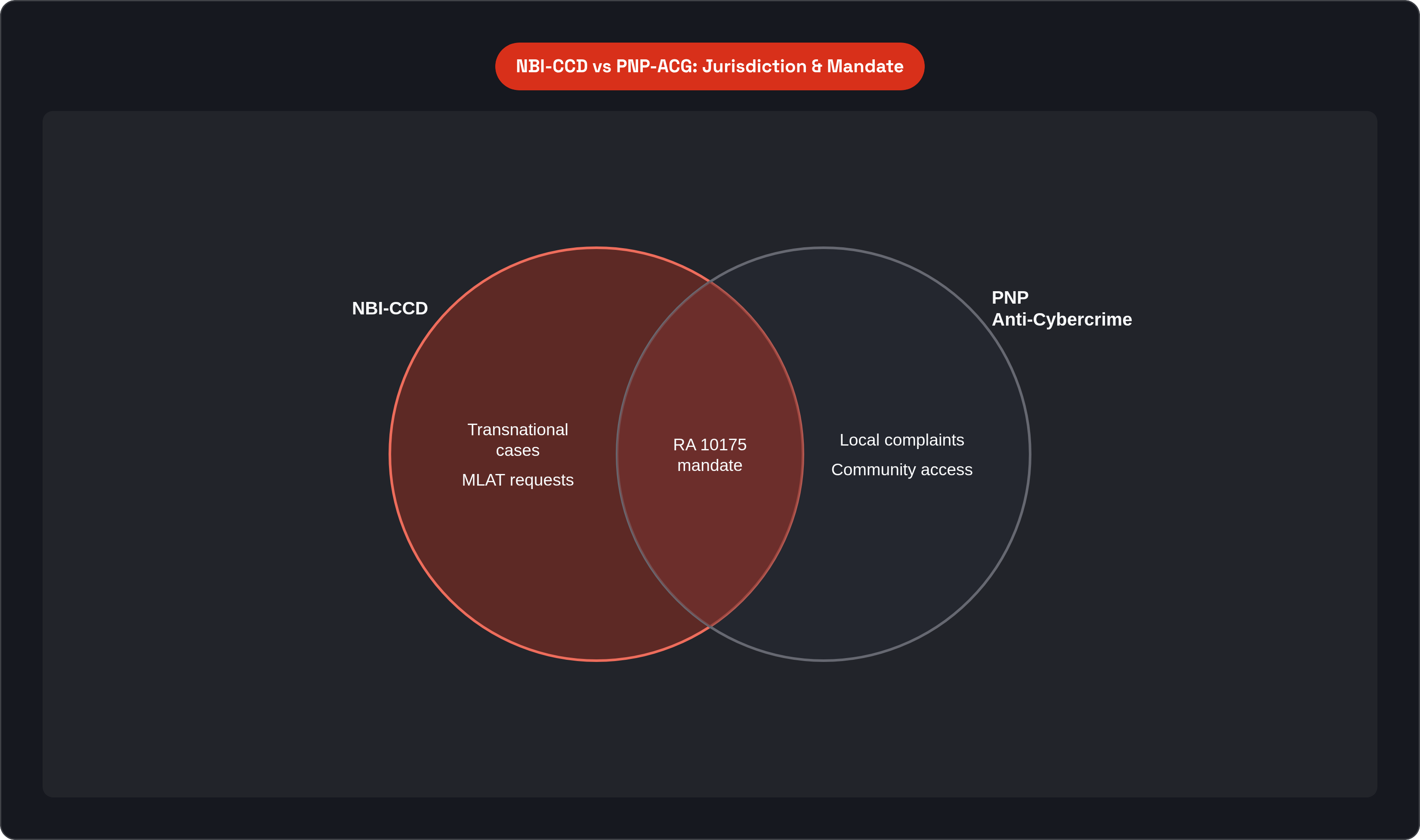
Both the NBI-CCD and the PNP Anti-Cybercrime Group are authorised under Section 10 of RA 10175. Neither one has a monopoly.
The practical split comes down to case fit. NBI-CCD is built for high-complexity, high-profile, or transnational cases. Large-scale hacking. Compromised government systems. Terrorism-linked digital activity. PNP-ACG is typically the more accessible route for localised or straightforward complaints.
Now here is the part that caused real damage to real cases. Section 10 says these units shall "exclusively handle cases involving violations of this Act." That reading misinterprets the provision.
OCA Circular No. 139-2024, issued May 6, 2024, clarified that the exclusivity language limits the type of cases those units handle, not who may apply for a cybercrime warrant. Any duly authorised PNP or NBI unit can file a warrant application. The DOJ also clarified that cybercrime complaints can be filed directly with a prosecutor's office without a prior NBI-CCD or PNP-ACG investigation. Cases were dismissed over a gatekeeping requirement the law never actually created. The clarifications fixed that.
The CCD is a resource.
How the cybercrime warrant system gives investigators lawful access to digital evidence
Digital evidence does not just appear. Investigators access it through four court-issued warrant types, governed by the Supreme Court's Rule on Cybercrime Warrants (A.M. No. 17-11-03-SC), which took effect in August 2018.
- WDCD (Warrant to Disclose Computer Data): compels a service provider or person to hand over stored data. Compliance is required within 72 hours of receiving the order.
- WICD (Warrant to Intercept Computer Data): authorises interception of data in transit.
- WSSECD (Warrant to Search, Seize, and Examine Computer Data): covers search and seizure of data on a device or system.
- WECD (Warrant to Examine Computer Data): authorises forensic examination of a device already in custody.
All four are time-limited. Effective for a court-determined period of up to 10 days, extendable by court motion for up to 10 more days. They are issued by Regional Trial Courts designated as cybercrime courts, sitting in Quezon City, Manila, Makati, Pasig, Cebu, Iloilo, Davao, and Cagayan de Oro, with additional designations added under OCA Circular No. 333-2024.
The constitutional backstop here is the Supreme Court's 2014 ruling in Disini, Jr. v. Secretary of Justice (G.R. No. 203335). The court struck down the warrantless bulk collection of real-time traffic data that Section 12 of RA 10175 had allowed. The reasoning was direct: digital surveillance is as intrusive as a physical search. Judicial oversight is not optional.
Investigators work within that ruling.
The complaint and investigation process from first contact to prosecution referral
The process is more linear than people expect, which is either reassuring or frustrating depending on how urgently you need something done.
Entry. A complaint comes in at the NBI-CCD main office on Taft Avenue in Manila, a regional Cybercrime Regional Center, the NBI online portal ([email protected]), or directly at a prosecutor's office. All of those are valid entry points, following the DOJ and OCA clarifications.
Intake assessment. The division checks whether the complaint actually falls within RA 10175 offence categories. Not every internet-related dispute qualifies as a cybercrime under the statute. A lot of people learn this the hard way.
Investigation. This is where the division's forensic capacity becomes central. Digital examination, data preservation, and evidence authentication. If the data is held by a service provider, investigators apply for a WDCD. If a device is already in custody, a WECD covers the forensic examination.
Transnational track. When key evidence or suspects are overseas, the NBI transmits a Mutual Legal Assistance Treaty (MLAT) request through the DOJ Office of Cybercrime. This is where timelines stretch, sometimes dramatically. Foreign data disclosure and extradition processes can run months to years depending on which country is involved and what cooperation framework applies. That timeline falls outside the division's control.
Referral. The completed investigation goes to the DOJ. The NBI builds the case file. The prosecutor decides whether to charge. The quality of the digital evidence package the division assembles is what determines whether a case moves forward or falls apart at that stage.
The NBI Citizens' Charter sets out the formal steps for investigative assistance to victims of computer crimes, and that document is the procedural reference point for anyone who wants the official sequence in writing.
What recent operations show about how the division applies its mandate in practice
Operations over the past two years show the division running two modes simultaneously: reactive, meaning complaint-driven, and proactive, meaning OSINT-led. The proactive side warrants closer attention.
June 2024. The NBI-CCD arrested three individuals connected to Philippine LulzSec and Globalsec for illegal access to Facebook accounts, bank systems, and government websites. Charges included Illegal Access under RA 10175 and Unauthorized Access under the Data Privacy Act (RA 10173). A straightforward example of how charges stack across statutes in a single operation.
October 2024. OSINT monitoring identified a member of "Deathnote Hackers" responsible for defacing at least 370 Philippine government websites. The division used open-source intelligence techniques alongside formal warrant tools. That combination has become the standard approach.
July 2024. The NBI dismantled a trafficking ring linked to Chinese and Russian crime groups, rescuing multiple victims including minors and foreign nationals. Cybercrime intersecting with human trafficking, handled with transnational coordination. The operation is a good illustration of how broadly the division's actual work extends beyond any narrow "hacking" definition.
February 2026. Fourteen suspects arrested in the Clark Freeport scam hub operation. Targets were retirees lured through fake investment platforms and phishing links. Charges under both RA 10175 and RA 12010.
April 2026. Two significant operations ran close together. Forty-eight individuals were arrested in a Parañaque online scam hub operation conducted by the NBI Special Action Unit, which shows coordination well beyond the CCD working alone. Separately, the CCD arrested an individual in Manila for illegally accessing and distributing an explicit video of a minor. The NBI also formalised a partnership with Child Rescue Coalition specifically to strengthen work on online child exploitation.
The pattern across all of these is consistent. The division monitors, builds intelligence, and acts when it has the evidence to do so, alongside receiving complaints.
What the division cannot do and where its practical limits sit
The NBI-CCD has real constraints. Knowing them matters if you are trying to figure out whether this is the right place to bring something.
No warrantless bulk surveillance. The Disini ruling removed that option entirely. Every data access action requires a court order, which is the correct outcome.
Cyber libel requires a private complainant. The division cannot initiate those cases independently. Someone has to come forward and file.
Transnational cases get complicated fast. MLAT processes depend entirely on the willingness and capacity of foreign governments. Foreign data disclosure and extradition processes can run months to years depending on which country is involved. When suspects or evidence are overseas, the timeline is largely outside the division's control. That reflects the reality of how international legal cooperation works.
The CCD is not the only door. Following the DOJ and OCA clarifications, complainants have genuine options. Prosecutors can receive direct filings. The division does not control all cybercrime case intake in the Philippines, and that was an intentional design choice. Multiple access points exist for a reason.
The NBI-CCD's advantage is specialisation and forensic depth; jurisdiction runs concurrent with the PNP-ACG.
The division investigates; the DOJ prosecutor makes the charging decision. The NBI builds the case package, and that line holds. Whether a case results in charges depends almost entirely on what the CCD puts together, which is exactly why the forensic work is, in practice, the entire job.