Dark Web Platform Administrators Arrested
Coordinated raids across continents signal law enforcement's new operational tempo.
2025 is the year dark web administrators found out that anonymity has a shelf life. Operation RapTor, Operation Deep Sentinel, Operation Ratatouille, another round of hits on BreachForums, and the strange double-arrest tied to Crimenetwork all landed within months of each other. This reads as a pattern, and the pattern is the story.
Start with scale, since that's what separates 2025 from every prior year of scattered wins. RapTor produced 270 arrests spread across several continents, more than $200 million in cash and crypto seized, and over 144 kilograms of fentanyl-related narcotics pulled off the street. Deep Sentinel took down Archetyp Market, a place with 600,000 users and 3,200 vendors that had moved somewhere between $250 and $290 million in illegal goods. Its administrator got picked up in Barcelona, the servers came down in the Netherlands, and investigators confiscated €7.8 million along the way. Then there's Crimenetwork, where the new administrator rebuilt the whole platform from scratch within days of the shutdown, pulled in over 22,000 users and more than 100 vendors, and got arrested again in May 2025. That single case tells you everything about both sides of this fight: how badly people want back into these markets, and how little patience investigators have left for round two.
Arrests landed in Germany, Spain, Ukraine, and across the US and Europe inside the same calendar window. It points to a coordinated campaign rhythm. So here's the actual question worth chewing on: these platforms were built for anonymity, layer after layer of it, so how did anyone get close enough to the actual administrators to slap on handcuffs?
Why administrators were historically so hard to reach
Administrators don't just hide behind Tor. They sit behind Tor routing, encrypted chat, crypto payments, servers hosted somewhere with zero interest in cooperating, and a layer of trusted intermediaries who handle the messy vendor relationships so the boss never has to get their hands dirty. Running a platform at real scale takes constant, hands-on management, even when that management stays invisible to everyone outside it.
Hydra Market is the case study everyone points to. It ran from 2015 to 2022, took in roughly $5.2 billion in cryptocurrency over that stretch, and at its peak accounted for something like 80% of all darknet market crypto transactions. A platform moving that kind of volume needs someone steering it every single day; that someone stayed hidden for seven years, which is longer than most startups survive, let alone criminal ones.
Russian-language forums made the problem worse for a long stretch, and this is the part most coverage gets backwards. Neglect protected those platforms. Law enforcement spent years focused on English-speaking platforms, and forums built for Russian-speaking actors sat largely outside the reach of Western agencies, shielded primarily by language and geography rather than by technology. Administrators also rarely touch the actual crime. They arbitrate disputes, moderate content, and collect fees, keeping deliberate distance from whatever their users are buying and selling. Peel back one layer of anonymity and there are still three or four left standing behind it. That's exactly why the investigations that end in an administrator arrest tend to run for years, not months.
How operational security failures open the door
Every layer of anonymity eventually depends on a human being who gets tired, careless, or cocky. That's where the cracks start, and human error opens them far more often than any hacking breakthrough.
The most common mistake is reusing a username. An alias that shows up on one forum in 2019 and a different platform in 2023 builds a paper trail without anyone hacking anything; investigators just have to notice the pattern and pull the thread. Misconfigured servers do similar damage, and a single moment where a server leaks its real IP address, even for a few seconds, hands investigators something they can chase for months.
The XSS case shows this playing out in slow motion. French authorities started watching the predecessor site, thesecure.biz, back in 2021, and along the way they intercepted encrypted messages tying the alias "Toha" to known ransomware operators. That's a four-year surveillance window before the actual arrest in Kyiv in July 2025. The administrator behind XSS earned more than €7 million arbitrating deals between criminals, and money like that doesn't move invisibly. It crosses jurisdictions and banking systems, and every crossing is a place where someone can get spotted.
Archetyp's administrator, a 30-year-old German national, got arrested in Barcelona rather than at home, which tells you he was moving around, and movement is exactly the kind of thing investigators track. Here's the pattern worth naming, and it's the one operators never seem to plan for: success is the thing that eventually undoes them. Discipline is easy when nobody's watching, but it gets a lot harder once a platform is big enough to draw federal attention, has real money flowing through it, and has an administrator who's been running the same show long enough to get comfortable and sloppy.
The investigative tradecraft that closes administrator cases
Blockchain forensics does the heavy lifting on the financial side. Investigators cluster wallet addresses using behavioral heuristics, cross-reference that against open-source intelligence, and pull records from exchanges, turning what looks like anonymous on-chain noise into evidence a court will actually accept. The $25 million bitcoin seizure tied to Hydra back in 2022 proved this approach works at scale, not just in theory.
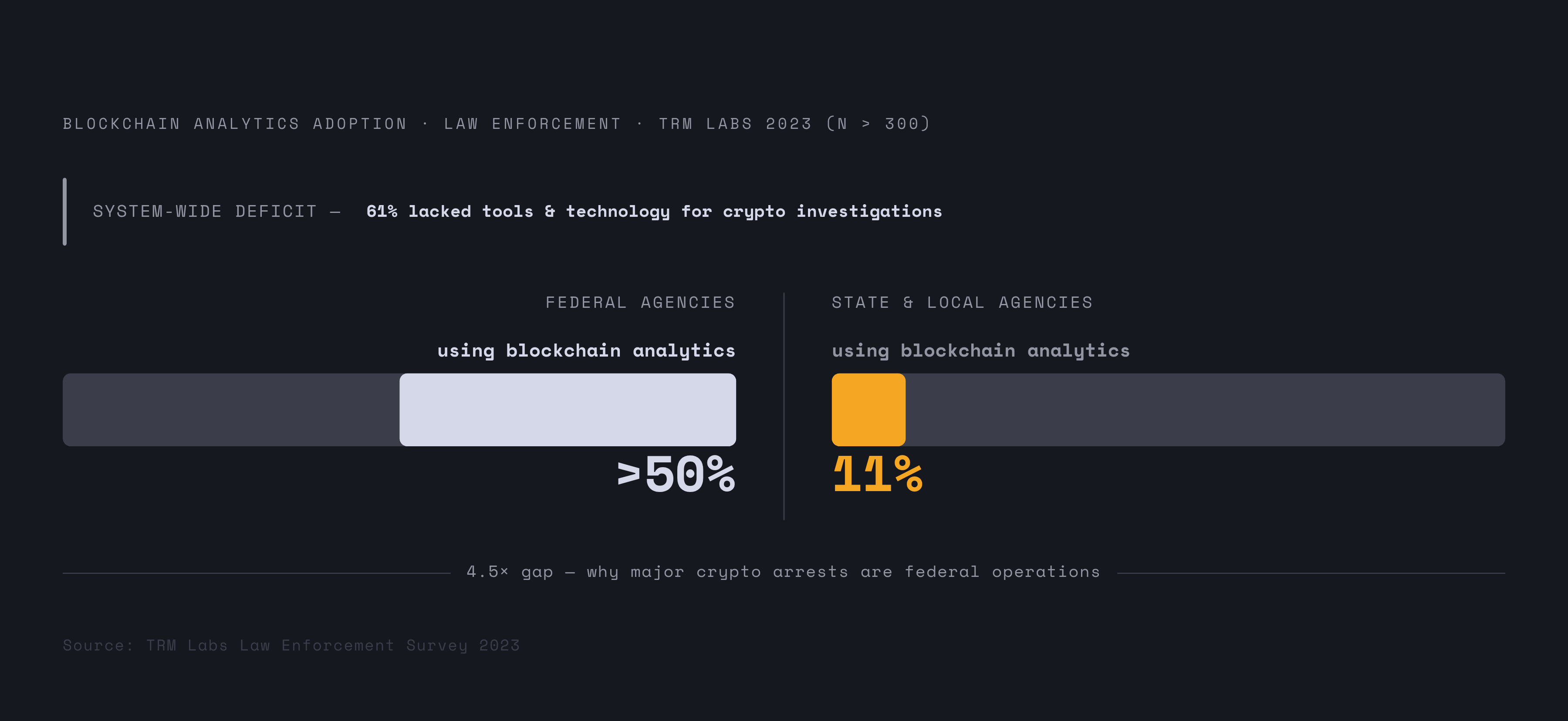
There's a real capability gap underneath all of this, though, and it's worth naming plainly instead of glossing over it. A 2023 survey by TRM Labs of more than 300 law enforcement professionals found that 61% said they lacked the tools and technology needed for crypto investigations. Only 11% of state and local agencies were using blockchain analytics tools at all, against more than half of federal agencies. That gap is the whole reason the biggest administrator takedowns are almost always federal-level operations. Local police simply don't have the tooling, and no amount of good intentions closes that.
These forums require human intelligence alongside technology, and the biggest takedowns prove it. Reputation and vouching systems keep outsiders locked out, so undercover operatives and informants matter as much as any blockchain tool, maybe more, on forums where trust is the entire gatekeeping mechanism. Seizing a server often marks the start of the most valuable part of an investigation. Seized infrastructure hands investigators private messages, transaction logs, user databases, and metadata that would've taken years to reconstruct any other way. The XSS database alone held 123,241 messages spread across 51 trading sections, an almost complete map of how that one forum sat inside the ransomware supply chain, linking affiliates, tool developers, and access brokers to each other. None of this moves fast. The XSS investigation ran four years, and Archetyp's takedown needed the BKA, Europol, Eurojust, and Homeland Security Investigations coordinating across multiple countries before anyone made an arrest.
How cross-border coordination became the decisive factor
Every major administrator arrest in 2025 crossed at least one border, usually several. RapTor spanned the US, Europe, South America, and Asia. Deep Sentinel combined the BKA, Europol, Eurojust, HSI, and five more national agencies, while Ratatouille brought together France's BL2C, Europol, and Ukraine's SBU.
The Ukraine piece of the XSS case deserves its own mention, because it breaks a rule that used to hold. Getting SBU cooperation during active conflict is a significant ask, and arresting a Russian-language forum administrator in Kyiv upends the old pattern where those platforms sat outside anyone's effective reach. Europol and Eurojust are the connective tissue behind all of this: they hold the liaison relationships, pass intelligence across agency lines, and let separate national police forces synchronize arrests and server seizures across time zones without tipping off the target.
Timing decides everything here. Deep Sentinel seized servers in the Netherlands and arrested the administrator in Spain inside the same coordinated window; a delay of even a few hours could have let evidence get destroyed or the target slip away. The Crimenetwork double-arrest shows what patience looks like on the other end of that same clock. Spanish police picked up the rebuild's administrator months after Germany's BKA had already taken down the original platform, proving the investigation didn't stop just because the first target went dark.
What the seized data reveals about how these platforms actually operated
A seized database maps out the entire ecosystem that grew up around the platform, not just the administrator running it. The XSS database charted ransomware affiliates, initial access brokers, tool developers, and escrow participants across four years of forum activity, and that's the part people underestimate. The seizure's value extends deep into every downstream investigation it seeds.
XSS sat upstream of almost every major ransomware brand from the past five years. The intelligence pulled from this one takedown feeds identification efforts across the entire ransomware supply chain, extending well beyond the forum itself. Archetyp's marketplace data tells a similar story on the drug side, where 600,000 users' worth of buyer-vendor relationships, pricing history, product categories, and shipping patterns map out how darknet drug logistics actually function on the ground.
Private messages are the real prize, though. People write differently when they think no one's listening, and that's exactly the material investigators get once a server comes down. Negotiation, dispute resolution, operational planning, all the candid back-and-forth that only shows up when someone believes their channel is secure. Every person who ever transacted through XSS left a record behind, and investigators now hold every one of them. That's the kind of intelligence that seeds the next five investigations, not just this one.
Why platforms reconstitute so quickly after takedowns
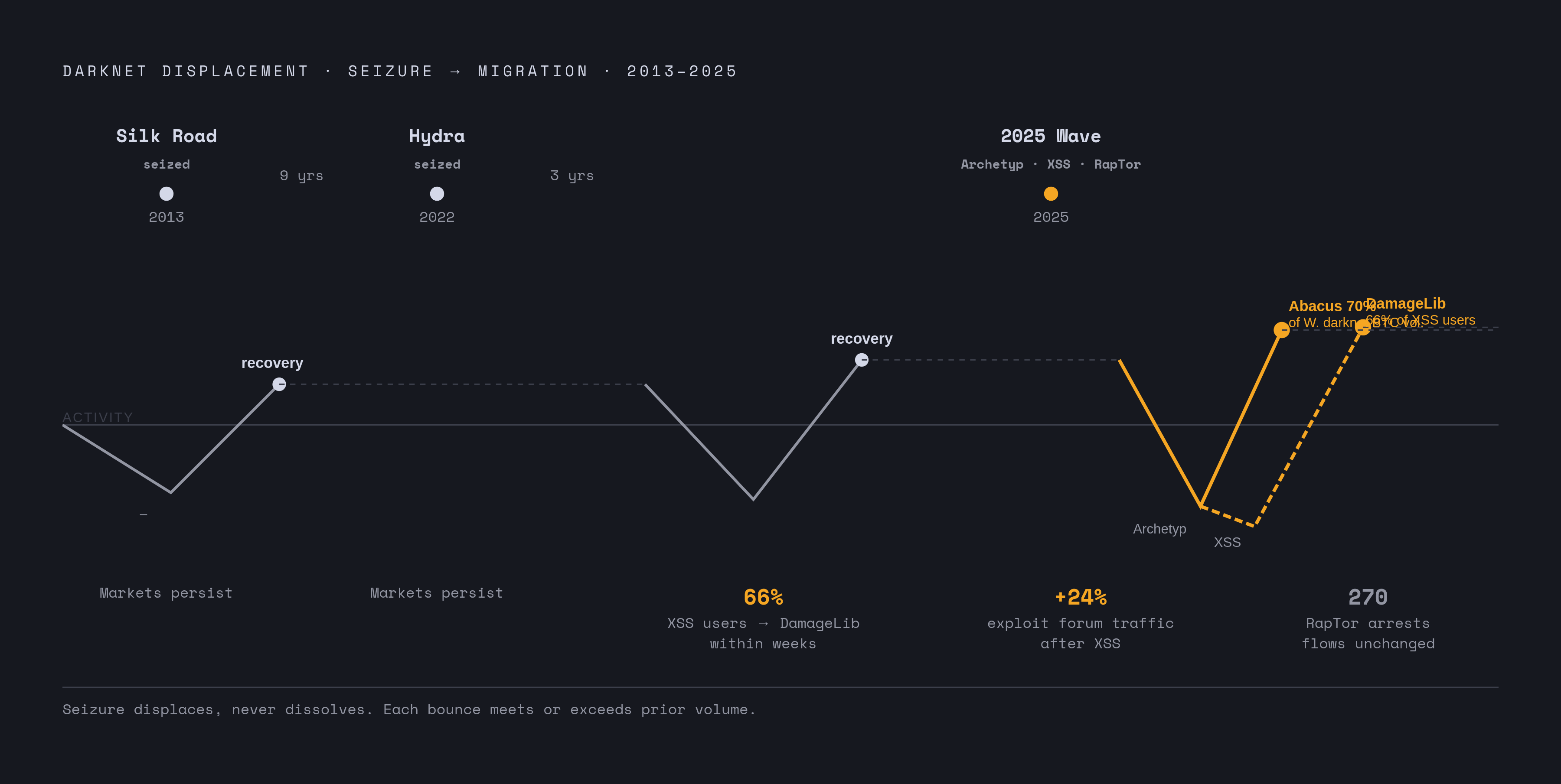
Here's the pattern that's held for over a decade, and it's the one thing most takedown coverage refuses to say out loud: takedowns disrupt, and the market absorbs each hit and continues. Silk Road went down in 2013, Hydra got seized in 2022, and the 2025 operations produced the same result every time, with users migrating to whatever platform is next instead of the market simply collapsing.
After Archetyp's seizure, buyers and vendors mostly landed on Abacus Market as the next available destination. Abacus then ran an exit scam in July 2025 while holding an estimated 70% of Western darknet Bitcoin transaction volume at its peak, which proves displacement opens a door for the next opportunist. After the XSS seizure, exploit forum traffic jumped nearly 24% as people scrambled for alternatives, and a splinter forum called DamageLib picked up 33,487 users within weeks, about 66% of XSS's 50,853 former members, with some of XSS's own former moderators among its founders. Old wine, new bottle, same buyers.
Available indicators suggest aggregate dark web market flows held steady in 2025 despite RapTor, and the enforcement wave left the market intact at the top level even with 270 arrests behind it. BreachForums tells the same story from a different angle: disrupted repeatedly between 2023 and 2025, its users eventually scattered to DarkForums and private Telegram channels. Decentralization is the real obstacle, and arrests address only part of it. A market that can rebuild across a dozen smaller channels the moment the original goes dark is far harder to eliminate than any single administrator.
What the real strategic value of these takedowns is
The arrests carry real value, and the right measure is the intelligence event each takedown produces, not whether the market disappeared. The seized databases, private messages, and financial records keep feeding follow-on investigations long after the headlines fade.
XSS is the cleanest example on record. Four years of surveillance led to one arrest, and that arrest handed investigators 123,241 messages worth of operational history. The arrest was the visible ending; the four years of surveillance beforehand were the actual intelligence operation. Cost imposition matters here too, even without a permanent shutdown, since every takedown forces the next operator to rebuild infrastructure, rebuild reputation, and rebuild trust with a user base that just watched the last guy get arrested. That friction adds up over time, accumulating well below the threshold of individual headlines.
The Crimenetwork case is the sharpest proof of that friction. Rebuilding the platform took days. Staying ahead of the agency that had already taken it down once took months, and the new version never came close to matching the original's scale or stability before its administrator got arrested a second time. There's also a bigger shift buried in the XSS case: enforcement pushing into Russian-language forums signals that territory once considered operationally insulated is now fully in play. For security teams watching from the outside, the takeaway is straightforward. When a major forum goes down, its intelligence moves into law enforcement's hands, and the community that depended on that forum reorganizes in ways that are visible and trackable, if anyone's actually looking.
What security teams can act on while investigations are in progress
Dark web monitoring catches the warning signs before an attack happens, not after. Credentials posted for sale, access listings tied to a specific company, vulnerability chatter about a named target: all of it surfaces on forums before anyone acts on it. That's the window worth watching, and most teams miss it until after the attack.
According to Bitsight's State of the Underground Report, data breaches posted on underground forums rose 43% in 2024, so the volume of usable pre-attack signal keeps growing, not shrinking. Credential exposure sits at the center of the risk. IBM's 2025 Cost of a Data Breach Report found that compromised credentials carry some of the longest detection timelines and highest costs of any attack vector out there, and dark web monitoring shrinks that window by catching the exposure while it's still sitting in a criminal marketplace instead of after it's already been used against someone.
Forum disruptions create their own kind of opening, too. Right after the XSS takedown, displaced actors got noisier and sloppier as they scrambled to migrate somewhere new, and that's exactly when threat intelligence teams watching the migration catch signal that gets much harder to find once everyone settles into a new home. This intelligence plugs straight into workflows teams already run: SIEM enrichment, vulnerability management prioritization, access control reviews, extending the tools security teams already have.
A handful of practitioner-facing platforms cover this space directly, including Recorded Future, DarkOwl, Cybersixgill, and Flashpoint, all evaluated in Javelin's 2025 Dark Web Threat Intelligence Vendor Scorecard across categories like threat actor identification, source collection, and contextual analysis. The administrators keep getting arrested, and the forums keep coming back under new management. The intelligence keeps piling up on both sides of that cycle, and the teams paying attention to it are the ones who get ahead of the next breach instead of reading about it in someone else's postmortem.