Hacker Extraditions From Eastern Europe to the US
US prosecutors catch Russian hackers only when they leave home.
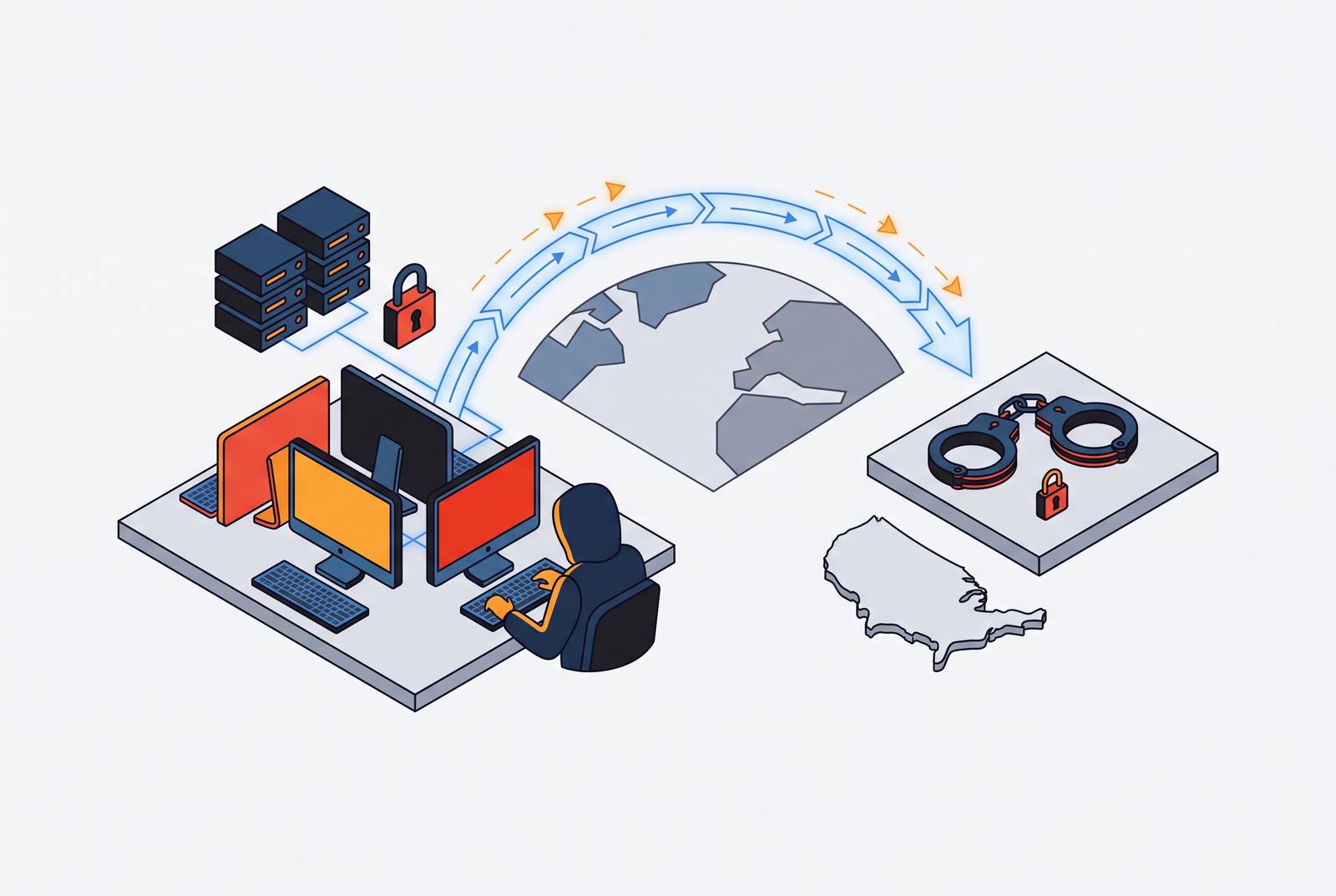
Extraditing a hacker out of Eastern Europe is a matter of geography, not courtrooms. The whole system runs on treaty gaps, constitutional loopholes, and whether a suspect books a beach vacation to the wrong country.
The internet ignores borders; law enforcement is defined by them, badly. An attacker sitting in Moscow can hit a hospital in Ohio and never see the inside of a US courtroom, because the United States and Russia don't have an extradition treaty. Never have, and on top of that, the Russian constitution flatly bans extraditing its own citizens, full stop, no exceptions carved out for cybercrime.
Moscow actively intervenes, too. Former officials have described Russian authorities tipping off suspects the moment an international warrant gets filed, which is a bit like a lifeguard warning swimmers about a shark by yelling at the shark first. When Russian nationals do get arrested somewhere else, Moscow has been known to file its own competing extradition request, pulling the suspect home to face charges that then quietly evaporate. The Prosecutor General's Office treats these US requests as geopolitical weather reports rather than legal documents; anything tied to sanctions enforcement or state-adjacent activity is dead before the ink dries.
The result is a graveyard of headlines with no bodies. The Mueller-era GRU indictments, the Sandworm case, the LockBit and Evil Corp charges: all filed, all real, all sitting unanswered in Moscow. Treasury said the quiet part out loud in May 2024, describing LockBit administrator Dmitry Khoroshev's home country as a place that "continues to offer safe harbor for cybercriminals." That's about as close to an official diagnosis as this problem gets.
How the US actually gets suspects: the travel trap
Since Russia won't hand anyone over, the US strategy has shifted from asking to waiting. Call it the travel trap: catch the suspect the second they step outside safe-haven territory.
Here's the thing about that territory. It's small, and it's shrinking, leaving a cybercriminal based in Russia effectively under house arrest at a continental scale, free to roam Russia and a narrow band of friendly states, but one wrong flight itinerary away from a very bad day. The machinery behind this is Interpol red notices, bilateral law enforcement agreements, and real-time intel sharing between allied countries.
Speed is the whole game. Denis Obrezko, an alleged member of the group Void Blizzard, landed in Thailand and got arrested one week later, a trap that was already loaded, waiting for him to walk into it.
Geography outweighs the legal argument entirely. A suspect remains sheltered in Moscow and becomes fully prosecutable the moment he changes planes in Warsaw. This is a very patient, very well-mapped game of Whac-A-Mole, where the mole occasionally makes the mistake of surfacing at passport control.
What successful extraditions actually look like: the cases that made it through
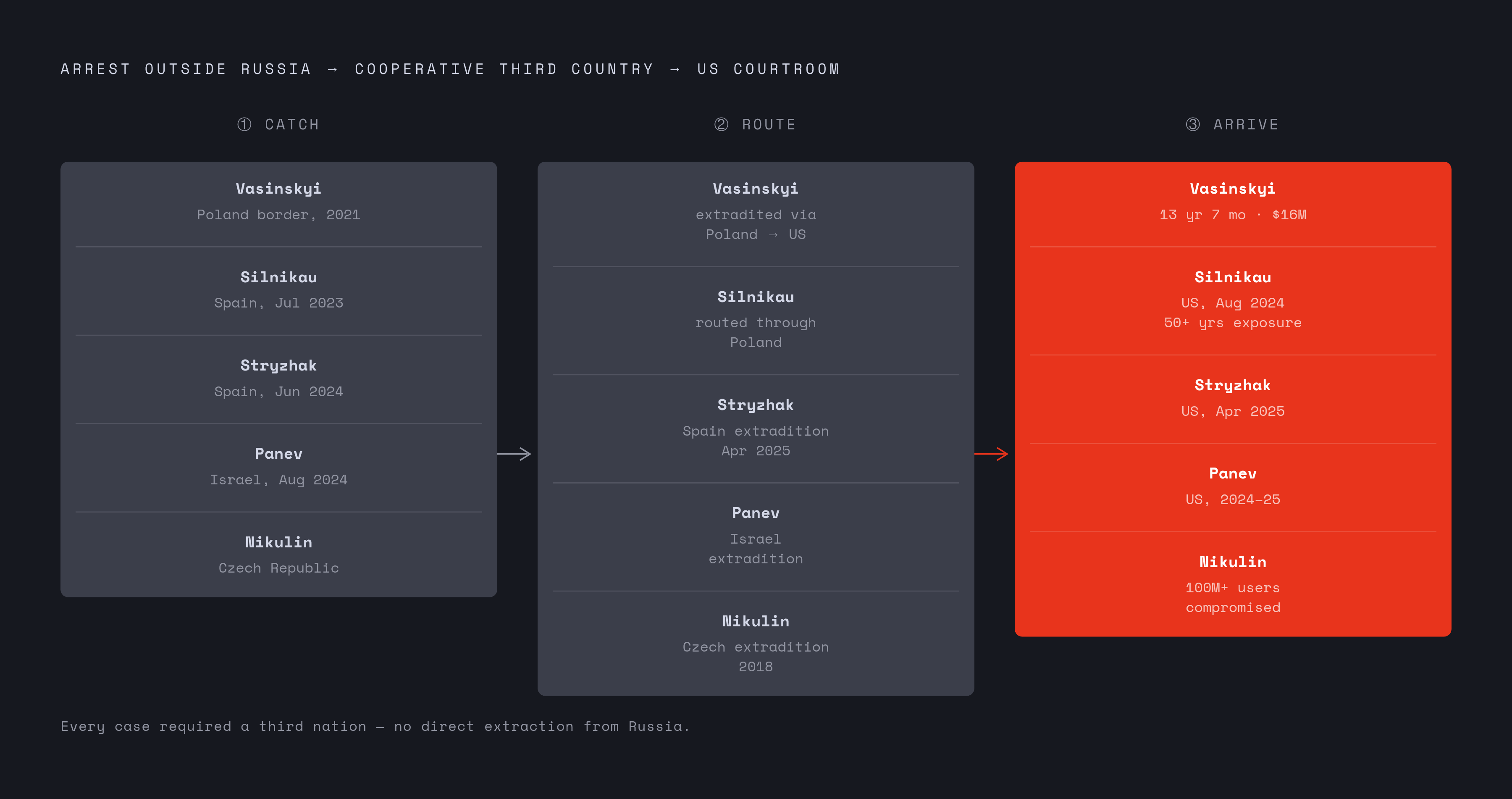
Every extradition that's actually worked follows the same script: suspect leaves Russia (or was never based there to begin with), suspect gets picked up in a cooperative third country, suspect ends up in a US courtroom.
Yaroslav Vasinskyi, tied to the REvil ransomware operation, got stopped at a Poland border crossing while traveling from Ukraine. Extradited in 2022 and sentenced in 2024 to 13 years and seven months, he was on the hook for more than $16 million in restitution. His group is connected to over 2,500 ransomware attacks demanding more than $700 million total.
Maksim Silnikau, linked to the Reveton ransomware operation and the Angler Exploit Kit, got arrested in Spain in July 2023, routed through Poland, and landed in the US in August 2024. The UK's National Crime Agency called him and his associates "elite cyber criminals who practiced extreme operational and online security," and credited them with essentially inventing the exploit-kit and ransomware-as-a-service business models everyone else copied later. He's facing more than 50 years if convicted on everything.
Artem Stryzhak, connected to the Nefilim ransomware strain, followed a near-identical path: arrested in Spain in June 2024, extradited to the US on April 30, 2025. Rostislav Panev, allegedly a LockBit developer, was picked up in Israel in August 2024 at the request of the US. LockBit's rap sheet is staggering on its own: victims across over 120 countries, roughly 1,800 of them in the US, with damages estimated around $500 million.
Then there's Operation Cronos, the February 2024 takedown that read like a season finale more than a police raid. The NCA, FBI, Europol, and a dozen countries knocked out 34 servers across eight nations, coordinated arrests in Poland and Ukraine, froze 200 cryptocurrency accounts, and handed victims more than 1,000 decryption keys. French authorities separately grabbed a suspected LockBit developer while he was on vacation, outside Russia, because apparently nobody in this line of work gets to actually relax.
Go back further and there's Yevgeni Nikulin, accused in breaches touching LinkedIn, Dropbox, and Formspring that compromised more than 100 million users combined. He was arrested in the Czech Republic and extradited after a lengthy process. A Freedom House analyst summed up the Czech decision as coming down to following its own laws, not making a geopolitical statement. Worth noticing: every one of these cases started with an arrest outside Russia, and every single one needed a third country to do the actual catching.
Where the system still fails: Russian nationals and the impunity that remains
Notice the pattern in that case list. Ukrainian, Belarusian, and Russian nationals, all caught somewhere other than Russia, with nobody pulled directly out of Russian territory. Nobody.
Khoroshev, the alleged LockBit administrator, is reportedly still sitting in Voronezh. The DOJ has a reward of up to $10 million on offer for information leading to his arrest, an admission that the legal toolbox is empty. Indictments against Russia-based operators mostly function as attribution and financial pressure: sanctions, seized assets, public naming. They brand rather than bind.
Sometimes the impunity has a family tree attached. Roman Seleznev, tied to large-scale payment card fraud, was reportedly shielded in part because his father sat in the Russian Duma. And sometimes it's a straight-up trade. Alexander Vinnik pleaded guilty to laundering billions in cryptocurrency, and got released in February 2025 anyway, in what appeared to be an outcome shaped by factors beyond the legal case itself. Criminal cases involving Russian nationals sometimes end with a handshake between governments rather than a verdict.
The deterrence gap that this creates is real and it's structural. An operator who never leaves Russia or Belarus is playing an entirely different game than one who books a flight to Bangkok.
How the safe-haven map is shrinking — and where the edges are still contested
The list of countries where a Russian-linked hacker can travel safely keeps getting shorter, and the ones falling off the list are telling.
Kazakhstan arrested Nikita Kislitsin, which Recorded Future's Dmitry Smilyanets described to The Record as "a clear indication of the shift in Kazakhstan geopolitics." Georgia extradited a Russian national accused of building and selling a brute-force RDP credential tool, another former Soviet republic quietly stepping out of the buffer-zone role it used to play. Thailand, of all places, arrested Denis Obrezko in Phuket in November 2025, proving that popular tourist destinations are now active interception zones as well as places people go to get sunburned and eat pad thai.
Spain keeps showing up too, as the transit point where Silnikau and Stryzhak both got caught, which says something about EU member states with strong US cooperation being reliable capture environments. Inside criminal circles, this isn't going unnoticed. Some hackers reportedly griped about the Kazakhstan arrest as a "betrayal" on private Telegram channels, proof that the shrinking map is understood, and resented, by the people it's shrinking around.
Russia and Belarus remain the fixed points on this map. The real contest is happening at the edges, in countries where American diplomatic pressure, financial incentives, or a shift in political alignment are slowly closing the gaps one border crossing at a time.
Where state sponsorship complicates the extradition picture further
Some of these cases are intelligence operations wearing a criminal indictment as a costume.
The NCA, along with the US Treasury and Australia's Department of Foreign Affairs, said publicly in October 2024 that Evil Corp "were tasked by Russian Intelligence Services to conduct cyber-attacks and espionage operations against NATO allies." Victoria Dubranova, tied to the group CyberArmyofRussia_Reborn, got extradited to the US in 2025 on an indictment alleging the GRU financed the group's access to DDoS-for-hire services, state resources funding what looks, on paper, like garden-variety cybercrime.
Once a suspect has documented ties to Russian intelligence, Moscow's refusal to extradite hardens from policy into a wall. These are assets on the payroll, tolerated deliberately. Nation-state actors have also gotten smarter about blending in, using commercially available criminal tools and front companies to blur the line between state operation and freelance crime, which makes both attribution and prosecution messier for everyone downstream.
For law enforcement, a confirmed state nexus changes the whole objective. Disruption, public attribution, and financial isolation through sanctions become the actual playbook, with prosecution an unrealistic goal.
What the extradition record tells defenders and security teams about threat actor behaviour
Threat actors who stay active and stay in Russia year after year, indictment after indictment, are making a calculated bet on geography, and so far that bet keeps paying off.
That travel trap cuts both ways, though. The most dangerous operators are often the most geographically boxed in, which is a useful asymmetry for anyone trying to model how these groups actually operate. Groups with documented state ties, Evil Corp, CyberArmyofRussia_Reborn, Void Blizzard, need to be treated as persistent threats rather than deterred ones. The legal and diplomatic walls protecting them will hold for the foreseeable future.
Disruption operations are doing more practical work for defenders than extradition ever has. Operation Cronos handing out more than 1,000 decryption keys probably helped more victims in a single stroke than a decade of unanswered indictments. The shrinking safe-haven map is also changing behavior on the other side: tighter operational security, less travel, heavier reliance on anonymizing infrastructure, all of which shows up in the threat landscape whether or not anyone ever gets arrested.
Security content that treats the legal system as a reliable backstop tells a comforting story that falls apart on contact with reality. Accountability here is geographically selective, and threat modeling needs to reflect that rather than assume the cavalry is coming. That distinction matters just as much for how vendors talk about these threat actors as it does for how defenders plan around them; keeping that line clear means separating what's actually known about a group from what's still speculation, so the marketing doesn't outrun the evidence, something studios like Cyberou, which anchors cybersecurity content in live threat intelligence, are built specifically to navigate. When the courts can't deliver closure, precision is the only currency left, and it's worth spending carefully.