LulzSec and Anonymous Member Prosecutions
One unmasked login brought down a group that breached the CIA.
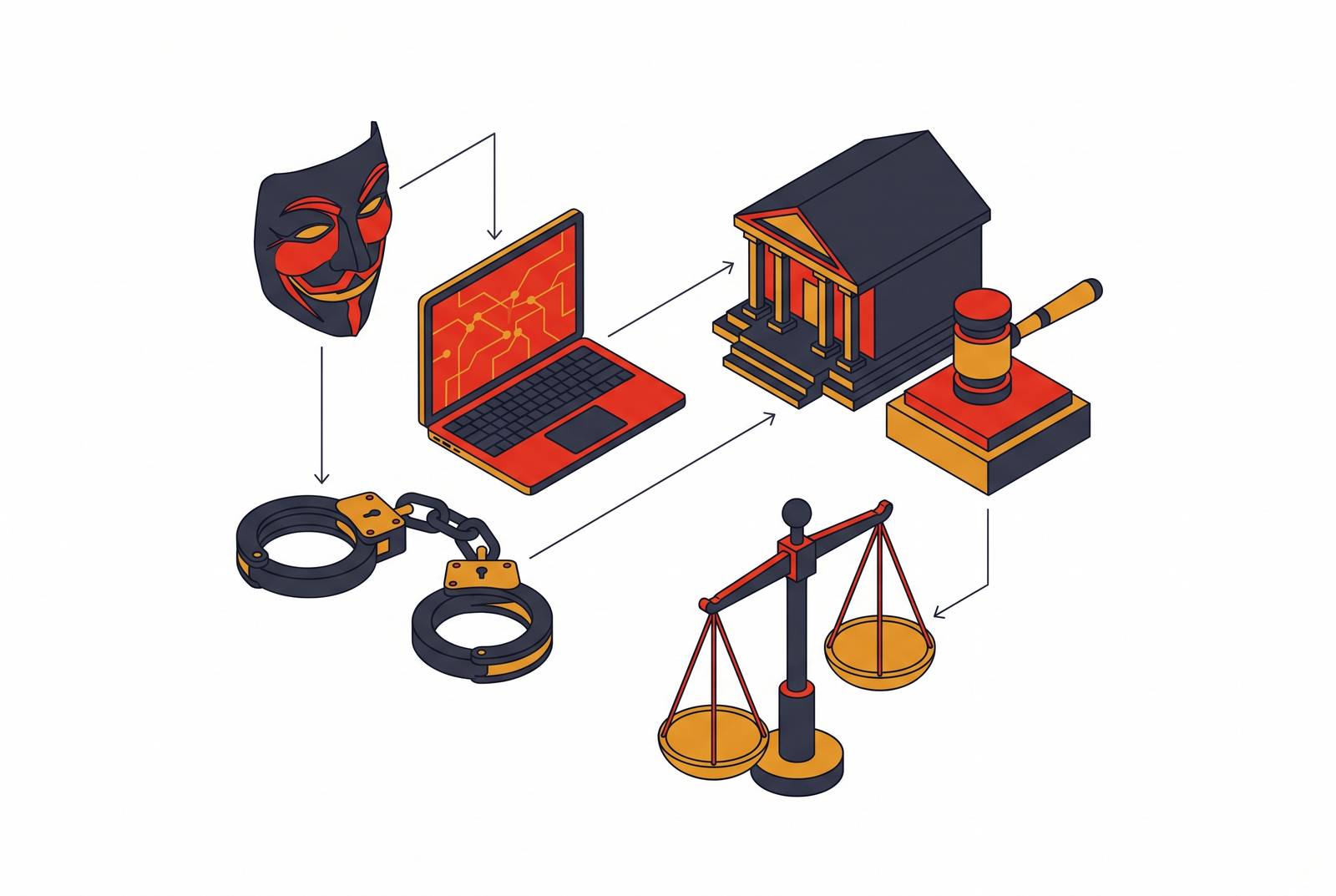
LulzSec and Anonymous ran a hacking campaign in 2011 that made the FBI, Sony, the CIA, and the UK's serious crime unit all look flat-footed at the same time. Two years later, most of the core people involved were in prison, and the way they got caught says more about human error than it does about government cyber wizardry.
Anonymous was the loud, sprawling activist collective everybody's heard of, the one with the Guy Fawkes masks and the manifestos. LulzSec split off from Anonymous's AnonOps wing in 2011, and it pulled from a smaller, sharper crew, one that overlapped with a hacking group called gn0sis. Where Anonymous talked ideology, LulzSec talked lulz, meaning they hacked things because it was funny, with cause entirely beside the point. That distinction was mostly theater, though, since prosecutors later showed the two groups coordinated far more closely than either admitted in public.
The LulzSec core was six people, each running a different job. Sabu (Hector Monsegur) led, Topiary (Jake Davis) ran communications, and Kayla (Ryan Ackroyd) handled technical work and social engineering. Tflow (Mustafa Al-Bassam) wrote code, while Viral (Ryan Cleary) brought the botnet. That structure matters, because when law enforcement finally moved, they flipped the leader and let the org chart do the rest of the work.
The 50-day campaign that put both groups on law enforcement's radar
LulzSec's active run lasted about 50 days in the spring and summer of 2011, and the target list reads like a dare. Sony Pictures, the US Senate, the CIA's own website, and Britain's Serious Organised Crime Agency all made the list, and nobody was hiding from the size of who they picked.
The Sony Pictures breach used a straightforward SQL injection attack and exposed personal data on more than 138,000 people, then posted a chunk of it publicly. That's the kind of number that makes corporate legal teams and federal agencies pick up the phone on the same afternoon.
Cleary's contribution is the part that explains how six people did this much damage: he supplied a botnet of roughly 100,000 compromised machines. That gave a group the size of a book club the denial-of-service muscle of a much bigger operation. The wider campaign, known as Operation AntiSec, stretched to Visa, MasterCard, and PayPal; PayPal alone put its mitigation costs at £3.5 million.
Oddly, the same group also flagged vulnerabilities to the UK's National Health Service without exploiting them. That one detail muddied the "pure criminal enterprise" narrative and fed years of argument about what hacktivism actually is. Whatever the motive, the volume and visibility of targets in such a short window put real institutional pressure on the FBI to move fast, and the group had already, without knowing it, handed them a weak point to work with.
How a single OPSEC failure gave the FBI its entry point
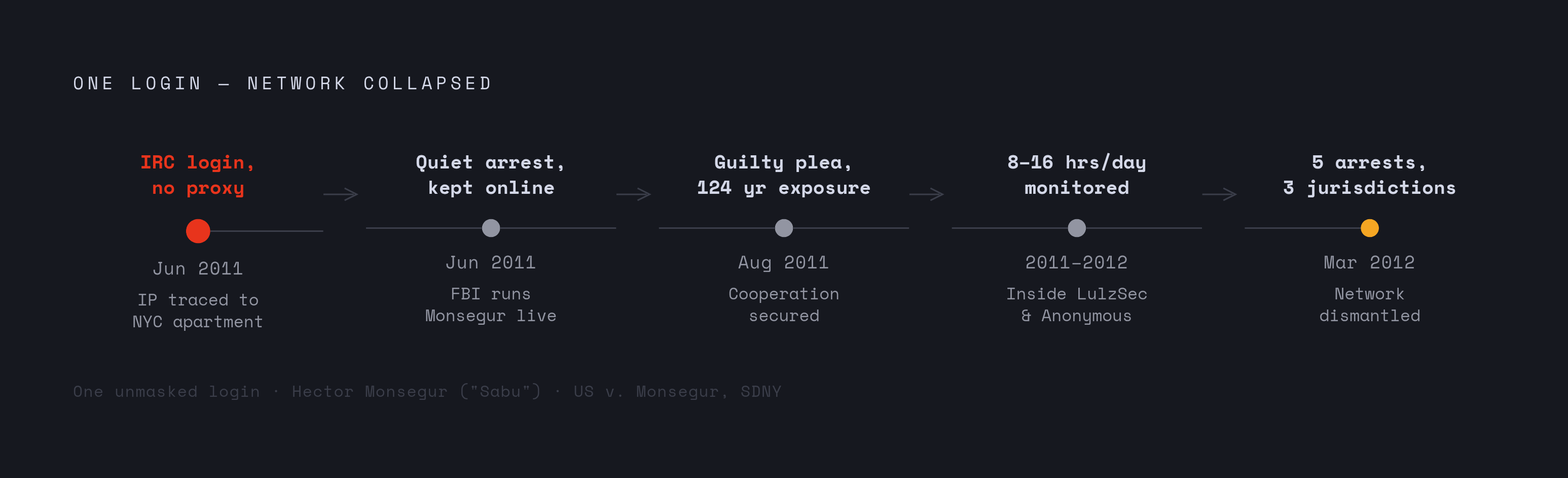
Monsegur had been careful, using proxy servers and masked IPs, consistent tradecraft for most of the campaign. Then one login to an IRC channel went out without the proxy switched on, and that was it: the FBI traced the real IP address straight to his apartment in New York City and arrested him in June 2011.
There was no press conference and no headline. He was processed quietly, and his online presence kept running as if nothing had happened, which became the cover for the next stage of the operation.
Here's the irony worth sitting with: a group that breached the CIA and the US Senate got taken down by one unmasked login, a sophisticated set of attacks undone by an elementary mistake. That gap is the whole story in miniature, and it points to something structural about anonymity as a defense. Every single session is a fresh chance to slip up, and it only takes one.
Monsegur's cooperation agreement and how it was used operationally
Facing a maximum exposure of 124 years, Monsegur pleaded guilty in August 2011 to computer hacking conspiracy, access device fraud, bank fraud conspiracy, and aggravated identity theft. Then he went back to work, for the other side.
Under the cooperation deal, he spent eight to sixteen hours a day at his computer, monitored by federal handlers, still active inside LulzSec and Anonymous networks. He was a functioning node in the network, still logged in, still talking to people who had no idea, beyond feeding tips.
The FBI used that access defensively too, notifying hundreds of government, financial, and corporate entities about vulnerabilities hackers had already found. Monsegur's cooperation is directly tied to the arrest of five other hackers across Anonymous, LulzSec, and AntiSec, a payoff that only works because the group was scattered across multiple countries and needed a network-wide approach to unravel.
It also opened up a real legal question. Jeremy Hammond later argued entrapment, claiming Sabu, under FBI direction, suggested foreign targets to attack. Courts rejected the argument, but the underlying tension is real: the Bureau was gathering evidence and, according to critics, steering new offenses into existence at the same time. Judge Loretta Preska credited Monsegur's cooperation with disrupting hundreds of cyberattacks and effectively shutting LulzSec down as an operating group.
The UK sentencing of the LulzSec core members in May 2013
Southwark Crown Court handed down sentences in May 2013, and the spread tells you the court was grading on role and age, not handing out one flat punishment. Ryan Cleary got 32 months, Ryan Ackroyd got 30 months, and Jake Davis got 24 months in a young offenders facility. Mustafa Al-Bassam, who was a juvenile when the offenses happened, got a 20-month suspended sentence plus 300 hours of community service.
Cleary, the botnet operator, drew the longest custodial term, and his charges included hacking US Air Force computers, an offense that needed US-UK coordination just to document properly. Ackroyd's background as a former British Army soldier featured heavily in how prosecutors framed him: a trained professional who turned those skills to criminal use.
Al-Bassam's suspended sentence turned into a footnote for a different reason. He went on to a legitimate career in security research, and that path became its own case study in how the justice system handles young, technically gifted offenders who didn't necessarily need a cell to learn a lesson.
US sentencing for the Sony Pictures intrusions
Cody Kretsinger, who went by "recursion," pleaded guilty in April 2012 to conspiracy and unauthorized impairment of a protected computer. He got a year and a day in federal prison, a year of home detention, 1,000 hours of community service, and $605,663 in restitution.
Raynaldo Rivera, known as "neuron" or "royal," pleaded guilty to conspiring to cause damage to a protected computer and received the same restitution figure of $605,663, plus a year and a day in prison and 13 months of home detention.
The two knew each other from the University of Advancing Technology in Tempe, Arizona; Kretsinger recruited Rivera into LulzSec. That's a college acquaintance, exactly the kind of real-world connection an investigation can trace without touching a single encrypted channel. The breach itself exposed data on more than 138,000 people, the same figure that shows up in the Sony case generally, and prosecutors used it to justify the restitution order. Both men got hit with the identical dollar figure, joint and several, meaning each was on the hook for the full harm rather than a slice of it.
Jeremy Hammond's ten-year sentence and what the Stratfor case established
Hammond pleaded guilty to violating the Computer Fraud and Abuse Act over the December 2011 Stratfor hack, which compromised hundreds of thousands of user accounts and involved tens of thousands of stolen credit cards used for unauthorized charges. Real money moved out of real accounts.
Judge Preska sentenced Hammond to ten years, the statutory max under the CFAA charge, on November 15, 2013. She rejected the civil disobedience framing outright, saying he'd hacked websites because he disagreed with them politically, not because he was defending anyone's rights.
His entrapment claim, that Sabu suggested the Stratfor target while working for the FBI, went nowhere in court but stayed very much alive in civil liberties circles. The Stratfor case is where the FBI's use of an informant got the most scrutiny: using someone to help produce a hack, actively directing one, raises a question the courts settled in the government's favor but that legal scholars never treated as closed. Ten years, for one hack, by one person, set a marker, and later prosecutors could point to it and say hacktivist motive doesn't buy anyone a discount under the CFAA.
Barrett Brown's prosecution and what it revealed about the boundaries of association
Brown never hacked anything. His prosecution rested on posting a hyperlink to data stolen from Stratfor, acting as an accessory after the fact to unauthorized computer access, and threatening an FBI agent. He got 63 months in federal prison and a restitution order of $890,250, tied back to the same Stratfor breach, despite never touching a keyboard to break in.
Press freedom groups paid close attention because Brown was operating as a journalist and analyst covering Anonymous, not as a member of it. The significance is that writing about a hack, linking to stolen data, or embedding oneself in the community around it can constitute criminal participation, independent of whether someone touched a keyboard. The prosecution answered that question against Brown, though it's still an open argument everywhere else, especially for anyone working in threat intelligence who has to handle stolen data as part of the job description. Proximity to leaked material, it turns out, carries legal risk of its own, no direct involvement required.
The methods law enforcement used across these cases and what made them work
Every one of these cases cracked open the same way: through a single unmasked connection, a college friendship, or an enrollment record somebody forgot to think about. The pattern repeats enough that it stops looking like coincidence and starts looking like the actual rule.
Informant deployment did the heavy lifting after that. Monsegur's cooperation alone produced arrests across three jurisdictions and multiple groups, work that would otherwise have taken years of separate investigations stitched together. US-UK coordination filled in the rest for the Southwark sentencings, since the attacks crossed borders and the evidence had to cross with them, all without any dedicated treaty built for the job.
Digital forensics closed the loop: metadata, IRC logs, connection records nobody scrubbed properly. All of it came from evidence the defendants left sitting in plain sight. And the FBI's use of Monsegur as an active operator, not a passive listener, is exactly what generated the entrapment defenses that kept coming up, and kept getting rejected.
What the prosecution record established about accountability in hacktivist operations
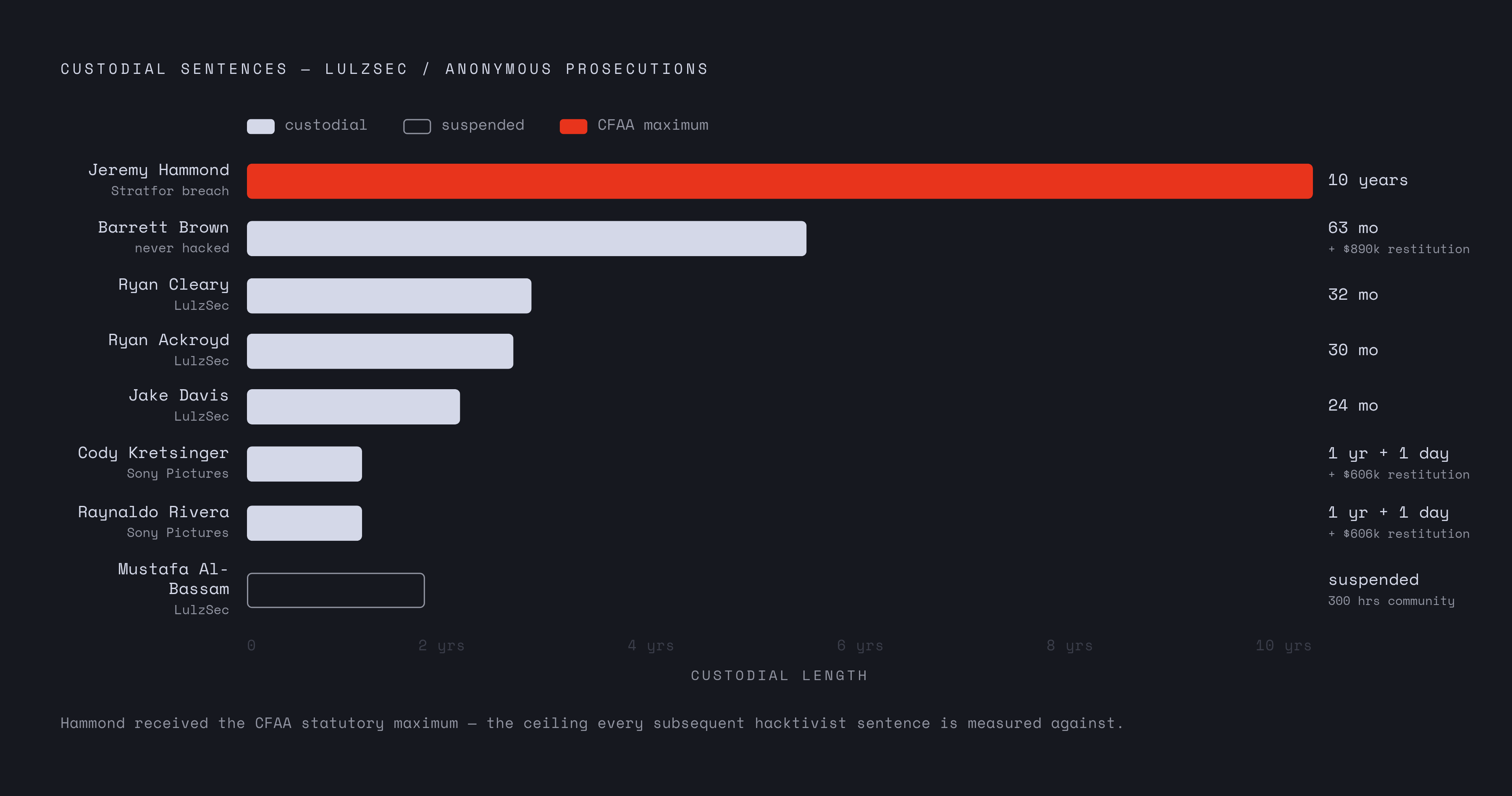
Across the board, the pattern was real prison time, heavy restitution, and zero successful civil disobedience defenses. Political motive did not move the needle at sentencing, not once.
The punishments still weren't uniform. Hammond got the CFAA max, Brown got restitution despite never hacking anything, and Al-Bassam got a suspended sentence balanced against community service because of his age. Courts were clearly calibrating to role and harm, but the floor never dropped below serious consequences.
The belief that pseudonyms, distributed operations, and offshore servers make prosecution impractical got tested here and it failed the test. Every core LulzSec member was identified, and most did time. The decisive factor was one informant with full network access. The weakest link in any operational security chain is a person.
For anyone in the security industry, this is primary source material on attribution. IRC log analysis, IP correlation, and social graph mapping are the same categories of evidence threat intelligence teams still use to attribute criminal or state-linked activity today. And the timeline itself is the last data point worth noting: a 50-day hacking spree that ended in a ten-year sentence, wrapped up within two years of the campaign's close. That's the tempo other hacktivist prosecutions get measured against now.