Is Extortion a Crime Under Federal and State Law
One coercive demand can trigger charges in multiple courts under overlapping federal and state laws.
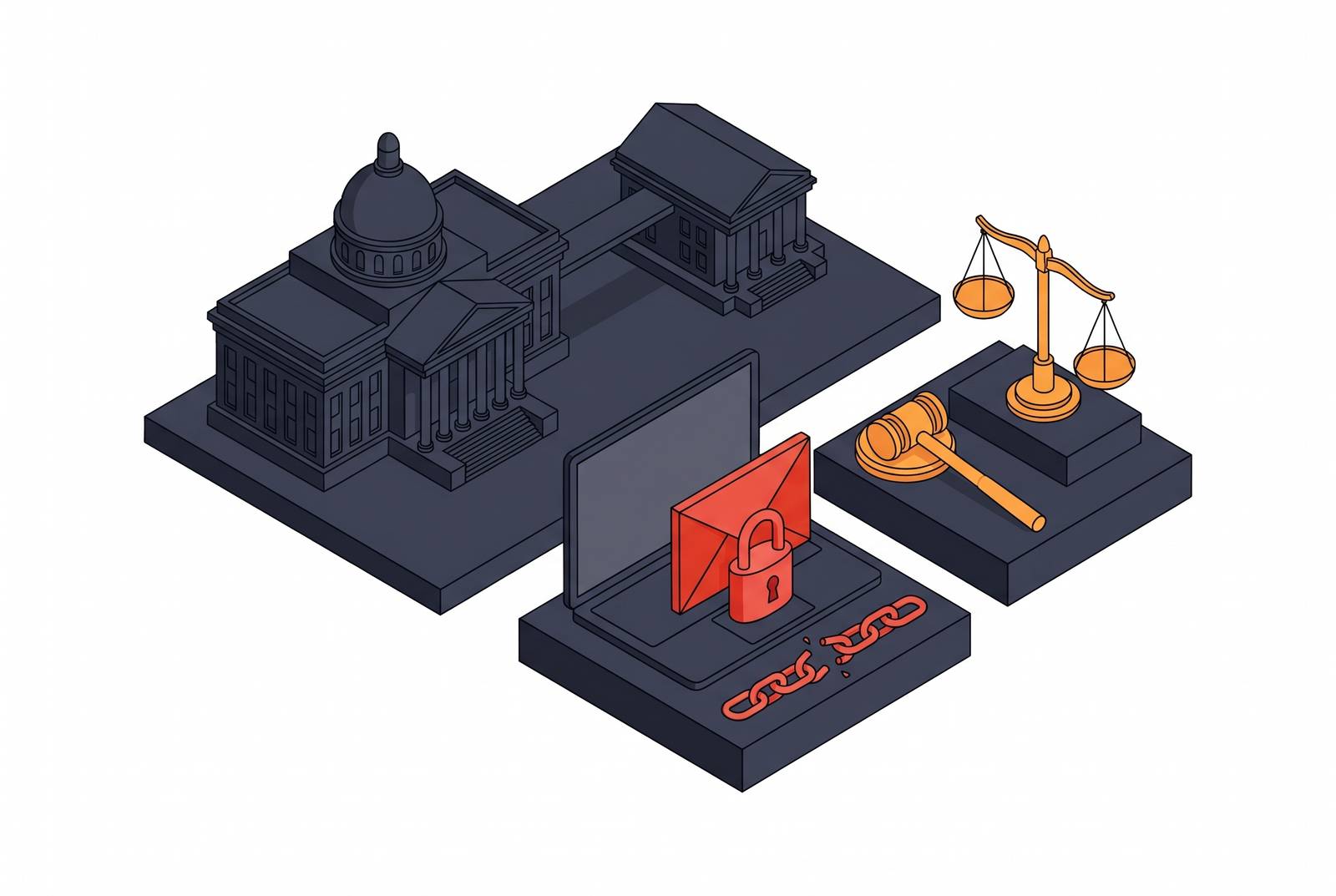
Extortion is a crime under both federal and state law. The complication is not whether it is illegal, but which laws cover a particular threat, what prosecutors must prove, and how the charges overlap. This article maps that framework, including its digital applications. A single coercive demand can lead to charges in several courts, each with its own rules and possible penalties.
What extortion means as a legal matter, distinct from related crimes
Extortion uses threats or coercion to compel someone to surrender money, property, or something of value, or to compel an official act. Its usual structure combines a threat, a demand, and an intent to obtain value through that threat. The threat is the lever that makes the demand coercive. Unlike robbery, extortion need not involve immediate physical force. A threat of future harm, reputational damage, or exposure of private information can do the work instead.
Blackmail generally describes the threatened-disclosure branch of that conduct, although jurisdictions often use the terms interchangeably or treat blackmail as a subset of extortion. Bribery draws a different distinction because it involves offering value to corrupt an official. Extortion can instead involve an official using public office to demand payment, or a private person threatening harm to extract value. These differences explain why a payment and an unpleasant conversation do not, by themselves, identify the crime.
The two main federal extortion statutes and what each covers
The Hobbs Act prohibits extortion affecting interstate or foreign commerce. It defines extortion as obtaining property from another with consent induced by the wrongful use of actual or threatened force, violence, or fear, or under color of official right. “Consent” is doing some uncomfortable work in that definition. The victim agrees to hand over property, but only because wrongful pressure produces that agreement. The statute therefore distinguishes a coerced transfer from a freely negotiated exchange.
The official-right branch addresses public officials who use their positions to demand payments. It is central to public corruption cases involving elected officials, law enforcement, and government contractors. The commerce requirement gives the statute its federal reach. Federal courts interpret that connection broadly, so even a small or indirect effect on commerce can establish jurisdiction.
The federal blackmail statute, 18 U.S.C. § 873, covers a narrower form of leverage. It addresses demands for something of value backed by a threat to inform on someone for violating federal law. Its focus is limited to federal legal jeopardy. That limitation separates it from the Hobbs Act’s broader structure. Both statutes expose defendants to significant federal prison terms, and prosecutors may add related charges, including fraud and conspiracy, when the conduct supports them.
How federal wire and mail fraud statutes extend the reach of extortion prosecutions
The wire fraud statute, 18 U.S.C. § 1343, and the mail fraud statute, 18 U.S.C. § 1341, give prosecutors additional charging paths when a scheme uses electronic communications or the mail. Wire fraud’s scheme-to-defraud language can reach conduct that deprives victims of money or property through threats when the fraud requirements are met. That gives prosecutors another route where the Hobbs Act does not fit cleanly. The statutes overlap without becoming interchangeable.
A telephone call, email, or text message used to transmit a demand can supply the communications link relevant to a wire fraud charge. That link is distinct from the Hobbs Act’s commerce requirement. An electronic threat is not automatically wire fraud, however, because the prosecution still needs to establish the offense’s other elements. Where those elements exist, communications delivering or negotiating the demand can support separate counts.
This layering increases potential sentencing exposure beyond the extortion charge alone. When computer systems are involved, the Computer Fraud and Abuse Act, 18 U.S.C. § 1030, gives prosecutors another law to use. Threats to damage systems or release stolen data can bring that law into the case. Prosecutors may therefore use different provisions to charge what was done with the computer, the coercive demand, and any fraud scheme that meets the law’s requirements.
How digital threats — ransomware, sextortion, and data-leak extortion — fit within the existing federal framework
An attacker encrypts systems and demands payment for a decryption key, using continued loss of access as leverage. A cryptocurrency demand in that setting fits the familiar structure of threat, demand, and intent to obtain property. The Congressional Research Service report on “Ransomware and Federal Law” identifies the CFAA and wire fraud as key statutes used to prosecute ransomware attackers.
Sextortion puts pressure on the victim by threatening to share intimate images unless the victim pays. Existing federal law can address that coercion, including through the interstate extortion statute, 18 U.S.C. § 875(d), and, where applicable, cyberstalking provisions. The choice of charge depends on the conduct and the statute’s requirements.
Data-leak extortion likewise does not require an attacker to encrypt or damage a system. The threat to publish sensitive stolen data supplies the leverage. The Hobbs Act and wire fraud can apply to threatened disclosure where their respective elements are established. The line is harder to draw when a security researcher or journalist threatens to publish unless a company takes action. There, liability turns on a wrongful threat combined with an improper demand.
How state extortion laws are structured and where they diverge from federal law
Every U.S. state criminalizes extortion, but the statutes do not use one shared blueprint. Some have broad laws that cover wrongful threats used to get property. Others focus more narrowly on physical threats and address blackmail or coercion through separate provisions. The wording changes the prosecution’s burden of proof. States also differ in punishment, so the same general conduct can have different consequences depending on where charges arise.
The qualifying threats vary as well. Nearly all states cover threats of physical violence and threats to destroy property, while many also cover threats of criminal charges, immigration consequences, or disgrace. Some extend coverage to economic harm or a person’s business interests. In some jurisdictions, the threat itself can be enough, while others require a completed transfer for the completed offense.
California’s Penal Code § 518 et seq. illustrates the broad statutory model, with completed property extortion generally requiring both a threat and actual acquisition of property. New York divides the terrain differently. Its Penal Law Article 155 addresses larceny by extortion, while Article 135 addresses coercion, creating two tracks for conduct other states may group together. Texas places theft by extortion within its consolidated theft provision, Penal Code § 31.03. Florida’s § 836.05 is notably broad, reaching threats to publish reputation-damaging writings as well as threats of violence or property destruction.
Where federal and state jurisdiction overlap and how prosecutors choose between them
Federal and state authority can cover the same conduct. Because the federal government and states are separate sovereigns, overlapping prosecutions are not automatically barred by double jeopardy. That does not mean every case becomes a race between courthouses. How prosecutors work together, or sometimes clash, shapes which charges they bring.
Federal prosecution is more likely when a scheme crosses state lines, uses interstate communications, involves public corruption, or operates on a large or organized scale. Cases that involve cyber infrastructure or national security can also draw federal attention. State authorities are typically the primary route for local extortion between private individuals. Examples include a neighbor threatening a neighbor, an employer coercing an employee, or a domestic partner threatening disclosure of private information.
The choice has practical consequences for plea negotiations and sentencing exposure. The Hobbs Act allows up to twenty years in prison, generally exceeding state maximums for comparable conduct. That possible prison term affects how much leverage each side has when more than one jurisdiction could bring charges. Federal prosecutors sometimes defer to state authorities, and state prosecutors sometimes defer to federal authorities. Investigative resources, evidentiary strength, and prosecutorial priorities shape that decision.
Defenses that arise in extortion cases and what they require to succeed
Extortion defenses test the boundaries built into the offense. The central questions include whether the threat was wrongful, whether the demand sought something the defendant had no legal right to claim, and whether the required intent existed. An unpleasant demand is not necessarily a criminal one. At the same time, claiming a right to payment does not automatically excuse how someone tries to collect it. The legal analysis must address both the demand and the pressure behind it.
A claim-of-right defense rests on a genuine belief that the demanded property was owed. In some jurisdictions, that belief can negate criminal intent. Courts differ, however, on whether a good-faith right to payment defeats liability when the collection method was itself wrongful. The existence of a debt and the legality of the threat remain distinct questions.
An attorney’s warning that a client will pursue legal remedies unless a debt is paid, or a party’s threat of civil litigation, is not by itself extortion. The analysis changes when the threat involves unlawful action or the demand seeks something the person has no legal right to receive. The word “unless” does not decide the case.
Entrapment addresses a different issue in sting operations, including those used in public corruption investigations. It requires government inducement of someone who was not predisposed to commit the offense, rather than an undercover officer merely providing an opportunity. Other defenses turn on missing statutory elements. When the law requires proof that the victim was afraid or that the defendant actually got the property, prosecutors must prove those facts. Their absence can defeat the completed-offense charge that depends on them, rather than merely make the conduct look less serious.
What the layered legal framework means for victims, defendants, and practitioners navigating these cases
For victims, overlapping jurisdiction provides more than one possible enforcement route. If state authorities decline to act, a victim can report the conduct to federal law enforcement, including the FBI or DOJ. Digital threats can draw federal attention regardless of where the victim lives, subject to the applicable federal requirements. The practical recommendation is to preserve all communications and involve law enforcement before responding. Negotiating with or paying an extortionist leaves prosecution possible and can complicate the criminal case and civil recovery.
For defendants and practitioners, the decisive questions concern the applicable statute, its required elements, and the combination of charges. Which jurisdiction brings the case and how many charges are stacked can lead to very different sentencing ranges for the same acts. At least one law, and often several, can reach most serious extortion, though how strongly those laws are enforced varies by jurisdiction. The core prohibition is settled, while digital applications continue to develop through the CFAA, wire fraud, and cyberstalking laws. Courts are still defining how those provisions apply to new delivery methods and forms of coercive leverage.
Sources
- Federal Ransomware and Computer Extortion Crime Defense Latest Federal Defense Update 20260723
- Analyzing the Evolution of Cyber Extortion Techniques and Legal Responses Under US Federal Law - Leppard Law - Top Rated Orlando DUI Lawyers & Criminal Attorneys in Orlando
- When Is Extortion Considered a Federal Crime
- Is Extortion a Federal Crime? Laws and Penalties
- The Hobbs Act: Federal Extortion Prosecution and the Color of Official Right - Burnham & Gorokhov Attorneys Washington DC
- Difference Between Extortion and Blackmail - Eisner Gorin LLP
- The Reach of Federal Blackmail and Extortion Statutes (Part II)
- Federal Extortion Statute : 18 U.S.C. § 875 Threats & Penalties