Doxxing Prevention Tactics Used by High-Risk Targets
Multiple defenses working together can interrupt different stages of a doxxing attack.
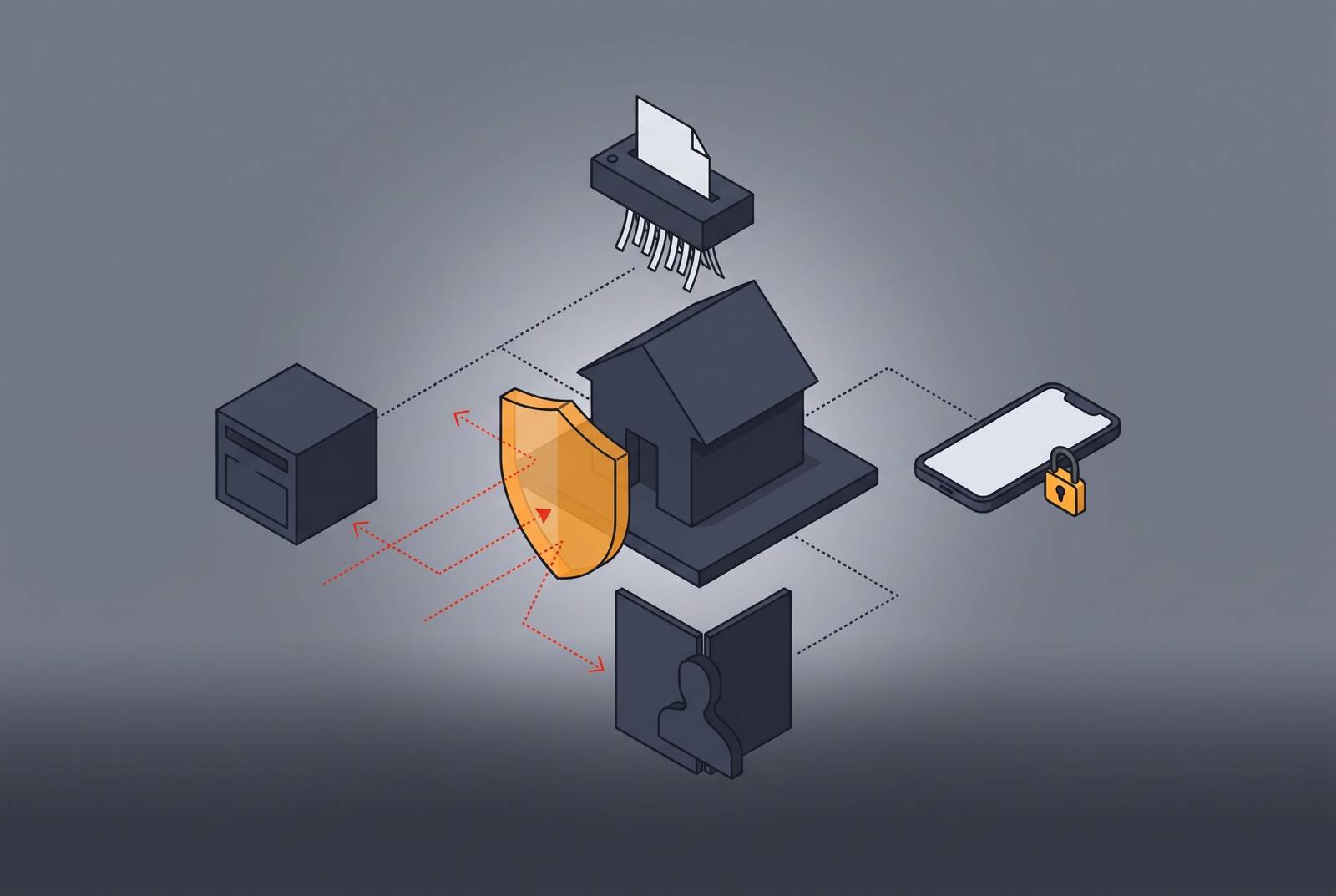
Effective protection combines data suppression, identity compartmentalization, continuous monitoring, household security, and physical threat reduction. Each layer interrupts a different part of the attack because modern doxxing turns scattered personal details into an actionable dossier faster than any single defense can reliably stop.
Why doxxing has become a precision weapon, not a blunt instrument
An attacker can start with a username, a photo, or an email address. Open-source intelligence tools connect that fragment to other accounts, while data broker searches and breach databases add names, phone numbers, and addresses. Photo metadata can supply location details. Automated tools can assemble those pieces into a comprehensive dossier within minutes. The attacker does not need to break into an account if the useful information is already available elsewhere.
Data brokers make this process accessible to non-technical attackers. Spokeo, Whitepages, BeenVerified, and Radaris aggregate public records and connect them through shared identifiers such as a primary email address or phone number. The resulting profiles can be available for a small fee or free. These separate facts can easily become a map of a person’s life that an attacker can use.
That map can support social engineering, intimidation, or physical threats, with consequences that reach an employer. Ransom letters sent to executives’ home addresses without a prior breach show that attackers can put pressure on people with real personal data alone. A compromised corporate system need not be the starting point. Because the chain draws on several separate sources, removing one record or securing one account still leaves other routes through it.
Who is actually targeted and what exposure looks like before an attack lands
Executives, journalists in exile, reproductive health workers, activists, and public-facing professionals face different adversaries but share a basic vulnerability. Their public work can be connected to their private lives through searchable records. When an attacker finds a home address, its sensitivity remains unchanged while its availability becomes much more consequential.
Nisos’ 2026 Executive Digital Exposure Trends report found that nearly all assessed executives had a home address publicly linked to their name. Every assessed executive also had breach data connecting their name to at least one past or current email address. Those findings apply only to the executives in the assessed group. Even with that boundary, they show how little separation may exist between a public professional identity and the information needed to reach someone privately.
Abortion access organizer Sarah Philips took steps to deal with that exposure before an attack forced her to act in an emergency. A mentor advised her to monitor her personal information and paid for access to DeleteMe, which monitored data brokers and automatically requested removal of her information. The Digital Defense Fund offers structured training in cybersecurity to people across the abortion access and autonomy movements. The context differs from executive protection, but the underlying problem does not. An attacker needs the connection between identities.
Reducing the data surface that makes a dossier possible in the first place
Data brokers are the largest doxxing vector for non-technical attackers because they perform much of the work of assembling records. Removing an anchoring identifier, usually a primary email address or phone number, makes those records harder to join into a searchable profile. The objective is not merely fewer search results.
In practice, suppression includes deletion requests to data brokers, people-search services, social platforms, domain registrars, and public agencies where the law permits. Removing home addresses and personal phone numbers from corporate pages closes another direct route. Showing less on social profiles gives an attacker less information to anchor a search. Each control addresses a source, rather than waiting for someone to publish a finished dossier.
California’s DELETE Request and Opt-out Platform, or DROP, launched in January 2026 and allows eligible residents to submit one deletion request covering all registered data brokers. Companies begin processing requests on August 1, 2026. Its reach is limited to California. Centralized submission simplifies the request process, but it does not turn deletion into a universal or immediate result.
Email aliases also give each service a different address, so accounts no longer share that thread. Photos pose a separate risk because their EXIF data can hold GPS coordinates. Suppression needs a companion control that makes the remaining fragments harder to connect.
Identity compartmentalization as a structural control, not a privacy preference
Identity compartmentalization separates the public persona from the legal identity. The goal is to sever the cross-references that let an attacker turn scattered information into a single actionable profile. Privacy settings govern what an account shows, while compartmentalization governs how accounts relate to one another. One closes the curtains, while the other stops every window from looking into the same room.
For people at genuine high risk, the practice includes pseudonyms on every public platform, separate email addresses for each exposure context, and no cross-linking between private and public accounts. Avoiding reused usernames is part of that separation. Sherlock and WhatsMyName check hundreds of platforms for matching handles, making a familiar username a useful thread for an attacker. Domain registration belongs in the same identity architecture because public domain registration records can expose personal details. Privacy-protected registration, or registration through a legal entity rather than a personal name, removes that direct route.
Social engineering can get past controls that rely on keeping technical systems secure. The 2022 Twilio breach began with smishing messages sent to multiple employees, illustrating how a non-technical entry point can compromise a hardened environment. Compartmentalization limits the scope of compromise. Authenticator-app multi-factor authentication protects each identity against credential compromise without relying on SMS, which is vulnerable to phone-number hijacking. Suppression obstructs data acquisition, while compartmentalization obstructs correlation.
Continuous monitoring as the control that covers what suppression and compartmentalization miss
Suppression and compartmentalization both leave open the question of whether someone has already put the available data into a dossier. Continuous monitoring looks for signs of that across the deep web, dark web, and breach repositories. It can surface stolen credentials, personal data packages, doxxing dossiers, access claims, and attempted account sales before they become physical or organizational threats. A one-time assessment can miss changes that come later. The defensive task shifts from designing separation to watching for evidence that someone is crossing it.
Tracy Reinhold, Global Chief Security Officer at Everbridge, described that shift plainly. “Safeguarding today's leaders is no longer limited to providing a physical security detail. It demands real-time intelligence and the ability to anticipate and respond to a wide range of threats, from targeted attacks and digital doxxing to geopolitical instability.”
An inventory lists exposed information, while intelligence assesses identity, intent, capability, credibility, proximity, and timing, then assigns a proportionate response. An address in a search result and an address in a targeted dossier call for different judgments. Without that context, both may look the same in the rows of a report. A spreadsheet can be immaculate and still leave the security team asking what happens next.
AI tools can help defenders scan open-source databases and track digital footprints in real time, but faster collection does not by itself produce a sound assessment. The 2025 State of Threat Intelligence report found that tools that work poorly together, too much information, and too little relevant context were among the biggest barriers to programs that work. Execution is difficult and expensive. Monitoring has to fit the team’s workflow well enough that a meaningful signal becomes a response.
Extending the defensive perimeter to family members and home networks
Monitoring only the principal leaves a route through the household. A partner or child may have less security training while using accounts and devices on the same home network as the high-risk individual. Attackers can go after that weaker point and avoid taking on the strongest controls. A program that separates professional and private identities still needs to account for the people connected to both.
The 2025 BlackCloak/Ponemon Digital Executive Protection Report found that a majority of surveyed organizations believed an executive’s partner or child would be highly likely to click a phishing link in a targeted campaign. The same report found a sharp rise in deepfake attacks targeting executives in recent years. Fabricated audio or video can also impersonate or manipulate family members to extract information or access.
BlackCloak’s DEP program states that it also protects home networks, personal devices, and family accounts. That scope reflects the practical boundary of the threat. The corresponding controls include router security, network segmentation between personal and work devices, and authenticator-based MFA for family members. These are the household extension of the earlier layers. Otherwise, the principal’s carefully divided digital life can remain reachable through someone else’s unprotected account.
Physical threat reduction when digital exposure has already occurred
Victims have reported threatening calls, strangers arriving at home addresses, and stalkers camping near properties after their information was exposed. They are not merely worst-case scenarios added to make a presentation more dramatic. Physical intimidation can arrive before a digital warning is detected. For high-risk targets, planning for exposure is therefore part of prevention.
When exposure occurs, the response starts with documentation. Screenshots, URLs, and timestamps keep a record of each piece of information posted before it disappears. That record helps with both platform takedown requests and action by law enforcement. The reactive sequence includes platform takedowns, law enforcement contact when a credible physical threat exists, and broker opt-outs at the moment of exposure. Those steps address the incident, but they cannot substitute for controls that reduced what the attacker could collect beforehand.
Residential measures then add friction between a dossier and a confrontation. They include changes to routines, removing addresses from remaining public-facing records, and, in some cases, relocating address registration to a legal or mail forwarding entity. The purpose is specific to the threat, reducing the usefulness of exposed information rather than treating digital disclosure as an abstract privacy loss. These measures sit at the end of the defensive chain because the consequence is now physical. Legal recourse can be inconsistent and slow, so the protective posture cannot wait for the legal process to resolve every ambiguity.
Why the adoption gap is the real problem, and what closes it
The tactics are documented, but adoption has not matched the threat. The BlackCloak/Ponemon report found that 51% of respondents said their executives’ personal digital lives had been directly targeted by a cybercriminal in the preceding two years. Yet a majority of security professionals are not tracking threat actors targeting executives and their families, and a majority of executives do not understand the threat to their personal digital assets. Capability is not the missing ingredient. Programs fail to take hold when people leave exposure for someone else to deal with or never make monitoring part of their daily work.
The need to fit a layered program within an existing security team’s tools and attention limits makes that failure more understandable, though no less costly. Information without context gives the team more work without helping it decide what to do. Tying intelligence to a proportionate response protocol gives the team a basis for action on a finding. Lists of exposed information alone tend to produce paralysis or get shelved.
That distinction also sets the standard for vendors and content teams explaining executive protection to CISOs and security engineers. Claims with little technical detail and generic security marketing do little to help people who deal with live threats. Credible communication needs the same precision as the program it describes, connecting exposure to a threat and that threat to a response. A defense becomes useful when its findings change what someone does next.