Doxed Meaning in Cybercrime and Real-World Harm Cases
Exposed personal data now fuels organized threats beyond online harassment.
Doxing is a cybercrime technique with consequences that can reach far beyond a screen. It puts people in danger by exposing personal information that can lead to real-world harm. For security teams, that means doxing belongs in threat intelligence and incident response as well as in the folder marked “privacy complaints.
What doxing means and where the term comes from
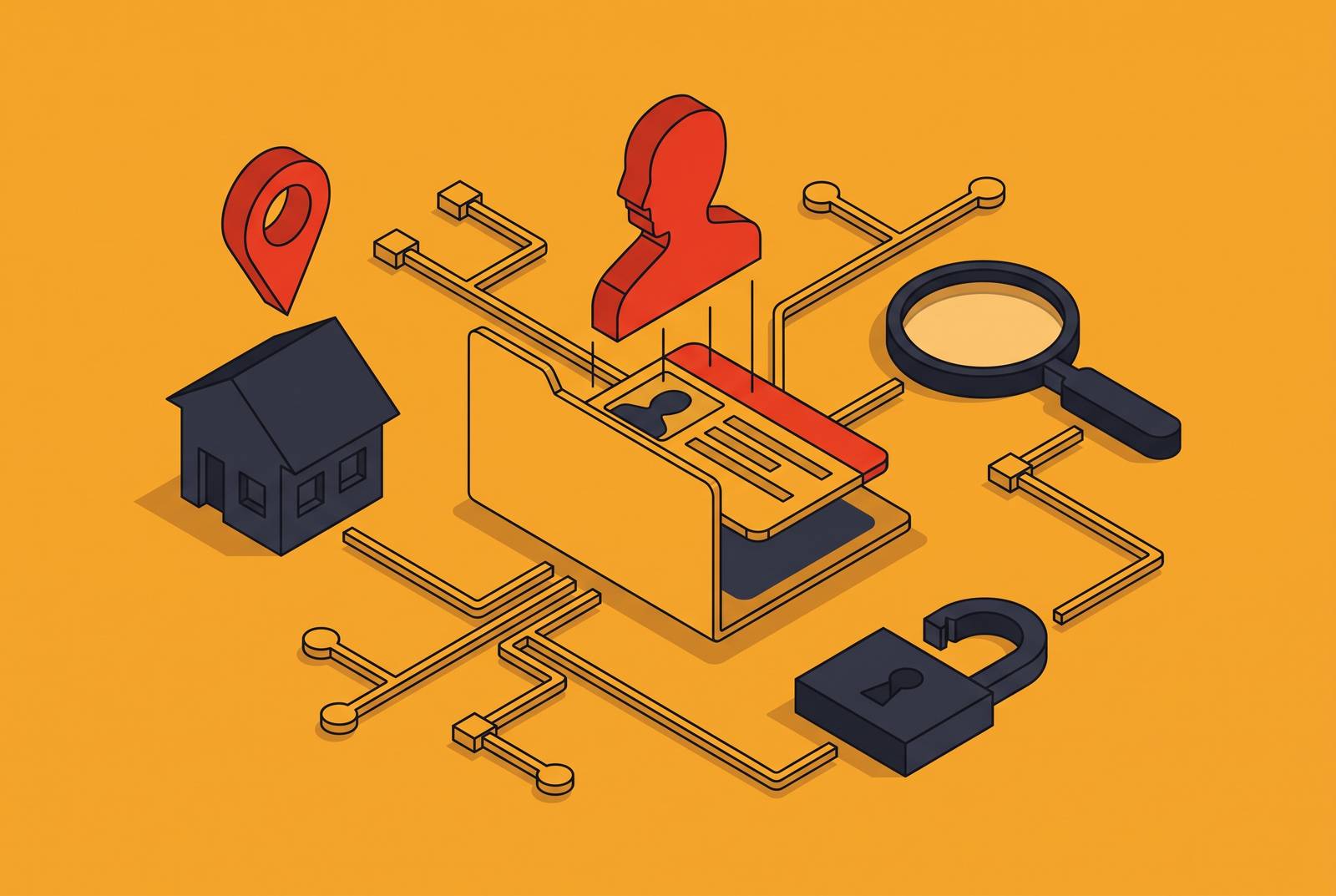
Doxing is the deliberate collection and public release of someone’s private identifying information without consent, typically to expose, harass, or harm them. The information may include a home address, phone number, workplace, full name, email address, or photos. More severe exposures include financial records, Social Security numbers, and family member details. The target loses control over who can find them.
The term comes from “dropping docs,” 1990s hacker slang for stripping away a rival’s anonymity and exposing the person behind an online handle. Within hacker communities, it served as punishment, revenge, or a way to assert dominance. Both spellings, doxing and doxxing, appear in legal, journalistic, and technical sources. Neither spelling is wrong, but this piece uses doxing. Gamergate brought the practice into mainstream awareness, well before it developed into the attack service it has become.
How doxing moved from hacker feuds to an industrialized attack service
An attacker no longer needs technical skill to assemble a target’s personal dossier. Data brokers, leaked breach databases, social media scraping, and people-search engines such as Spokeo and Whitepages supply much of the raw material without any hacking. Because the work often consists of collection, protecting corporate systems alone cannot prevent the exposure of the people who run them.
On dark web markets, a client can submit a target’s name and receive a compiled dossier. What once required personal effort is now a purchasable product. The attacker can outsource the homework and keep the grudge. This shift from improvised revenge to a commodity helps explain the growth in frequency and severity since 2024.
Automation expands that service’s reach. The National Association of Attorneys General identifies accessible AI tools and automated data scraping as factors that have intensified the scale, precision, and anonymity of attacks. AI-assisted scraping lets attackers build detailed profiles faster than they could by hand, and synthetic media tools let them use that material for voice cloning and impersonation. Swatting has followed the same commercial path. The practice involves filing a false emergency report to send an armed police response to a target’s address, and paid services now use synthesized voices and spoofed numbers to hinder attribution.
The pathway from a doxing post to physical danger
A published home address connects an online grievance to a place where someone can be reached. Victims have reported threatening calls, strangers turning up at their homes, and stalkers watching their properties. These consequences do not require a breach of another account or device. The information has already crossed into the physical world.
The Andrew Finch case shows how an address can draw an uninvolved person into a lethal sequence. In Wichita, Kansas, in December 2017, an argument over a negligible Call of Duty wager escalated after someone supplied a false address as a taunt. A serial swatter called police and said someone was holding hostages. Police shot and killed Finch, a 28-year-old who had no connection to the dispute. Three people were convicted, and the caller received twenty years.
In 2025, an 18-year-old was sentenced for placing at least 375 hoax swatting calls over roughly 18 months. The calls were placed for a fee, using synthesized voices and spoofed numbers. That case demonstrates an organized, monetized threat rather than a single dispute spiraling out of control.
Detection often starts after the opportunity to intervene has narrowed. By the time a doxing post surfaces publicly, it has typically already circulated for days in closed Telegram channels and dark web forums. Most security teams are not watching those channels and forums. Public visibility is therefore a poor proxy for when targeting began, and waiting for it leaves both individuals and organizations responding late.
Recent cases that show how doxing now operates at scale and speed
Post-2024 campaigns have expanded beyond individual feuds into coordinated targeting of professionals, executives, political figures, and public institutions. In March 2025, an online map published the names, home addresses, and phone numbers of Tesla owners and dealerships. Viewers were encouraged to vandalize Teslas. A Tesla service center in Las Vegas was attacked by someone wielding a gun and Molotov cocktail.
Executive exposure has also become a mass event. The Fortune 500 executive mass-doxing in May 2025 targeted corporate leaders together in one campaign. Its significance extends beyond the seniority of those exposed. A campaign aimed at many executives at once creates a security problem that cannot sensibly be treated as each person’s private administrative chore.
The attorneys general association reports that, since 2024, doxing and swatting incidents have disproportionately affected schools, election offices, and religious centers. It points to federal bulletins and independent reports, and Georgia, Arizona, and Pennsylvania report more harassment of people who work in elections. Taken together, these cases show why a threat model built around a lone internet feud no longer fits the scope of the problem.
Why enterprises are structurally unprepared for executive doxing as a threat vector
Most enterprise security programs have no coverage for executive doxing because it is absent from standard threat models, SIEM dashboards, and annual red team exercises. If an exposure is omitted from security event modeling, there may be a lack of monitoring designed to find it or a response process designed to handle it. Organizations then discover the problem through its consequences.
Information held outside corporate systems can still put a company at risk. CybelAngel’s executive doxing guide identifies social media scraping, public records and databases, data breach dumps, people-search engines, and social engineering as sources for attacker profiles. None requires elevated access or technical sophistication. A published home address can enable physical threats and swatting, while exposed employee details can make phishing and business email compromise more convincing.
Deepfake fraud makes that boundary even less useful. The early reconnaissance for a deepfake CEO fraud attack is structurally identical to the early stages of executive doxing. Attackers find leaders through public sources, gather audio from earnings calls and conference recordings, and build detailed profiles. The same dossier supports both physical targeting and impersonation. Treating those as unrelated problems divides a single preparation phase between separate security concerns.
The Security Executive Council reports that executive targeting incidents surged between 2023 and 2025, reaching their highest recorded level. That trajectory has outpaced updates to most organizations’ threat models. The blind spot therefore reinforces itself. When doxing remains outside the security program, its links to fraud and physical danger are easier to overlook, and those missed links make it easier to keep classifying the problem as PR, HR, or private executive protection.
Where the legal framework leaves victims and security teams exposed
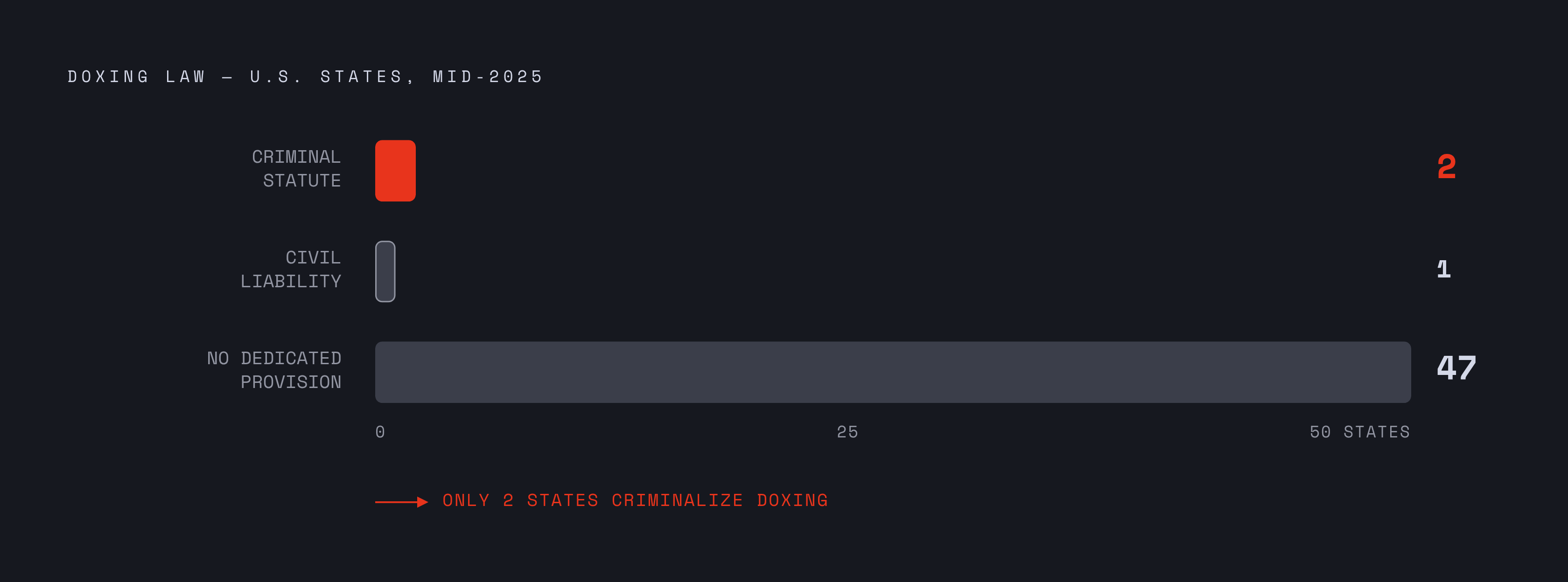
Legal remedies have an important role, but their timing makes them a secondary defense. The United States has no single federal doxing statute, and state coverage is uneven. Damage can begin within hours of exposure. A remedy that depends on jurisdiction, statutory elements, and a developed evidentiary record cannot substitute for detecting a campaign while it is taking shape.
As of mid-2025, only Alabama, California, and Illinois had established standalone doxing provisions with explicit statutory definitions. Alabama and California made doxing a crime, while Illinois made doxers liable in civil court. Other states had criminalized the conduct without using the term itself, and the remaining states had no dedicated provision. That distinction is consequential for victims.
Federal law can reach some campaigns through cyberstalking, threats, and, in some cases, computer fraud statutes. Those laws apply only when a campaign meets their requirements, and many campaigns are set up to avoid them. International frameworks also offer partial coverage. The same guide identifies the UK’s Malicious Communications Act 1988, Australia’s Cybercrime Act 2001, and the EU’s GDPR as creating some legal exposure for doxers. None of these laws was written specifically to deal with coordinated doxing campaigns.
The interval between a campaign beginning and a legal remedy taking effect is typically measured in weeks, while damage can occur within hours. Legal action therefore works best as escalation and documentation. There is also a gap before any legal process starts. Only a very small number of victims contact law enforcement, so the evidentiary record on which remedies depend is rarely built in time.
What a threat intelligence approach to doxing exposure actually looks like
For security teams, the response is to monitor where targeting begins, before a public complaint. That includes closed Telegram channels, dark web forums, and fringe platforms before a post reaches the open web. The window between first exposure and first exploitation is measured in hours. Watching those channels for executives’ names, addresses, and exposed credentials can give teams a warning closer to when attackers are preparing.
The May 2025 executive campaign illustrates the value of that timing. Security teams that identified the exposure while the sites were live could begin removal requests. Those that learned of it afterward were left managing indexed versions.
Incident response plans must cover what to do when teams find signs of doxing. The plan needs a named response owner and clear removal and notification triggers. It also needs to connect legal escalation with monitoring, and coordinate physical security when an executive’s address is confirmed exposed. Teams should agree on who owns the response before an exposed address forces them to discuss it.
The same monitoring can also give teams early warning of deepfake fraud campaigns that use the same source material. That makes it a unified investment rather than a separate toolset for every possible outcome. Leading enterprises are embedding threat insights into risk assessments, vulnerability management, and board-level decisions as threat intelligence becomes a broader organizational function. Doxing belongs in that framework. The practical goal is to detect the dossier while it is being assembled and shared, before its contents become instructions for someone else’s next move.