Interpol Cybercrime Investigation Operations by Region
Interpol tailors cybercrime strategies to regional threats and investigative capacity.
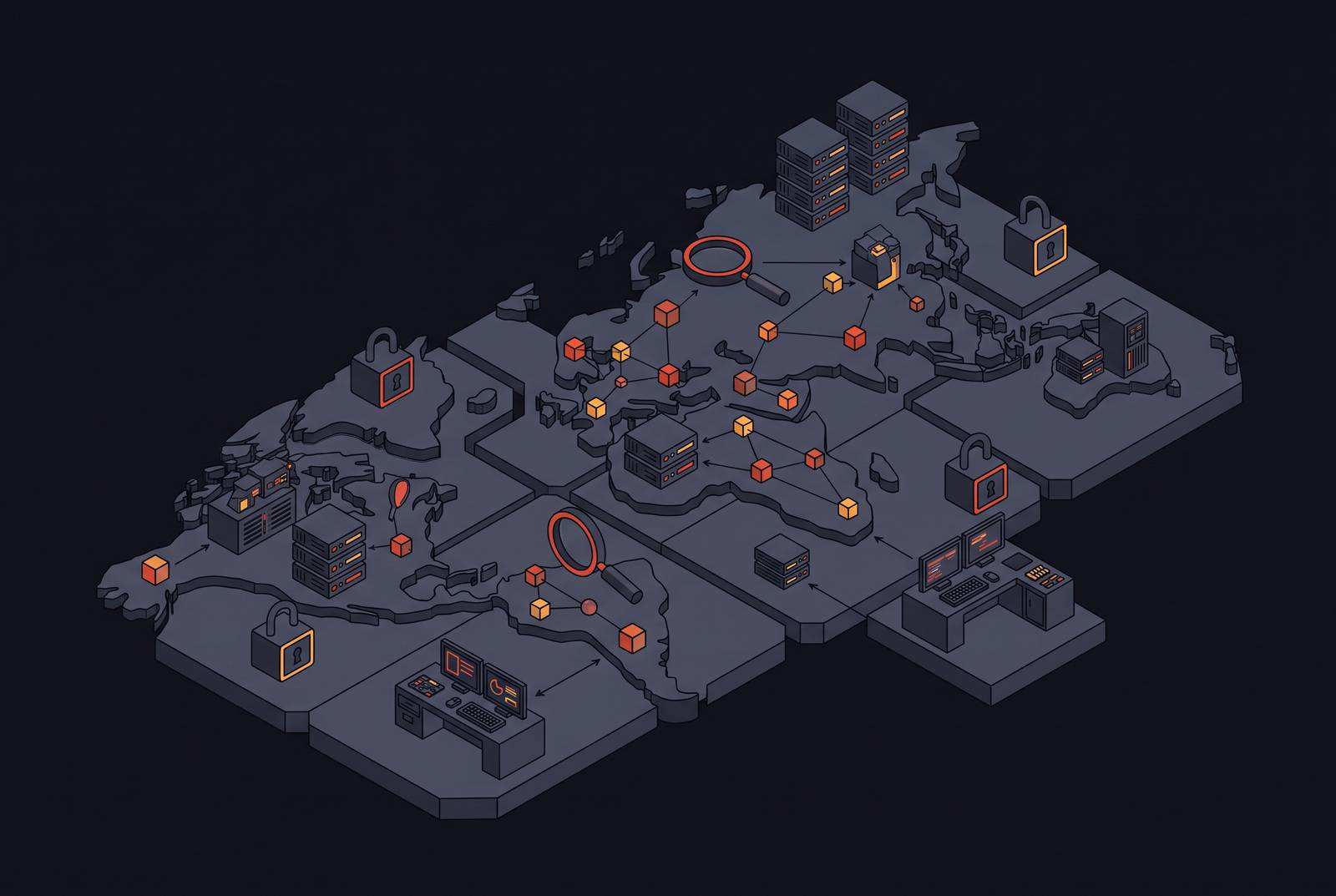
Interpol's cybercrime operations are built region by region, using distinct playbooks tailored to local conditions. They're built region by region, because the threats, the laws, and the investigative muscle on the ground look completely different depending on where you land on the map.
Why Interpol structures cybercrime work by region rather than by crime type alone
Interpol's cybercrime mandate covers the whole planet, but the execution of that mandate is anything but uniform. Much of the leadership for Interpol's cybercrime program is headquartered in Singapore, home to the Interpol Innovation Centre, which runs four labs focused on responsible AI, emerging threats, digital forensics, and global tech, strategy, and policy. Lyon sets the direction, sure, but the actual work of chasing down a phishing kit or a ransomware operator happens through regional bureaus and liaison officers who translate headquarters strategy into something a national police unit can actually act on. Without that scaffolding, what's left is a pile of one-off bilateral requests, a slow, clunky way to fight crime that moves at the speed of a wire transfer.
The deeper reason for the regional split, though, is that crime just doesn't distribute evenly. West Africa's threat mix looks nothing like Southeast Asia's, and neither looks like Eastern Europe's, so Interpol's operational priorities bend to match whatever is actually happening in that neighborhood. Member countries also walk in with wildly different levels of legal infrastructure and investigative capability. A single, one-size-fits-all operational model would smother some countries in resources they don't need and leave others stranded without the basics.
So geography ends up being the sharpest lens for understanding what Interpol actually does day to day, as opposed to what its charter says it's supposed to do. The regional breakdown that follows makes that concrete, region by region.
How Interpol operates in Africa, where business email compromise and online fraud dominate
Business email compromise and advance-fee fraud present Interpol with a concentrated problem in Africa, which has shaped the design of operations there more than any other factor. These are patient, socially engineered scams that unfold over time rather than in a single strike. They're patient, socially engineered scams that trick a finance department into wiring money to the wrong account, and they've scaled into a genuine global export.
Operation Falcon is the clearest example on record. It targeted the SilverTerrier group of Nigerian threat actors and led to coordinated arrests tied to BEC campaigns that hit thousands of companies worldwide. Operation Delilah picked up where that left off, going after the head of the SilverTerrier/TMT group specifically for BEC activity. What's notable about Delilah is the target: not just another scammer running a laptop out of an internet café, but someone sitting closer to the top of a recruiting and money-mule pipeline. That's a shift from picking off individual fraudsters to dismantling the supply chain that feeds them.
None of this happens in a vacuum of perfectly capable local police forces. Cyber investigative capacity varies a lot across African member states, so Interpol's role often stretches past straight operational support into actual capacity-building, training national units, sending in expert support teams, and helping with digital evidence handling. That's simply a reflection of the region's circumstances. It's just an operational reality Interpol has to design around, the same way any organization scales its approach based on what its partners can actually execute.
One tool ties all of this together on the intelligence side: the African Cyberthreat Assessment Report. Operation Ramz, spanning 13 countries in the Middle East and North Africa and running from October 2025 to February 2026, resulted in the arrest of 201 individuals, the identification of 382 additional suspects, and the seizure of 53 servers, with nearly 8,000 pieces of data and intelligence shared among participating countries. The African Cyberthreat Assessment Report, which Interpol produces for the region, feeds directly into operational targeting rather than serving purely as a public document.
How Interpol operates in Asia-Pacific, where cyber-enabled scam compounds and cryptocurrency fraud define the threat
The whole shape of the problem changes in Southeast Asia. This region has become the epicenter of industrialized, large-scale cyber fraud, most notoriously the pig butchering scams and forced-labor scam compounds running out of Myanmar, Cambodia, and Laos. These are organized networks, coordinated groups operating with structure and division of labor. They're compounds, sometimes literal buildings, staffed by trafficked workers running scripts against victims on the other side of the world. That's a fundamentally different animal than a lone fraudster in Lagos with a laptop, and it demands a different kind of response.
Interpol's answer has been coordinated, multi-country takedowns, and Operation HAECHI is the flagship example. Run across multiple phases targeting online financial crime, HAECHI has produced arrests and asset seizures spanning South Korea, Japan, the Philippines, and other member states. It's less a single raid and more a synchronized sweep, timed so suspects in several countries get picked up around the same window instead of tipping each other off.
Crypto complicates all of it further. ASEAN's fast adoption of cryptocurrency opened up a whole new attack surface, and Interpol's work in the region has leaned hard into tracing and freezing crypto assets. This means looping in financial intelligence units alongside the usual police partners. Tracking a wire transfer is one thing. Tracking a hop across three exchanges and a mixer is another animal entirely, and it needs people who speak that language.
Operation Storm Makers adds another layer, targeting the human trafficking networks that supply labor to the scam compounds. This is the part of the region's story that trips people up. Cybercrime and organized crime aren't adjacent problems here, they're the same problem wearing two hats. You can't dismantle the scam operation without also dismantling the trafficking pipeline that staffs it.
And here's the friction point. In countries where these compounds operate with some degree of local protection, plain law enforcement coordination hits a wall fast. So Interpol leans on other levers instead: financial disruption, freezing the money before it moves, and victim repatriation, getting trafficked workers out of the compounds. When the front door is locked, you go around the side.
How Interpol operates in Europe, where ransomware groups and infrastructure attacks drive the operational agenda
Europe is a different puzzle entirely, mostly because the national agencies there are already technically sharp. Europol handles the heavy lifting of intra-EU coordination, so Interpol's real value-add is bridging European investigations out to non-European jurisdictions, which is exactly where a lot of ransomware operators and their infrastructure tend to sit.
Operation Cyclone is the case study to know here. It went after the Cl0p ransomware group in partnership with South Korean, Ukrainian, and US law enforcement, and it shows Interpol's actual job in this region: facilitating arrests and infrastructure seizures that straddle the line between European and non-European legal systems. Nobody's chasing Cl0p operators through one country's court system alone. The whole operation only works because someone is stitching multiple legal frameworks together.
That stitching is visible structurally too. European cases lean more heavily on joint investigative teams and mutual legal assistance frameworks, with a clean division of labor: Europol runs the intra-EU coordination, Interpol runs the global linkage. Nobody's duplicating the other's job, at least not on paper.
Then there's the elephant sitting in the corner of the room. A lot of the well-funded ransomware-as-a-service ecosystems have historically operated out of Eastern Europe and Russia, and that creates jurisdictional dead ends that don't have a clean legal fix. Interpol's workaround isn't diplomatic pressure or backroom deals, it's patience: waiting for an operator to travel, then making the arrest in whatever third country they land in.
That's where Red Notices earn their keep. They're arguably as important as any direct operational deployment in this region, because they're the trigger that turns a border crossing into an arrest the moment a flagged individual appears somewhere cooperative.
How Interpol operates in the Americas, where cybercrime intersects with organized crime and financial fraud networks
The Americas bring their own wrinkle: cybercrime here rarely stands alone. Money mule networks, fraudulent banking schemes, carding operations, a lot of that infrastructure is run by or tied to established organized crime groups rather than freelance hackers. Pulling the thread on a carding ring in Latin America has a decent chance of leading back to a cartel-adjacent operation.
Operation Lyrebird is the standout case, and it's a bit of an odd one geographically. It led to the arrest of a Moroccan national operating under the alias "Dr HeX," who was running operations out of Morocco while exploiting financial systems in the Americas. The lesson there is that Interpol's work in this region isn't purely about local enforcement. Sometimes it's about tracing a threat actor who's never set foot anywhere near the systems they're draining.
South America has developed some genuinely strong national muscle. Brazil, Colombia, and Argentina all run cybercrime units that work with Interpol on a regular basis, which makes parts of the continent noticeably more plugged into Interpol's global operations than some of their neighbors.
North America is its own case, and it's important to be precise about it. Interpol's Regional Bureau in Buenos Aires, Argentina serves as the coordination hub for operational work across South America, tackling crimes including cybercrime, money laundering, corruption, human trafficking, and terrorism. US agencies keep up bilateral cybercrime cooperation with Interpol, but they mostly run their own show through FBI Legal Attachés and DOJ Mutual Legal Assistance Treaties. That doesn't mean the US sits outside Interpol's reach. It just means the division of labor tilts toward the US leading and Interpol supporting, rather than the other way around, which is basically the reverse of how things work in Africa.
Across the region broadly, financial fraud against banking systems, card skimming, account takeover, fraudulent wire transfers, has stayed a steady focus for Interpol's Americas operations. The Americas function as both a target for this kind of fraud and a transit corridor for the money once it's stolen, which is a bit like being both the crime scene and the getaway route at the same time.
What cross-regional operations reveal about how Interpol unifies its regional work
The regional pieces actually connect into something bigger. The operations that matter most aren't confined to one region, they use regional intelligence and regional arrests as building blocks to take down threat actors whose infrastructure and money trails span continents.
Some operations do stay contained, and that's instructive too. Certain HAECHI phases and Operation African Cyber Surge stayed within African member states, with cross-border cooperation happening continent-internally rather than reaching outward to other regions. That's not a limitation so much as a design feature. Regional operations function as entry points into bigger global networks.
The clearest proof that Interpol is building toward something unified, not just running four separate regional shops, is the I-GRIP mechanism, Interpol's Global Rapid Intervention of Payments. It operates identically across every region as a shared tool for freezing fraudulently transferred funds before they get laundered away. Whatever regional flavor an operation has, when money needs freezing fast, everyone reaches for the same tool.
That convergence happens on the intelligence side too. The Africa Working Group on Cybercrime, the ASEAN cybercrime working groups, and the notice system running through Europe all feed into one shared threat picture, synthesized centrally by analysts at the Cybercrime Directorate. Threat intelligence should be steering operational decisions in real time rather than sitting in a report nobody reads until the next planning cycle rolls around, which is the same argument Cyberou, a cybersecurity content studio that grounds its work in live threat data, makes about how security vendors communicate with their markets.
The obvious pushback to all of this regional framing is that serious threat actors don't respect borders in the first place. Fair point. The regional structure was never about mapping where the criminals physically sit. It's about mapping where the law enforcement relationships and legal entry points actually exist. A criminal can be anywhere. An arrest can only happen where there's a cooperating agency, a working legal framework, and someone willing to answer the phone when Lyon calls.
That's really the whole story of how Interpol fights cybercrime. Not a single global machine, but four regional engines built to match four very different threat environments, all wired back into the same intelligence picture and the same handful of shared tools. Understanding that regional wiring is central to grasping how the system functions. It's the only way to actually understand how global cybercrime enforcement works in practice, rather than how it looks on an org chart.
Sources
- INTERPOL ASIA AND SOUTH PACIFIC CYBER THREAT ASSESSMENT REPORT 2025/2026
- INTERPOL arrests 201 suspects in regional cybercrime operation | The Jerusalem Post
- New INTERPOL report highlights escalating cyber threats across Asia and South Pacific
- 201 arrests in first-of-its-kind cybercrime operation in MENA region
- 574 arrests and USD 3 million recovered in coordinated cybercrime operation across Africa
- INTERPOL AFRICAN CYBERTHREAT ASSESSMENT REPORT 2026 JUNE 2026
- AFJOC - African Joint Operation against Cybercrime
- Cybercrime operations