Money Mule Prosecution Patterns in the US and UK
Prosecutions split sharply: US warns first, UK suspects lightly.
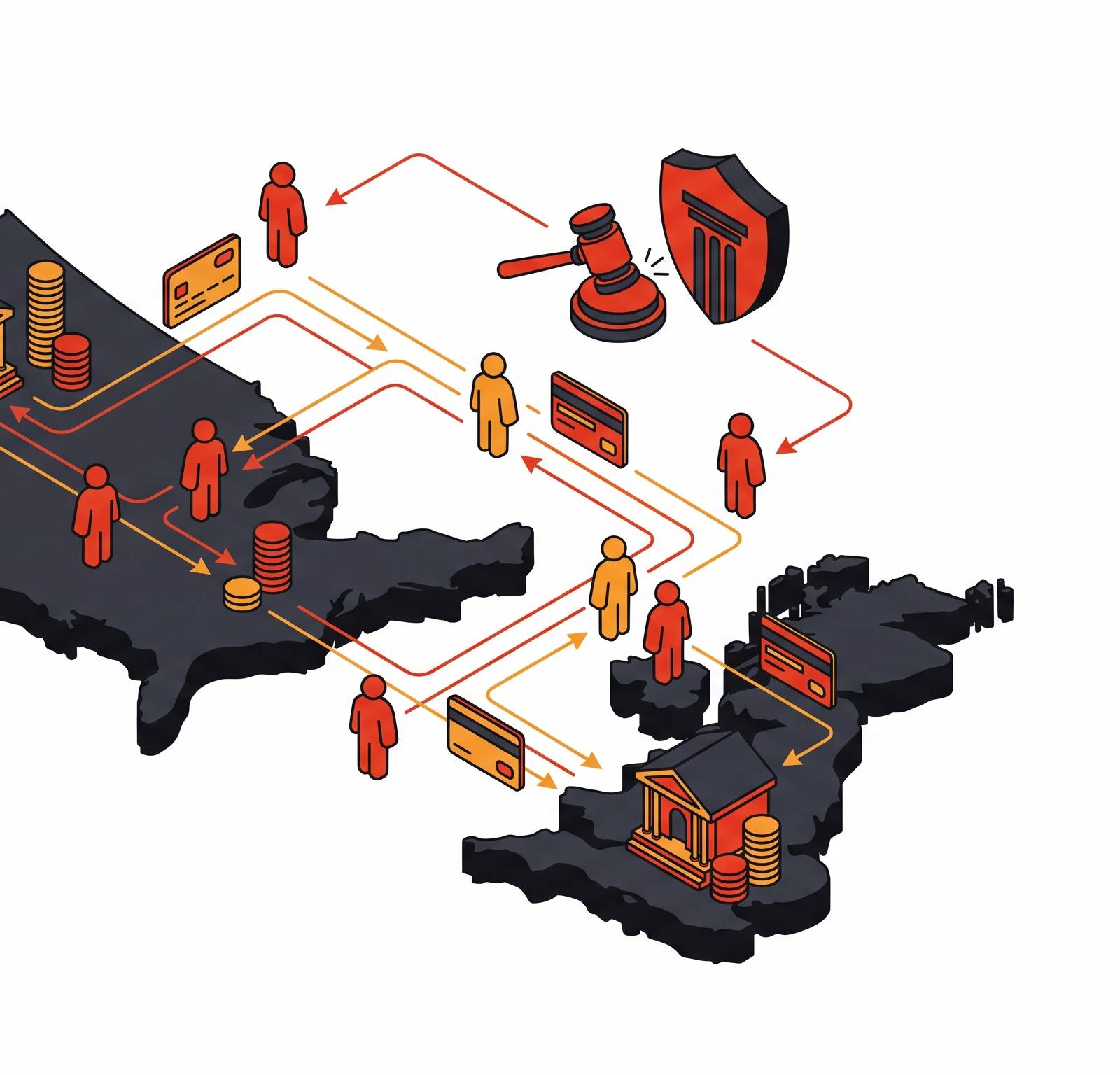
A money mule is someone who moves illegally obtained money on behalf of someone else. Usually they keep a cut. That is the simple version.
The complicated version is that many people doing this job are unaware they are doing this job.
Recruitment runs through romance scams, fake job postings, and peer pressure. Many mules genuinely believe they are processing payments for a legitimate employer, helping out a romantic partner, or doing a favor for a friend. Some are teenagers. Some are elderly. Some are people who needed money fast and did not ask enough questions.
All of that is a real operational reality that both the US and UK systems have had to reckon with. Enforcement policy has to account for genuine unwitting participants, while still reaching those who knew exactly what they were doing. And some knew perfectly well but would rather you believed the first version.
So both systems are wrestling with the same core question: at what point does a victim become an offender, and who gets to make that call? It is a spectrum — one end is pure prey, the other is predator, and the hard cases all live somewhere in the murky middle, like fish caught between two currents that are pulling in opposite directions. That tension runs through everything else in this piece.
How the US Charges Money Mules — The Federal Toolkit and Who It Targets
Federal prosecutors charge money muling under existing statutes, assembling cases from whichever laws the facts support.
The charges available include:
Mail fraud
Wire fraud
Bank fraud
Aggravated identity theft
Each carries different sentencing weight. Aggravated identity theft comes with a mandatory two-year add-on that cannot be suspended or run concurrently. That detail matters when you are calculating real exposure.
The absence of a dedicated statute gives charging decisions to prosecutorial discretion. The same conduct can attract different charges depending on which agency leads the investigation and how the facts get framed. Outcomes vary in ways that remain opaque from the outside. Frankly, it can feel arbitrary depending on which side of the indictment you are on — which is a bit like being told the rules of the game after you have already lost.
The average money laundering sentence in the US sits at 71 months. Nearly six years. That number reframes money mule activity for anyone who still treats it as minor or victimless.
The agencies involved reflect how many financial channels fraud touches simultaneously. DOJ leads. FBI and the US Postal Inspection Service are primary partners. But the US Secret Service, IRS Criminal Investigation, Homeland Security Investigations, FDIC-OIG, and Social Security Administration OIG all have seats at the table. When fraud shows up in your tax returns, your bank account, your mail, and your federal benefits at the same time, jurisdiction gets crowded fast. Each agency picks up the baton wherever the money touched their lane.
How the UK Charges Money Mules — POCA, the Suspicion Threshold, and Prosecutorial Gatekeeping
In the UK, the legal framework is more consolidated at the statute level. Almost all money mule charges flow from the Proceeds of Crime Act 2002, known as POCA.
Three sections do most of the work:
Section 327: Concealing, disguising, converting, or transferring criminal property
Section 328: Entering into or becoming concerned in an arrangement to facilitate the acquisition or use of criminal property
Section 329: Acquiring, using, or possessing criminal property
Each carries a maximum of 14 years' custody, plus unlimited fines.
The most important concept in this framework is the suspicion threshold. Following R v Da Silva in 2006, suspicion under POCA only needs to be "more than fanciful." Not clearly established. Not firmly grounded. Just something you cannot completely dismiss. Once that is on the record, your options narrow quickly. The law requires only that you had a feeling you ignored, which is a bit like being convicted for not reading the writing on the wall.
That is a meaningfully lower bar than what US federal fraud statutes typically require to establish knowing participation. A defendant in the UK faces a prosecution that needs only to prove they had reason to suspect, a meaningfully lower bar than proving actual knowledge.
Then there is the question of who actually prosecutes. The UK routes cases through three different agencies depending on the nature of the underlying offense:
The CPS (Crown Prosecution Service) handles most money laundering cases
The Serious Fraud Office takes cases linked to serious fraud or corruption
The FCA (Financial Conduct Authority) can pursue cases where financial regulation is engaged
Unlike the US model, where DOJ holds central authority and assembles the coalition around it, the UK distributes that authority across agencies. Which one leads depends on what the predicate offense looks like. Coordination is baked into how the system is structured from the start.
The DOJ Money Mule Initiative — How a Tiered Annual Campaign Operationalises Enforcement
The DOJ has run an annual Money Mule Initiative every autumn since 2018. The scale has grown deliberately: roughly 600 actions in 2018, substantially more in 2019, approximately 4,750 in 2021, and back to over 3,000 in 2024.
The 2021 number tells you the most about how the initiative actually works. Of approximately 4,750 actions taken that year, law enforcement served around 4,670 warning letters. Criminal prosecution was the exception.
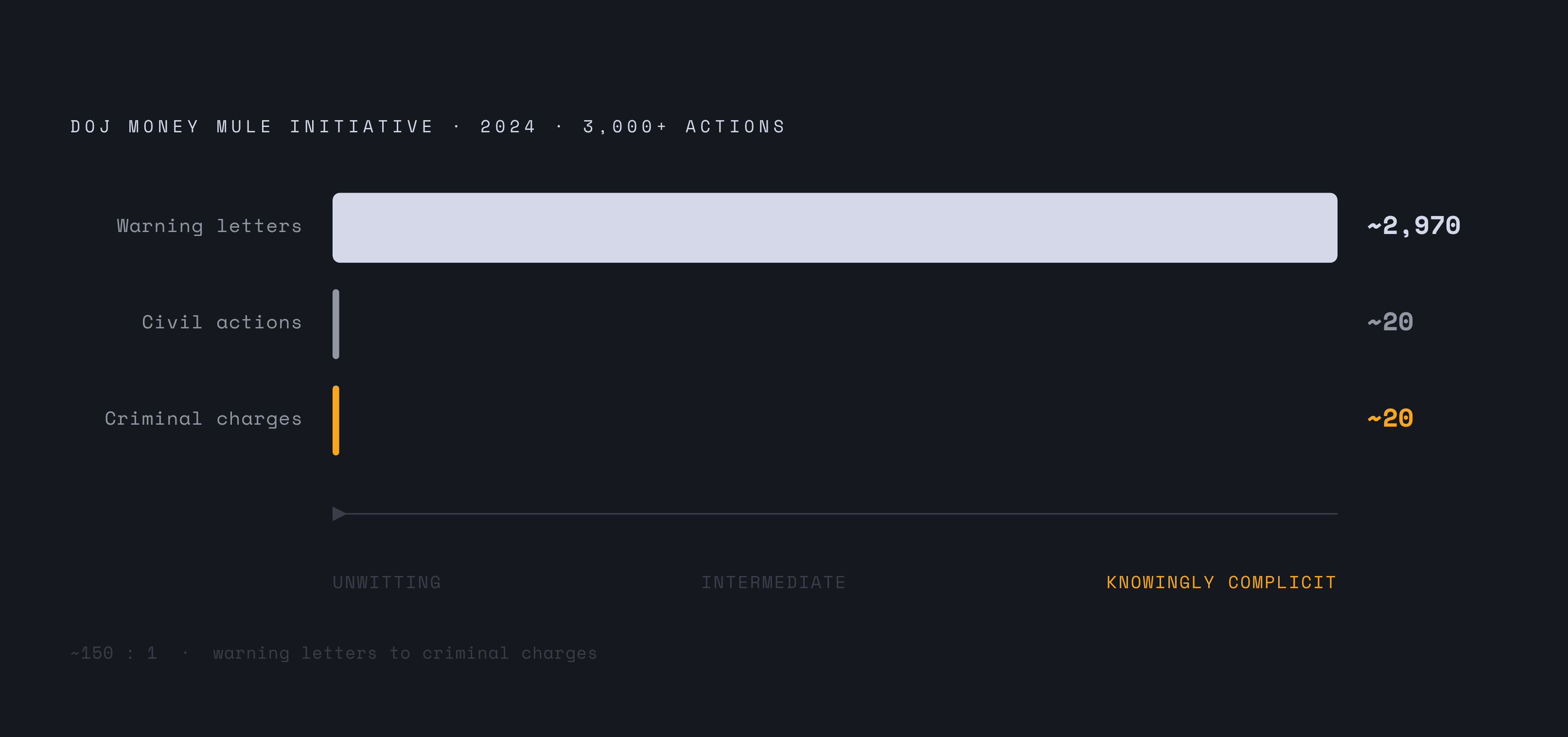
The 2024 breakdown makes this even plainer. Of more than 3,000 actions, fewer than 20 individuals were criminally charged. The rest got warning letters. Roughly 2,970 letters. Roughly 20 prosecutions. That ratio reflects a deliberate policy choice.
The initiative runs on an explicit graduated model:
Warning letters for the unwitting or first-time
Civil actions as an intermediate step
Felony prosecution for the knowingly complicit
This is codified DOJ policy, not informal practice. The warning letter does two things worth understanding. It serves as both a deterrent and an evidentiary step. The letter creates knowledge on the record, so a mule who keeps moving money after receiving one has handed the government a much cleaner case. A single piece of paper that simultaneously extends mercy and closes the escape hatch. That is a well-designed tool.
How the UK Has Structured Its Equivalent Intervention — Cease-and-Desist Notices, MMAP, and the Focus on Herders
The UK published its Money Mules Action Plan, known as MMAP, in March 2024. It coordinates enforcement across law enforcement, prosecution agencies, financial services, and government. That reach into the private sector gives MMAP a structurally broader footprint than the DOJ's agency-led model.
The UK equivalent of the DOJ warning letter is the cease-and-desist notice, issued under City of London Police guidance. Same logic: early intervention, establishing knowledge on the record, reserving prosecution for higher-culpability cases.
Where the two systems really start to separate is in who the UK is actually trying to prosecute. The CPS guidance and MMAP enforcement both explicitly prioritise "mule herders." Those are the recruiters and organizers who build and manage mule networks. The individual mule at the bottom of the chain is a secondary target.
This reflects a different theory of harm. The UK system treats many individual mules as victims of financial exploitation, particularly where coercion or deception is involved. In 2024, the CPS updated its money laundering legal guidance to formally recognise financial exploitation as a factor in culpability assessment. What had been informal prosecutorial discretion became published guidance, a significant policy shift. It signals how seriously the UK takes the victim-offender distinction at the policy level, not just in individual courtrooms.
Overall money laundering prosecutions in England and Wales increased 37% in 2024-25 compared to the previous year. MMAP is generating volume. The culpability filter is doing its job: pushing lower-level cases toward intervention and higher-level cases toward court.
Sentencing Outcomes and Conviction Rates — What the Numbers Reveal About Each System's Priorities
US cases from 2024 show the range of sentencing outcomes:
Viraj Patel received 3 years and 10 months for laundering $145,000
Daphne Gonzalez received 46 months for laundering between $1.5 million and $3.5 million
Two Florida co-conspirators received 18 and 13 months respectively and paid $127,646 in restitution
The 71-month average sentence sits well above all of these. That gap suggests the cases that actually reach sentencing tend to involve larger networks, greater culpability, or more sophisticated conduct. The warning letter system is filtering out the low end. What gets prosecuted skews serious.
On the UK side, the conviction numbers are striking. Since April 2021, the CPS prosecuted 25,665 defendants where fraud and forgery was the principal offense category, resulting in 21,717 convictions. The conviction rate was 85.3% in fiscal year 2023-24, nudging up to 85.4% in the first three quarters of 2024-25. The UK is not sending weak cases to court very often.
Asset recovery adds another dimension. Over £450 million was recovered through CPS Confiscation Orders in the five years to 2024. Of that, £88 million was returned directly to victims. The DOJ Initiative's public-facing metrics omit asset recovery entirely, confirming that the two systems measure accountability differently. Direct comparison gets slippery fast.
Here is a number that puts the scale of the problem in context: UK fraud prosecutions rose 14% year-on-year, but remain 72% below a 2013-14 record high, even as fraud now accounts for 45% of all crime. MMAP is designed to close that gap. It has not done so yet. Fraud cases in England and Wales passed 4 million in 2024. That is the size of the backlog the system is still chasing.
Where the Two Systems Diverge Most Sharply — Culpability Assessment, Coordination Model, and What Each Treats as Success
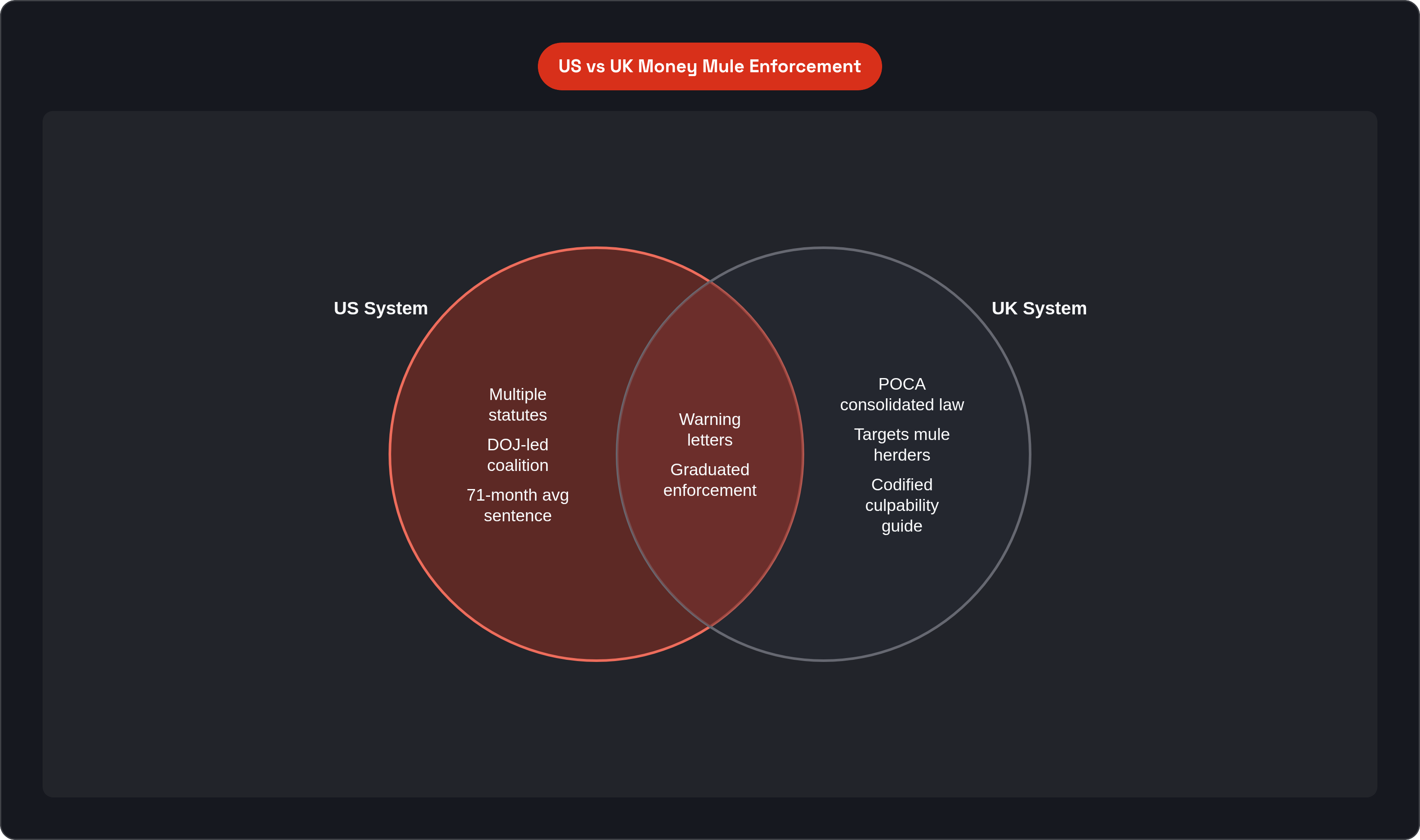
A few fault lines stand out when you look at both systems together.
Culpability assessment. The US applies prosecutorial discretion case-by-case within the annual campaign structure. The UK has moved to codified guidance that formally weights financial exploitation as a mitigating factor. That is a more institutionalised answer to the victim-or-offender question. The call is not left entirely to individual prosecutors. It is built into published policy.
There is a nuance worth catching here. The POCA suspicion threshold from R v Da Silva gives UK prosecutors a lower evidential bar than US federal statutes typically require for knowing participation. The UK can prove a case more easily once it is in court. But UK guidance simultaneously raises the threshold for getting into court in the first place, by pointing resources at herders rather than individual mules. Easier to win, harder to get there: a deliberate compression of the pipeline. Only the most culpable cases make it all the way through.
Coordination model. The US runs enforcement through a federal agency coalition anchored by DOJ. The UK distributes authority across CPS, SFO, FCA, and City of London Police, with financial industry participation built into MMAP. Banks are active participants in the UK system. Whether that is a structural advantage or just more moving parts is a fair debate.
What success looks like. The DOJ Initiative reports total actions taken, combining prosecutions and warning letters into a single headline figure. CPS reports conviction rates and asset recovery. These are genuinely different accountability frameworks. One system is optimising for deterrence at scale. The other is optimising for prosecution quality and financial accountability. Both are answering different questions.
Both systems are accelerating. Americans lost more than $6.5 billion to investment scams alone in 2024. US confirmed laundering cases more than doubled in the first half of 2025. Over 225,000 people in the UK were identified as acting as money mules in 2024, a 23% increase from the year before. The enforcement machinery is expanding on both sides of the Atlantic, and so is the problem it is trying to contain. The fundamental trade-off is not going away: how many people do you warn, how many do you prosecute, and how do you decide which is which.