Romance Scam Network Arrests in Southeast Asia
Massive arrests target a multibillion-dollar forced-labor scam empire.
The numbers alone should stop you cold. The UN Office on Drugs and Crime estimated combined losses from scam offenses across East Asia, Southeast Asia, Australia, and New Zealand at somewhere between $88.3 billion and $114.1 billion in 2025 alone. That range explicitly outstrips the GDP of several countries in the region. The FBI's 2025 Internet Crime Complaint Center report logged over one million complaints and more than $20.8 billion in losses, a 26% jump from the year before. Investment scams alone accounted for nearly $8.65 billion of that. For American victims specifically, the U.S. Treasury tracked at least $10 billion in losses in 2024 flowing to Southeast Asia-based operations. That was a 66% increase from the prior year.
Numbers that large require logistics. They require management. They require infrastructure. What enforcement agencies have been dismantling, piece by piece, is an industry, a fully operational criminal enterprise.
The "factory" label earns its keep once you understand what these places actually are.
Over the past decade, former casino districts and special economic zones along the borders of Cambodia, Myanmar, and Laos quietly transformed. What were once transit hubs for traditional smuggling became command centers for a global online fraud operation. From satellite imagery, the buildings look like corporate campuses. Walled perimeters. Guard posts. Dormitories. Server infrastructure. The whole thing.
The dominant product coming out of these facilities is pig-butchering. The name sounds ridiculous. The scheme is lethal. It originated in China around 2016 or earlier, spread aggressively across Southeast Asia during the COVID-19 pandemic when borders closed and legitimate economic activity collapsed, and it works like this:
A "worker" inside the compound contacts a target online, usually through a dating app or social media
They spend weeks or months building a genuine-feeling relationship
Then they introduce the target to a cryptocurrency investment platform
The platform is fake. The returns are fake. The money the victim deposits is gone.
Think of pig-butchering as a long con dressed in the clothes of a love story — it is a Trojan horse built out of affection, and by the time the victim sees the soldiers inside, the gates are already open.
The technology layered on top of this is what makes enforcement so difficult. Operators use AI-powered chatbots to maintain constant contact across multiple victims simultaneously. They use deepfake video calls to impersonate the personas workers have built. They clone legitimate exchanges and banking portals down to the favicon. A Korean nationals case in Vietnam, where an entire deepfake romance scam ring was dismantled, illustrates just how far this extends. That case showed that the regional node structure reaches well beyond Myanmar, Cambodia, and Laos.
These operations run as service-based ecosystems, modeled on corporate franchising, with specialist departments inside the compounds. Money laundering has its own team. Human trafficking logistics has its own team. Data harvesting has its own team. The compound supplies labor, communications infrastructure, financial rails, and management all under one roof.
Raiding a compound leaves the business model intact.
The forced labour pipeline that staffs these operations
This is the part that gets lost in the arrest headlines.
The UN's human rights office estimated in August 2023 that 220,000 people from dozens of countries were being held as forced laborers in scam centers in Cambodia and Burma alone. UNODC tracked recruitment from at least 56 countries. People from at least 80 countries have been identified inside compounds. The reach stretches from Indonesia to Liberia.
So how does someone end up inside a walled compound running romance scams? The recruitment data describes one pattern repeatedly. A young man in the Philippines sees a job listing: customer service representative, technology company, competitive salary, relocation provided. He applies. He gets the job. He crosses a border. His documents disappear the moment he arrives. The people who picked him up are now his captors. That is the pipeline, and it is the common pattern, not an edge case. You could call it the oldest trick in the book — except the book has been translated into 56 languages and distributed across every job board on the internet.
Workers inside these facilities are compelled to conduct fraud for up to 17 hours a day. Love scams, crypto fraud, money laundering, and illegal gambling. The Philippines' Migrant Workers Protection Bureau tracked over 1,120 Filipinos who reported being trafficked to Laos, Cambodia, or Myanmar by April 2025. Most had been repatriated by then.
Repatriation returns workers home while operators remain in place.
That distinction matters enormously for how we think about enforcement. Cambodia's mid-2025 mass arrest operation swept up over 2,100 people. Amnesty International identified 53 confirmed scam centers at the time, with many more suspected sites that were neither investigated nor closed. The workers caught in raids are not the architects of the system. Arresting them leaves the industry itself unchanged, and critics raised this directly after that operation.
What the KK Park and Shwe Kokko raids in Myanmar actually achieved
In mid-October 2025, Myanmar's military launched a major operation against KK Park in Myawaddy, Kayin State. Over 2,000 scammers were identified. Roughly 1,500 people fled across the border into Thailand. SpaceX disabled Starlink devices seized at the site. It was a significant, visible action. Between January and October 2025, Myanmar's military reported arresting 9,551 foreign nationals from scam compounds. A November 2025 follow-on raid at Shwe Kokko netted 346 foreign nationals and nearly 10,000 mobile phones in a single operation.
Those numbers are real and incomplete.
KK Park is one of approximately 30 scam compounds along Myanmar's Thai border. The raid removed one node from a distributed network. C4ADS examined satellite imagery of 21 known scam compounds in Myawaddy Township and found that 14 of them, including KK Park, showed construction or expansion activity in 2025 during the same period as the raids. As of June 2026, more than 5,300 people reportedly remain trapped in Myanmar scam centers near the Thai border despite the multinational crackdown.
The satellite data is about as clear as evidence gets. Physical enforcement without disrupting the economic and political incentives behind the industry produces expansion, not contraction. The industry is pricing raids in, not retreating from them.
Shwe Kokko is worth mentioning specifically. That hub was connected to a border guard force operating with structural political protection. The compounds exist inside special economic zones that operate with the tolerance or active involvement of local power brokers. That is a hard ceiling on what a military raid can accomplish on its own, and nothing in the 2025 operations punched through it.
How the Prince Group case exposed the financial architecture above the compounds
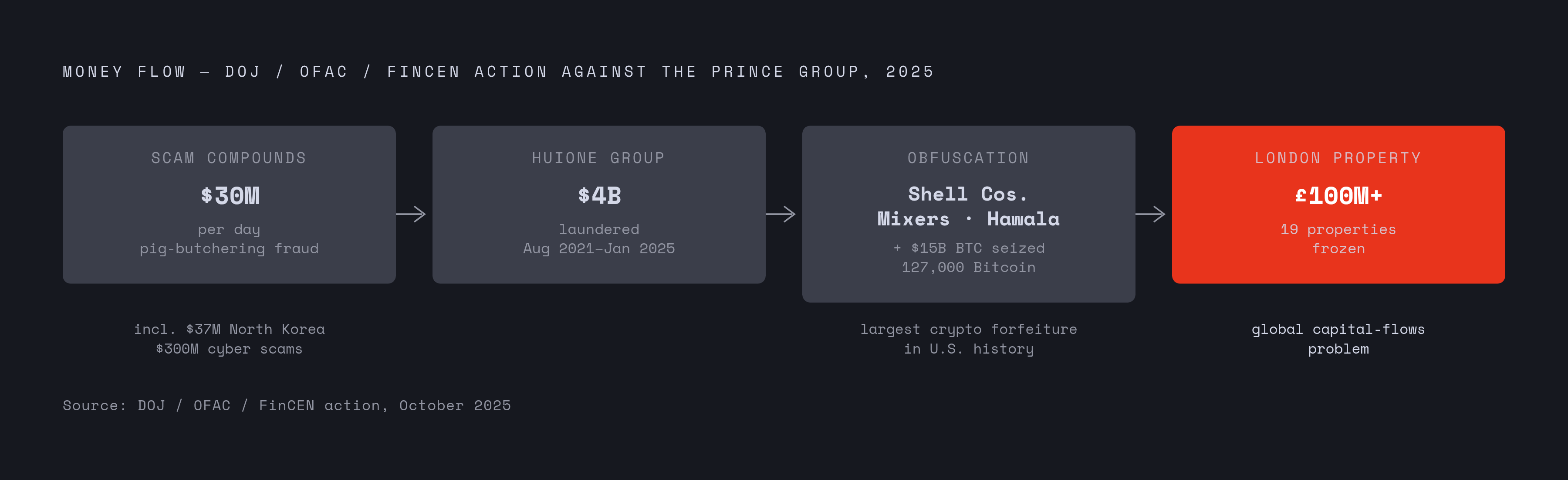
On October 14, 2025, the DOJ, OFAC, and FinCEN announced coordinated enforcement against Southeast Asian scam networks. It was the largest such action to date, and it was different in kind from anything that came before it because it targeted the financial layer directly, above and beyond the physical one.
OFAC sanctioned 146 targets within the Prince Group, a Cambodia-based transnational criminal organization led by Chen Zhi. The charges included wire fraud conspiracy and money laundering conspiracy. The case involved more than 127,000 Bitcoin, worth roughly $15 billion, making it the largest cryptocurrency forfeiture in U.S. history. The Prince Group allegedly generated up to $30 million per day through fake investment platforms.
The financial services layer that moved the money was called the Huione Group. Huione laundered at least $4 billion in illicit proceeds between August 2021 and January 2025. That included at least $37 million from North Korean cyber heists and $300 million from other cyber scams. The money moved out of Southeast Asia.
The UK moved simultaneously. Six entities and individuals associated with Prince Group were sanctioned. Nineteen London properties worth more than £100 million were frozen. Fraud proceeds from pig-butchering operations running in Myanmar and Cambodia were sitting in London real estate. This is a global capital flows problem, and the Prince Group case made that visible in a way no prior enforcement action had.
Chen Zhi was arrested by Cambodian authorities in January 2026 and extradited to China. Ly Kuong, a casino and real-estate tycoon connected to the network, was taken into custody and charged. Thousands of workers were reportedly released from compounds following these arrests. In June 2026, OFAC issued a follow-on round of sanctions hitting nine additional individuals and 26 entities linked to the Prince Group, including compound investors and front companies.
The sequence matters. October 2025. January 2026. June 2026. This is ongoing.
Why enforcement keeps producing arrests without dismantling the industry
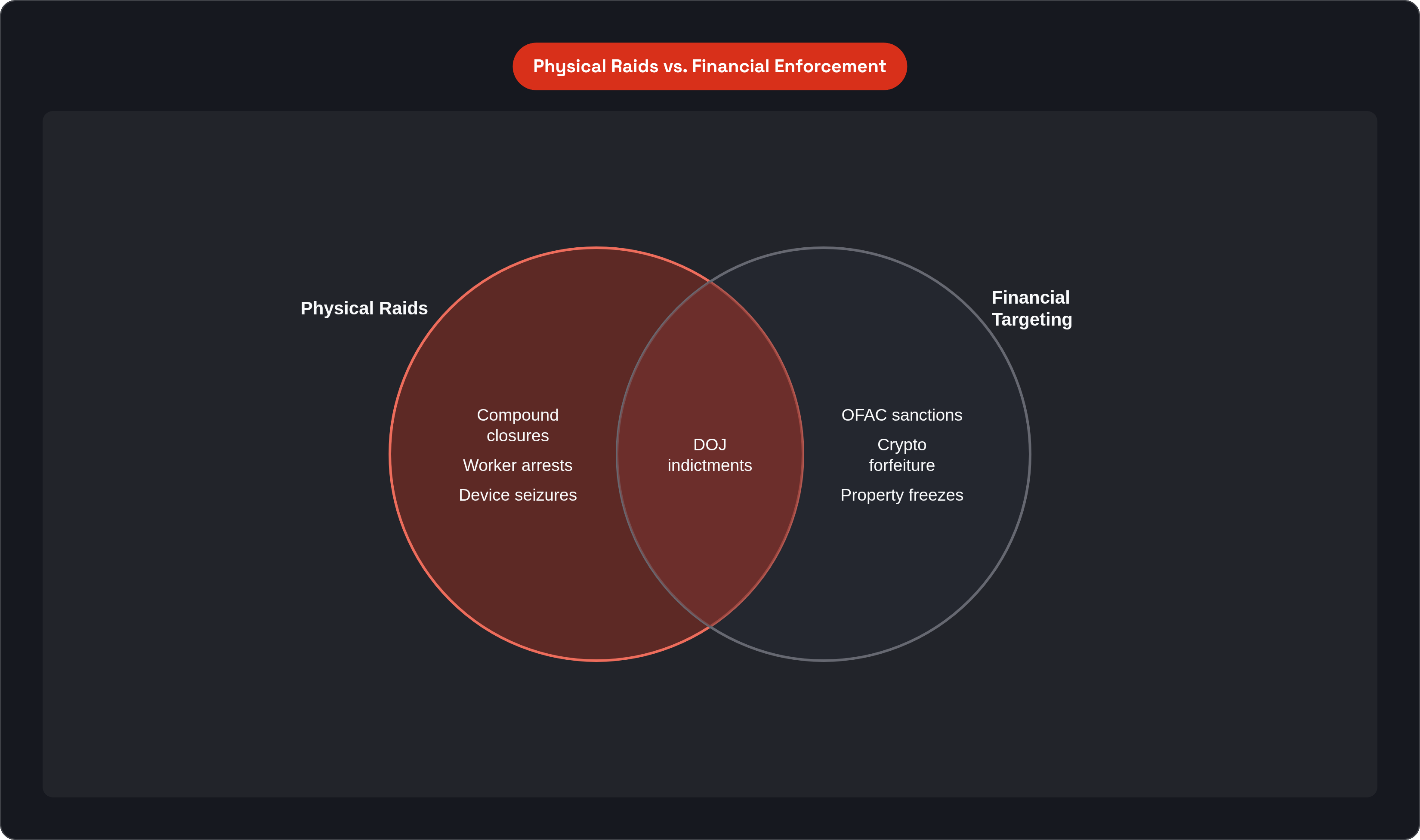
The compound model was built to survive enforcement. Every structural feature of it absorbs the impact of a raid or an arrest rather than collapsing under it.
The distribution is intentional. Thirty-plus sites along a single border stretch means removing any one node does not collapse supply. The franchise model means the brand, the platform templates, the money-laundering relationships, and the senior personnel survive a compound raid even when the compound does not. The financial rails are layered across shell companies, cryptocurrency mixers, hawala-adjacent networks, and eventually into property markets in places like London. Jurisdiction-hopping is a core design feature.
The workforce is replenishable. Recruitment pipelines running across 56 countries can restaff a compound faster than legal processes move through any single jurisdiction. The people who built these systems understood that from the beginning.
Actions that target the financial layer are structurally more disruptive than physical raids. OFAC sanctions, FinCEN designations, and DOJ indictments go after the economic incentives rather than the current occupants of a building. They move slowly, and they require cross-border legal cooperation that these criminal networks were specifically built to defeat. But they are operating at the right level. The October 2025 action and its follow-ons are evidence that enforcement agencies have worked this out.
The problem is that even the right level of intervention takes time to produce results, and the industry is not waiting around.
What the current enforcement trend actually signals for the threat landscape
The coordinated U.S.-UK action of October 2025 and the June 2026 sanctions represent a genuine shift. Whole-of-government, multi-jurisdiction, financially targeted. That is a different category of enforcement from anything that preceded it.
The satellite imagery of continued construction during active crackdowns tells you what the industry thinks about that shift. It is adapting.
A few things are worth tracking closely.
AI and deepfake tooling are lowering the per-worker skill requirement inside compounds. The industrial infrastructure becomes more efficient even as individual sites are disrupted. The victim pool widens as the barrier to a convincing initial contact drops. Fewer skilled workers are needed to run the same volume of fraud.
The DPRK overlap surfaced in the Huione data deserves serious attention. Thirty-seven million dollars laundered from North Korean cyber heists through the same financial rails as pig-butchering proceeds points toward a convergence between nation-state cyber operations and criminal fraud infrastructure. That is simultaneously a law enforcement problem and a national security problem, yet current treatment concentrates almost entirely on the former.
The enterprise threat dimension is real and underappreciated. These operations generate credential harvesting campaigns, phishing infrastructure, and financial fraud tooling that surfaces in enterprise environments, not only in consumer fraud cases. Security leaders who treat this as purely a consumer protection issue are misreading the threat surface entirely, a point that practitioner-focused cybersecurity content studios, such as Cyberou, have been surfacing through threat-intelligence-grounded reporting.
Enforcement is producing more pressure on this industry than at any prior point in its history. The arrests are real. The sanctions are real. The financial forfeitures are real. The industry is also still expanding in physical footprint and still generating losses measured in the hundreds of billions annually. Both of those things are true at the same time, and the second simply means the first has a lot further to go.