Budapest Convention Signatories and Cross-Border Prosecution Gaps
Signatories lack the capacity and cooperation to close predictable safe havens for cybercrime.
The Budapest Convention’s cross-border prosecution gaps show why treaty reach is not the same as enforcement reach. Despite 83 signatories and 25 years of momentum, non-member safe havens, slow evidence channels and uneven domestic capacity leave predictable corridors where cybercrime cases stall. The framework is changing, but attackers can exploit those corridors faster than treaty reform can close them.
What the Budapest Convention actually created — and what it left unresolved
The Council of Europe adopted the Budapest Convention on 8 November 2001 and opened it for signature in Budapest on 23 November 2001. It entered into force on 1 July 2004 as the first multilateral legally binding instrument to regulate cybercrime. Its purpose was to give states a shared legal framework for crimes and evidence that cross borders. It was a framework for cooperation between national systems.
The Convention has three stated aims, which are harmonizing domestic criminal law across substantive offenses, supplying procedural tools for investigation and prosecution, and establishing fast international cooperation. Those aims depend on one another. Shared offenses help give a case its legal basis, while procedural powers let investigators get evidence. Cross-border cooperation then connects the work of one national authority to another. A weak connection can therefore stall a case even when the domestic tools exist.
That architecture assumes participation on a scale the Convention has never achieved. In its 25th anniversary year, the Council of Europe lists a large group of parties and further countries that have signed or been invited to accede, but coverage remains incomplete. All existing parties must agree before a state is invited to join, so accession lets them check who joins but also slows the network’s growth. The network’s reach depends on who joins, and its usefulness depends on how its members act. “Fast and efficient cooperation” remains both the goal and the gap.
Which states are missing, and why their absence is not accidental
China, India, and Russia are not parties and are not likely to become parties. Russia never signed because it said the Convention violated sovereignty by allowing cross-border law enforcement operations without the host state’s consent. It has maintained that objection and sponsored a rival treaty. India declined because it did not participate in drafting the Convention, treating it as a European instrument developed without its input, while concerns about sharing data with foreign agencies persisted.
These absences do not have equal consequences. Where criminal groups act with impunity in states outside the party network, the framework cannot offer the way to work together that it gives members. In some cases, state security services have also co-opted those actors. That makes location more than a detail on an indictment.
The U.S. indicted GRU officer Dmitriy Sergeyevich Badin for targeting the World Anti-Doping Agency, but his prosecution has not advanced to conviction because he remains in Russia. The contrasting case is Vladimir Drinkman, whom the U.S. charged with infiltrating retailers, payment processors, and financial institutions, including Nasdaq. Dutch authorities extradited him, and he pleaded guilty and was sentenced to 12 years in prison. The contrast shows how access to a defendant can separate a charge from a completed prosecution. For actors who benefit from remaining beyond that access, the gap is self-reinforcing, with no incentive to close it.
The MLAT bottleneck inside the framework — why membership alone is not enough
Mutual legal assistance treaties, or MLATs, are the primary tool for cross-border evidence requests and arrest cooperation. Even among Budapest parties, those channels can be too slow for time-sensitive digital evidence. Servers get wiped, cryptocurrency moves, and accounts go dormant while the legal request is still working through the system.
India faces the same delays even though it is outside Budapest. Some electronic evidence from abroad takes many months to arrive through mutual legal assistance, so an agreement to help does not ensure that evidence arrives in time. The 2016 Bangladesh Bank SWIFT heist shows the multi-jurisdictional version of the same friction. The trail ran from SWIFT transactions in New York to cash-outs in Manila, crossing jurisdictions with different compliance standards that obstructed rapid intervention and complicated prosecution across years.
The EU’s European Production Order offers a useful contrast in design. It sets an 8-hour emergency response time and a 10-day maximum, putting a defined clock on digital evidence requests. Evidence access can be engineered around urgency. Paper-based MLAT channels were not built to work that fast.
How threat actors use jurisdictional geography as a deliberate operational choice
Transnational cybercriminals choose infrastructure, personnel, and cash-out chains to straddle jurisdictional seams. Legal non-harmonization and safe havens become operational infrastructure. The border that barely interrupts an attack can still interrupt the investigation. Jurisdiction is part of the operating plan.
The documented pattern involves actors based in non-party states orchestrating attacks across party states. Prosecution then depends on extradition that may be unavailable or evidence transfer that moves slowly across frameworks that do not interoperate. Evidence may be enough to support a charge even when the defendant is out of reach. A jurisdiction willing to help may also fail to send evidence before it loses its value.
In some cases, state security services give criminal actors immunity in return for domestic cyber operations, using them as a gray-zone resource beyond the Budapest framework’s reach. Attackers can work together across borders at machine speed while states take months to handle paper-based requests for legal cooperation. Drinkman’s prosecution shows that cross-border cases can still succeed despite this mismatch. It means the gaps offer a predictable advantage that threat actors can deliberately build into their operations.
Where developing-country capacity shortfalls deepen the gap inside the party list
A further gap sits inside the network, between treaty obligations and the ability to carry them out. States that sign still need domestic legislation, trained investigators, and round-the-clock contact points. The Convention requires states to have substantive and procedural laws and ways to work with other states. Many developing-country parties lack the means to meet those requirements. A signature is not an installation wizard.
The Council of Europe’s Programme Office acknowledged that it prioritized a substantial number of countries for capacity-building assistance in 2025. That work reflects an implementation shortfall among both current and prospective parties, rather than a problem confined to states outside the system. The Council of Europe lists countries including Kenya, South Africa, Kazakhstan, Malaysia, and Mexico as signatories or invited to accede. These countries are at different stages of joining and getting ready to take part. A count of countries alone cannot show whether a state has a working process to handle a request.
Malaysia makes the lag concrete. Invited to accede in September 2025, it had spent the preceding period of rising cybercrime cases outside the Convention’s cooperative mechanisms, without access to its round-the-clock contact points or standardized evidence preservation procedures. An invitation marks progress, but it is not operational participation. Likewise, a party with weak domestic cybercrime law may receive a request that stalls inside its own system. Capacity-building is therefore part of the framework’s global expansion.
The Second Additional Protocol as a partial engineering fix for the speed problem
The Budapest system has responded to delays in cooperation through the Second Additional Protocol. Adopted in November 2021 and opened for signature in May 2022, it establishes emergency mutual assistance procedures aimed directly at the MLAT bottleneck. That is a targeted change to the machinery of cooperation. It acknowledges that the original route is too slow for some of the evidence it must carry. The framework is not standing still while the problem grows.
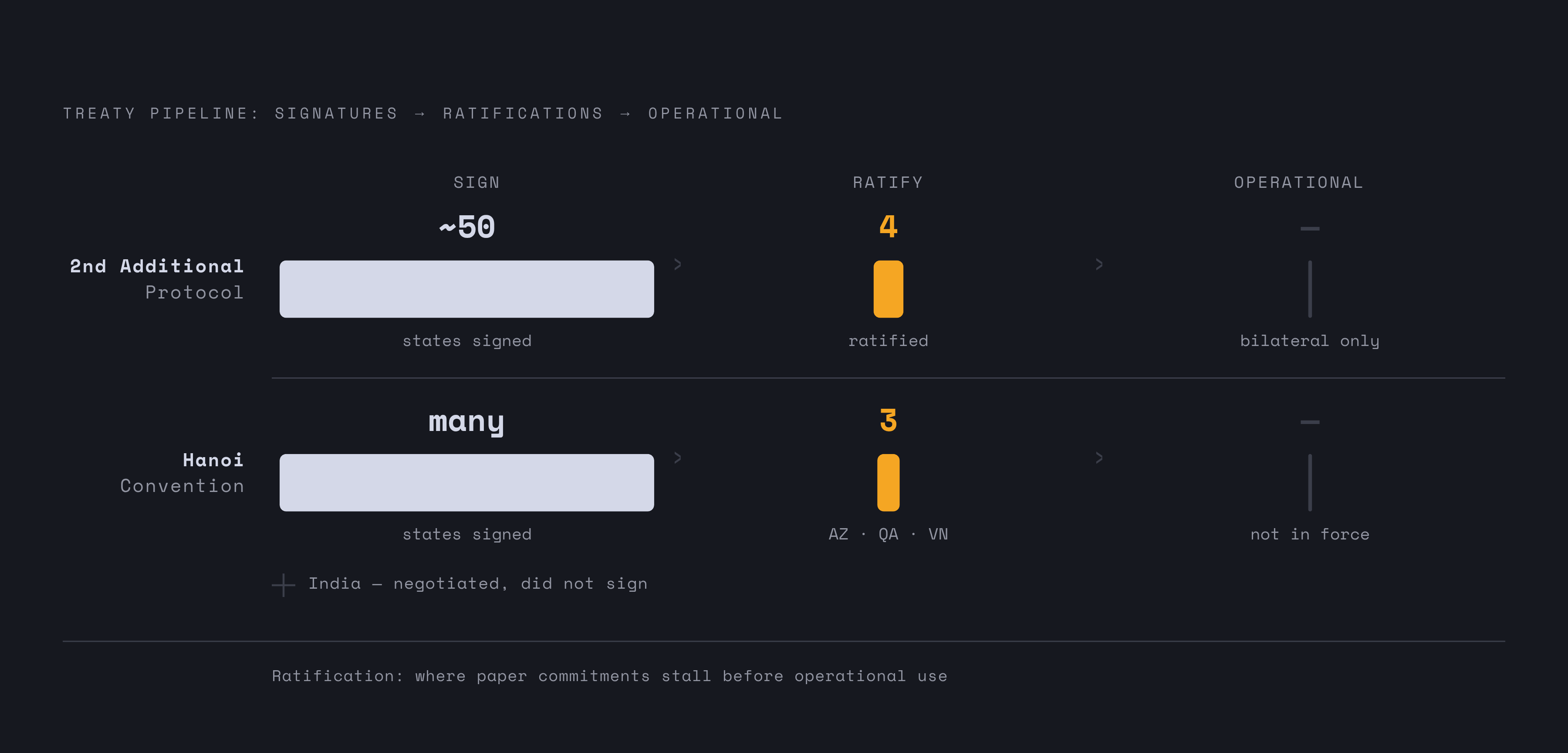
Adoption, however, creates a second clock. By early 2026, the Protocol had attracted a substantial number of signatures but only two ratifications, rising to three by February 2026 and four by April 2026. Its emergency procedures apply only between states that have both signed and ratified. A faster channel on paper therefore needs its own adoption curve before it can operate at scale. The distinction between support and usable coverage matters as much here as it does for the original Convention.
The Eurojust SIRIUS review looks at how the Protocol fits into the wider system for getting electronic evidence across borders, including how it works with EU e-evidence instruments. That interplay also appeared on the Protocol’s agenda at the 2026 Octopus Conference. The task is not just to accelerate one route, but to fit it among other routes to evidence. Even successful implementation would leave the non-member gap untouched, including the absence of China, India, and Russia. The system is reforming itself from within, but that reform remains bounded by the same membership ceiling.
The UN Hanoi Convention — whether a broader treaty closes or deepens the gaps
The United Nations Convention against Cybercrime, known as the Hanoi Convention, gives more states another way to join a treaty. Signed at the ceremony in Hanoi, Vietnam in October 2025, it reaches states the Budapest framework cannot. Its case is straightforward in principle. If important jurisdictions remain outside one cooperation network, a broader instrument could connect them. But having more states take part only helps prosecution if they can do what the treaty requires.
As of 30 September 2026, the Hanoi Convention had attracted a large number of signatories, including Indonesia and the Netherlands. Thirteen additional countries signed in September 2026 alone. India participated in negotiations but did not sign, so its involvement cannot be counted as an operational way to secure access to evidence. Only Azerbaijan, Qatar, and Vietnam had ratified, against the substantial ratification threshold required for entry into force. Here too, signing is not ratification, and ratification is not implementation.
Budapest defenders argue that the UN instrument has weaker human rights protections and procedural differences that could complicate cooperation. A central difference concerns jurisdiction and mutual legal assistance. The Hanoi Convention adopts passive personality jurisdiction, allowing a state to claim jurisdiction over conduct harming one of its nationals, unlike Budapest’s territorial and active personality approach. That creates the potential for overlapping and conflicting jurisdictional claims. A broader treaty could close some geographic gaps while introducing new friction between legal systems, leaving its practical relationship with Budapest unresolved.
What AI-enabled threats reveal about the pace of treaty adaptation relative to threat evolution
That unresolved landscape is now meeting threats that move faster still. Actors using AI can accelerate attack timelines, generate malware, and automate social engineering at a scale no MLAT response can match. They do not need a new set of safe havens to benefit. The same jurisdictional seams that sheltered earlier ransomware operators remain useful to AI-enabled attackers. Greater capability on one side compounds delay on the other.
The Budapest Convention’s 25th anniversary Octopus Conference in October 2026 brought hundreds of cybercrime experts from a broad range of countries to Strasbourg. It had a main session on AI-driven cybercrime threats. A mapping study presented at the conference identified threats including data poisoning, prompt injection, model theft, and AI-generated malware, for which no treaty provision yet exists. The legal system is updating its machinery while the attacker’s toolkit is changing.
For practitioners and vendors, the consequence is a limit on what treaty coverage can promise during an incident. Threat intelligence moves at a pace these mechanisms were not built for, and prosecution depends on location, evidence access, and domestic capacity as well as legal agreement. The most capable actors have chosen corridors where those dependencies become obstacles. The gaps are structural, known, and being exploited faster than the reform track can close them. Practitioners must operate in that gap.
Sources
- Budapest Convention on Cybercrime and
- About the Convention - Cybercrime - The Council of Europe
- Parties/Observers to the Budapest Convention and Observer Organisations to the T-CY - Cybercrime - www.coe.int
- Second Additional Protocol - Cybercrime - www.coe.int
- Budapest Convention reaches 75 Parties - Portal
- Momentum builds as new countries sign the UN Convention against Cybercrime
- A WORLD OF DIFFERENCE: THE BUDAPEST CONVENTION ON CYBERCRIME AND THE E
- The promise and pitfalls of the Second Protocol to the Budapest Convention: Assessing its impact on EU and UK cross-border criminal investigations - Gemma Davies, DeBrae Kennedy-Mayo, 2026