Cryptocurrency Exchange Executives Charged Under US Jurisdiction
U.S. prosecutors use three legal theories to charge crypto executives worldwide.
Cryptocurrency exchanges get prosecuted by a national government as if they were domestic banks, even when they're incorporated somewhere else entirely and have never opened an office in that country. It comes down to one statute, three recurring legal theories, and a jurisdictional reach that has already pulled in executives from multiple countries across different continents.
Crypto exchanges as financial institutions subject to US law
The Bank Secrecy Act is the hinge everything else swings on. Pass dollar-denominated transactions through a crypto exchange and US regulators treat that exchange as a financial institution, the same category as a bank or a money transmitter, regardless of where the company is chartered or where its servers sit. The BSA, along with the USA PATRIOT Act, requires any Money Services Business handling currency exchange to run an AML program: collect KYC data, monitor transactions, file suspicious activity reports. Binance found out what that standard costs when it paid $4.3 billion in 2023 to settle systemic AML failures. It's a number designed to make every other exchange's general counsel sit up straight.
Only one agency can turn these obligations into criminal charges. FinCEN and OFAC handle civil and administrative enforcement, important but survivable. DOJ is the body that files indictments, and DOJ is the one that puts executives in handcuffs. Everything that follows in this piece traces back to that split: compliance failures are civil until DOJ decides they're criminal.
Three legal theories prosecutors use repeatedly across every major case
DOJ doesn't improvise a new legal argument for each case. It runs the same three theories, sometimes together, sometimes alone, depending on what the facts support.
The first is BSA failure. An exchange that never builds an AML program, or builds one and quietly guts it, gets charged with conspiracy to violate the BSA. This has become the standard route for reaching founders and CEOs, because prosecutors don't need to prove an investment fraud scheme or stolen funds. It only requires proving the company knew its obligations and ignored them.
The second is market manipulation, charged as wire fraud. Wash trading, the practice of faking trading volume to make a token look more liquid or valuable than it is, gets treated as a fraud scheme under wire fraud statutes. This theory is the one that reaches furthest, because it lets prosecutors charge foreign nationals who've never set a foot on US soil, as long as their scheme touched US investors or US-listed tokens.
The third is fraud or misappropriation: executives tell customers their funds are safe and liquid while they quietly treat the balance sheet like a personal piggy bank. If the underlying asset gets classified one way or another, this can stack securities fraud, commodities fraud, or both.
The three theories work as a net with three different mesh sizes, each catching a different kind of actor. BSA theory catches the exchange that skipped building compliance. Market manipulation catches the trader who never touched a KYC form but moved the market anyway. Fraud catches the executive who lied directly to customers. Running all three leaves very little room for an exchange to argue it operated outside the reach of national law.
How internal compliance decisions become criminal evidence
DOJ stopped treating AML gaps as paperwork problems a while back. A missing transaction monitoring system doesn't read as an oversight anymore. It reads as a decision, made by someone, and prosecutors go looking for that someone.
The pattern repeats across cases: weak KYC at onboarding, thin transaction monitoring afterward, sanctions screening with enough holes in it that prohibited activity kept running for years. Regulators don't read that pattern as a company that tried and failed. They read it as a company that chose not to try, and Binance is the case that makes the mechanism visible. A $4.3 billion settlement doesn't happen because a compliance officer forgot to check a box. It happens because the failures were systemic, sustained, and traceable to decisions made at the top. That's the chain prosecutors are built to follow: leadership decision, documented failure, criminal charge. The paper trail inside the company becomes the prosecution's exhibit list.
How US jurisdiction reaches executives based outside the United States
An indictment is just a piece of paper until someone gets arrested, and arrest turns the enforcement perimeter into a travel itinerary problem for defendants.
Physical custody happens two ways. Defendants who travel to or through US-friendly jurisdictions get picked up on arrival. Defendants sitting in cooperating countries get extradited through bilateral treaties, coordinated by DOJ's Office of International Affairs. Aleksei Andriunin, founder and CEO of Gotbit, a Russian national, learned the first lesson in Portugal in October 2024, arrested there and extradited to face market manipulation and wire fraud charges in the District of Massachusetts. Antoine Tsao, a Taiwanese national working as Gotbit's business development manager, got arrested at JFK Airport. Nemanja Popov, a Serbian national and Gotbit account manager, got arrested at San Francisco International Airport. Neither man needed to live in the US to end up in US custody. They just needed to fly through it.
The investigative method behind these cases deserves a mention of its own. The FBI didn't wait for a tip. Agents created their own cryptocurrency tokens to draw out wash trading schemes, then watched who took the bait. It's a proactive agency willing to run a sting that takes years to pay off, not a reactive one processing complaints.
How the dollar and US investor exposure extend jurisdiction over firms with no US office
Two things, independently, are enough to put a firm with zero US presence inside US jurisdiction: routing money through dollars or dollar-pegged instruments, and having US investors lose money.
The Evita case shows how the dollar hook works on its own. Iurii Gugnin, a Russian national living in Manhattan, processed roughly $530 million for sanctioned Russian banks, Sberbank, VTB, Sovcombank, and Tinkoff, with separate payments tied to Rosatom, Russia's state-owned nuclear technology company. He moved the money mainly through tether, a dollar-pegged stablecoin, funneling it through US banks and crypto exchanges between June 2023 and January 2025. Prosecutors say he falsified compliance documents, doctored scores of invoices, and lied to banks and exchanges about his Russian ties. EDNY charged him in June 2025. The dollar peg is what pulled the case into US courts, not an office address.
The pump-and-dump cases out of the Northern District of California show the other hook. The indictments allege losses to investors in the United States and elsewhere, and that line alone is enough to anchor wire fraud charges no matter where the defendants were sitting when they ran the scheme.
Together, the two hooks make the math simple. Any exchange that takes US customers, settles in dollars or dollar-pegged stablecoins, or lists a token that US investors trade is already inside US criminal jurisdiction. Leadership never needs to set foot in the country for that to be true.
The range of cases shows the enforcement perimeter applies across firm size, geography, and crime type
The case record doesn't read like a highlight reel of a few famous scalps. It reads like a pattern applied consistently across very different kinds of defendants, evidence of a perimeter. At the top of the scale sits Binance, the largest exchange in the world, hit with that $4.3 billion penalty in November 2023. Further down the size chart, Paxful Holdings, a peer-to-peer platform, pleaded guilty on December 9, 2025 to three counts of conspiracy: operating an unlicensed money transmitting business, conspiring to violate the BSA's AML program requirement, and violating the Travel Act. Co-founder and former CEO Ray Youssef was separately charged with conspiring to evade AML requirements, operating an unlicensed money transmitter, and facilitating illegal prostitution-related activity through the exchange. Smaller still, Cryptonator founder Roman Pikulev, a Russian national, was indicted for running an unlicensed exchange that processed hundreds of millions of dollars in illicit funds, tens of millions of it traced to darknet markets and millions more to ransomware campaigns, with investigators using blockchain analytics to follow the money. And the crime type varies as much as the firm size: Alex Mashinsky, former CEO of Celsius, pleaded guilty to both securities fraud and commodities fraud, a dual plea that shows DOJ hedging its bets on how to classify the underlying asset rather than committing to one theory and hoping it sticks. Four firms, four very different sizes, four different flavors of criminal exposure, all run through the same playbook.
The 2025 DOJ policy memo narrowing exchange prosecution
On April 7, 2025, DOJ issued a memo that genuinely changed the landscape. The department said it would no longer target virtual currency exchanges, mixing and tumbling services, and offline wallets for the acts of their end users or for unwitting regulatory violations, and it disbanded the National Cryptocurrency Enforcement Team. That's a real retreat from the platform-level enforcement model, not a cosmetic one.
The Pilipis case, involving AurumXchange, shows what that retreat looks like in a courtroom. A federal judge partially dismissed charges against an Indiana businessman accused of failing to register his exchange with FinCEN, tossing money-laundering counts tied to conduct before 2013. DOJ then voluntarily dismissed the entire case in late April 2025, after finding that FinCEN hadn't actually put the industry on notice that crypto businesses needed to register until March 2013, which was after the relevant conduct took place. The retroactive-application objection won.
That raises a fair question about the whole thesis of a global enforcement perimeter. If DOJ is stepping back from platform-level cases and courts are receptive to notice-based defenses, maybe the perimeter isn't as fixed as the case record up to this point suggests.
How the policy shift narrows the perimeter's edges without dismantling its core
The memo draws a clear line between what it narrows and what it preserves. It preserves prosecution of individuals who commit fraud, sanctions evasion, and other serious crimes. All three core theories, BSA willful violation, market manipulation, and fraud, survive the carve-outs untouched.
The case record after the memo backs that up. Paxful's guilty plea came in December 2025, months after the memo. The Vortex and Contrarian extraditions from Singapore came in March 2026, over a year after. Disbanding NCET didn't pause prosecutions already underway, and it didn't stop DOJ from opening new ones built on fraud or BSA theories.
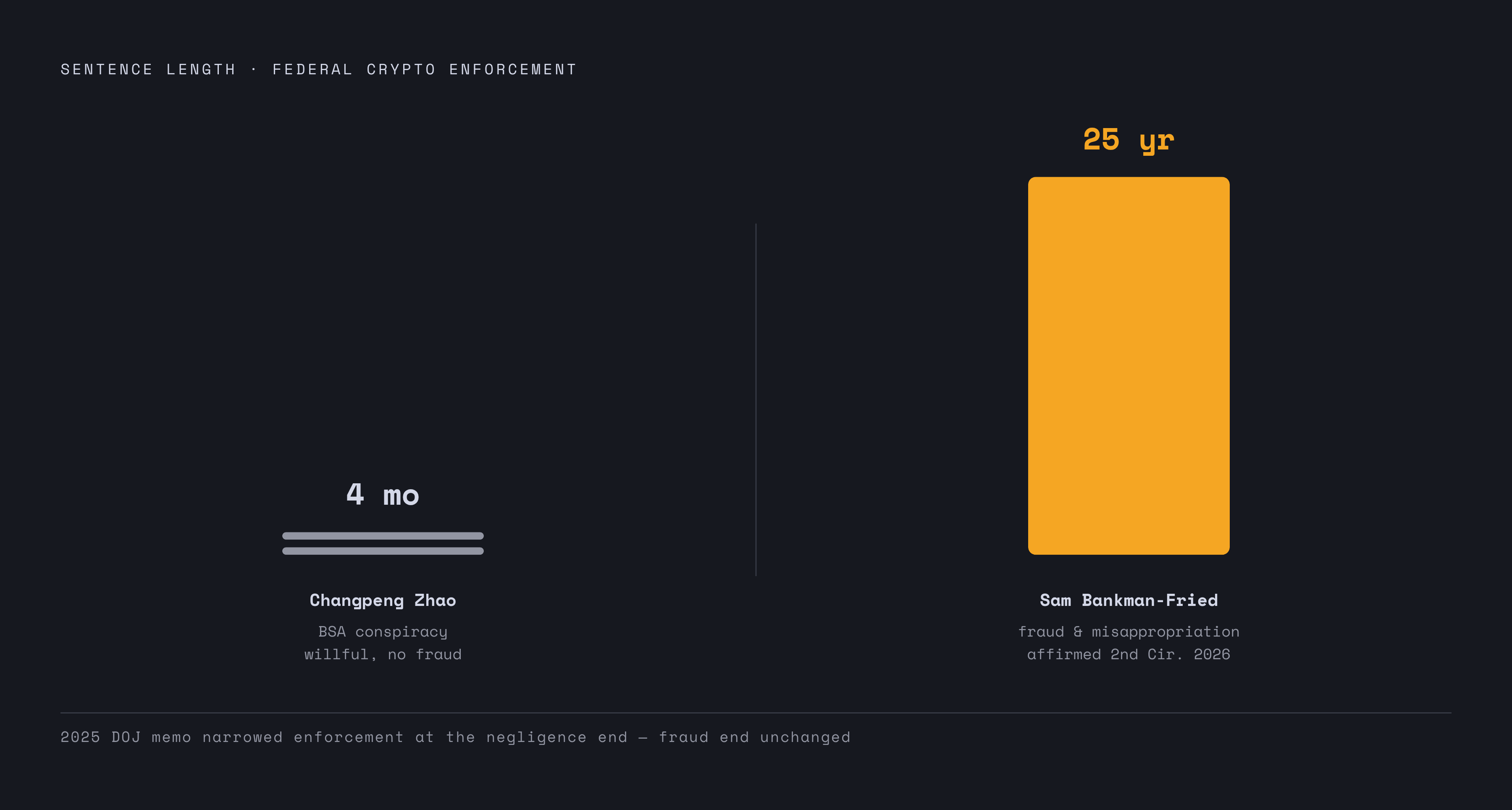
The sentencing gap between Changpeng Zhao and Sam Bankman-Fried tells the story of where the line actually sits. Zhao got four months on a BSA conspiracy charge. Bankman-Fried got 25 years for fraud and misappropriation, a sentence the Second Circuit affirmed as of June 2026. The memo's pullback applies to unwitting, technical compliance failures. It does nothing for an executive who built a fraud scheme on purpose. The perimeter shrinks at the negligence end and holds its shape at the fraud and willful-violation end.
The Pilipis dismissal fits into this picture as a narrow exception, limited to its own facts. It's a notice case tied to the earliest years of crypto regulation, before the industry had any enforcement history to draw on. Courts have since found that prior enforcement actions themselves put the industry on notice, so that argument doesn't travel forward into post-2013 conduct. The perimeter's edges are better defined now than they were before the memo, and its core, the three theories, hasn't moved.
Implications for Exchange Leadership Operating Internationally
The enforcement record adds up to a compliance standard that exists whether or not any individual firm agrees to it. Touch the dollar, serve US investors, or list a token that US investors trade, and the exchange is already inside the perimeter, no matter where its certificate of incorporation was filed.
What gets prosecuted traces back to leadership, not policy documents sitting in a drawer. From Binance to SafeMoon to Evita, prosecutors go looking for evidence that executives knew about compliance gaps, directed them, or actively suppressed fixes, and internal communications are what gets read into the record as that evidence.
Geography offers less cover than it used to. Singapore, Portugal, and ordinary layovers through US airports have all turned into arrest points. Countries without an extradition treaty with the US, Russia and Iran among them, still offer a kind of shelter, but that shelter comes with its own price tag in the form of cut-off banking relationships and restricted market access.
The posture that survives this environment is straightforward: documented, genuine AML and KYC programs that show good faith rather than a paper trail built after the fact to look like one. The memo's carve-out for unwitting violations only protects firms that can show real effort, not retroactive cover. Executives who understand where the perimeter actually sits have a defined path to stay outside the parts of it that matter. Executives who don't are already standing inside a jurisdiction they never chose to enter.
Sources
- Ten foreign nationals charged in an international operation targeting cryptocurrency market manipulation
- Northern District of California
- District of Massachusetts
- Northern District of California
- U.S. Department of Justice Curtails “Regulation by Prosecution” in Digital Asset Enforcement
- The DOJ’s Changing Crypto Enforcement Strategy: What Taxpayers Need to Know