UK NCA Cybercrime Sanctions Under Autonomous Regime
Law enforcement investigations now feed directly into UK cyber sanctions designations.
The UK now runs its own cyber sanctions regime, separate from the regional system it used before leaving that bloc. The real story is the pipeline running from national law enforcement investigations straight into designation packages, turning intelligence work into legal consequence for named cybercriminals and, increasingly, named state intelligence officers.
What the UK's autonomous cyber sanctions regime is
Britain's cyber sanctions framework is a fresh build, not a hand-me-down. It runs on its own statutory powers, built after leaving the regional bloc, rather than continuing the rules it used to follow as a member.
Two changes from the Economic Crime (Transparency and Enforcement) Act 2022 matter most for anyone tracking how this works in practice. First, the Act added an urgent designation procedure. If the US, EU, Australia, or Canada has already sanctioned someone, the UK can now designate that same person quickly, for a set short period that can be extended once. Second, and arguably more consequential, the Act dropped the old requirement that ministers prove "good reasons" or show sanctions were a "reasonable course of action" before acting. That's a lower bar to clear, and it means ministers can move faster and with less friction than before.
Two bodies split the enforcement work. OFSI sits inside HM Treasury, and it handles financial sanctions on the civil side. Criminal breaches of sanctions law go to the NCA. That division matters, because it shapes how intelligence turns into consequences: one track freezes assets and fines firms, the other track can put people in prison.
The NCA's investigative, upstream role
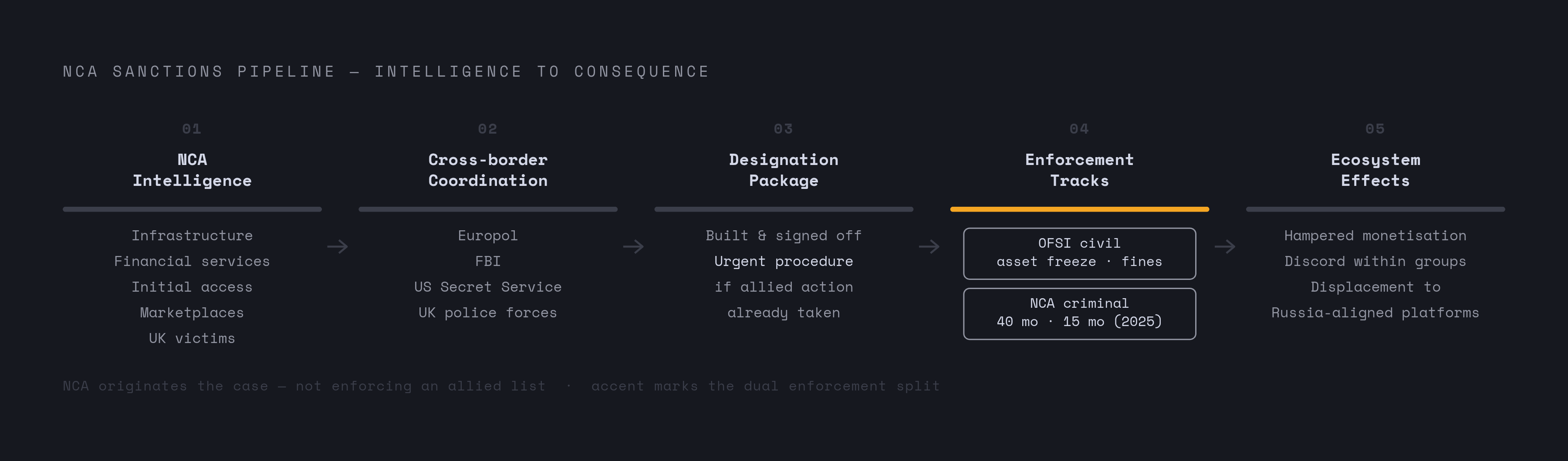
A common assumption treats the NCA as the agency that shows up after the Treasury decides who to sanction, enforcing a list someone else drew up. That gets the sequence backwards. The NCA builds the intelligence case first, and that case frequently becomes the grounds for someone's designation.
The NCA's National Cyber Crime Unit organizes its work around five pillars: infrastructure, financial services, initial access and compromise, marketplaces and forums, and UK victims. Each pillar generates intelligence, and that intelligence base is what later becomes the evidence behind a designation.
The NCA also prosecutes sanctions breaches directly. In 2025, two Russian nationals were convicted of breaching financial sanctions and money laundering following an NCA prosecution. One received a 40-month sentence; the other got 15 months, suspended.
OFSI's own intelligence function now produces actionable material that feeds both civil and criminal enforcement, so information moves in both directions between OFSI and the NCA rather than flowing one way from Treasury to law enforcement.
None of this happens in isolation. The NCA coordinates with UK police forces, regional organised crime units, Europol, the FBI, and the US Secret Service. That coordination isn't a nice-to-have. Most of the criminals and infrastructure in question sit overseas, so cross-border intelligence sharing is simply how the work gets done.
The threat environment shaping which targets the NCA prioritises
The NCA's 2026 National Strategic Assessment makes a point that reshapes how to read the whole designation pipeline: technology has stopped being just a tool crime uses and has become the thing driving crime's scale, sophistication, and staying power. That shift changes who rises to the top of the target list.
Ransomware sits at the top of that list. The NCA considers it the greatest cyber serious and organised crime threat facing the UK, and deployment against critical national infrastructure carries national security weight, not just a financial hit to one company.
Most high-profile ransomware attacks against the UK trace back to Russian-language criminals, and they run ransomware-as-a-service operations. Some of these groups have ties to a hostile state, though the NCA assesses that in most cases, those ties amount to tolerance rather than direct orders from that state's leadership. The state looks the other way; it doesn't necessarily hand out assignments.
A layer of Russian-speaking money laundering networks sits behind the ransomware groups, servicing ransomware operators, Russian elites, and hostile state-linked entities alike. These networks convert criminal cash into cryptocurrency through sanctioned exchanges. Operation DESTABILISE, which the NCA has led since 2022, targets exactly this infrastructure and has produced 129 arrests along with significant seizures of cash and cryptocurrency in the UK. That single operation shows how the NCA's threat picture turns directly into sustained enforcement action, not just one-off raids.
The Evil Corp and Conti designation cases
Conti/Trickbot and Evil Corp are two cases that make the pipeline concrete. Both show NCA-led investigations turning directly into coordinated international sanctions packages, built on the ground and signed off internationally.
The Evil Corp case runs deeper than a simple criminal takedown. NCA intelligence found that Aleksandr Ryzhenkov was both a high-ranking Evil Corp member and a LockBit affiliate at the same time, so you can see one person operating across groups that market themselves under entirely separate brand names. For threat intelligence teams, that's the kind of attribution work that reshapes how a group's org chart actually looks.
The state connection documented in the Evil Corp case runs through Eduard Benderskiy, father-in-law of Evil Corp leader Maksim Yakubets and a former high-ranking FSB official, who was identified by the NCA as "a key enabler of their relationship with the Russian Intelligence Services who, prior to 2019, tasked Evil Corp to conduct cyber attacks and espionage operations against NATO allies. That's a criminal gang with a direct line into the state.
The NCA's own read on what came after the 2019 action against Evil Corp gives a rare, honest look at what disruption actually achieves: "Since we supported US action against Evil Corp in 2019, members have amended their tactics and the harms attributed to the group have reduced significantly." Harms reduced, not eliminated. The group adapted rather than folded, and that distinction runs through everything that follows.
Star Blizzard and the FSB Centre designations
The pipeline doesn't stop at criminal gangs chasing profit. It now reaches named Russian state intelligence units and the officers inside them, a real escalation in how far the UK is willing to point its autonomous sanctions powers.
Following an NCA investigation, the UK sanctioned two members of FSB Centre 18, better known under the aliases Star Blizzard, SEABORGIUM, and COLDRIVER. Their spear-phishing campaigns gained unauthorised access to sensitive data and pulled it out, including operations aimed at high-profile UK parliamentarians, with the goal of undermining the UK government itself.
The pace of this work is picking up too. In July 2026, the UK and EU jointly announced sanctions against individuals tied to Russian intelligence, formally attributing a December 2025 attack on Poland's electricity network to FSB Centre 16. That's a seven-month gap between attack and attribution, so the pipeline now works on live, recent incidents, not events from years back.
The timing of that July 2026 announcement, matched exactly with EU action, shows what the UK's autonomous regime is actually built for: speed and independence at once. London can act alongside allies without waiting on EU consensus, using the urgent designation procedure to line up with US, EU, Australian, or Canadian designations within days.
Sanctioning an FSB officer doesn't lead to a trial, a jail cell, or an extradition hearing. These are instruments of attribution and diplomatic signalling, not arrest warrants. That limitation doesn't make the designations pointless, but it does raise an obvious question: if nobody gets prosecuted, what exactly do sanctions accomplish?
What sanctions do to cybercriminal operations
Sanctions were never built to put people behind bars directly. The NCA's underlying theory is ecosystem stress: make it harder to operate, harder to get paid, harder to trust the person sitting next to you in the criminal enterprise.
Will Lyne, the NCA's Head of Cyber Intelligence, assessed that sanctions have hampered the ability of cyber threat actors to monetise their activities and have contributed to sowing discord within certain groups. That's a different kind of damage than a prosecution causes, but it's damage all the same, paid criminals who suddenly can't get paid, and partners who stop trusting each other.
Getting named carries weight on its own. Designation strips away anonymity, puts stress on relationships between sanctioned individuals and the colleagues or corrupt officials they rely on, and sends a signal to everyone one rung below them on the ladder that they could be next.
The limiting factor is evidentiary. The Crown Prosecution Service requires a high evidentiary threshold, and clearing that bar for foreign intelligence officers and overseas cybercriminals is uncommon. UK designations often work as tools for attribution and business disruption, not tools that put someone in a UK courtroom. Results split along a clear line: state intelligence officers sit protected behind their own governments, while criminal groups have faced real, measurable disruption where sanctions land in a coordinated, enforced way.
Evasion adapts in response: the NCA assesses that when the UK and its allies disrupt sanctions evasion on crypto exchanges, activity gets pushed toward platforms based in Russia or in Russia-aligned nations. The UK and US sanctioned Russia-linked exchanges including Garantex and Grinex, and the pattern that followed wasn't collapse, it was displacement to the next platform down the line.
Detection has its own gap. OFSI stated it is "almost certain" that UK crypto firms have under-reported suspected breaches of financial sanctions.
What private-sector organisations are exposed to under this regime
Picture a ransomware attack hitting a UK company tomorrow. The moment the attacker asks for payment, that company faces a direct compliance decision: pay a sanctioned, designated actor, and that payment itself becomes a sanctions breach, with criminal referral to the NCA sitting on the table as a real possibility.
British authorities have detected up to five suspected breaches of the cyber sanctions regime so far, with no formal enforcement action taken yet. Whether that reflects a system working as a deterrent, or just a detection problem nobody's solved, stays genuinely unsettled.
OFSI can and does refer ransomware payment breaches to the NCA for criminal investigation. But the official Ransomware Guidance gives victims a clear incentive to come forward: an investigation into a ransomware victim is very unlikely to start where there has been proactive engagement with authorities, banks, crypto asset businesses, cyber incident responders, insurers, and negotiation providers. Cooperation, in other words, is the safer path by a wide margin.
Exposure isn't limited to the company that gets hit, either. Property and professional services firms have almost certainly acted as enablers for designated persons, helping facilitate breaches without meaning to. The NCA's finding that designated Russian nationals have used layered ownership structures to spread wealth through family members shows how compliance risk extends well past the moment money changes hands directly.
Enforcement intensity backs this up. The 2025 UK sanctions round-up recorded the largest annual number of OFSI enforcement actions on record, and it included the first sector-specific threat assessment built for financial services. That's a regime getting more active year over year.
The Cyber Security and Resilience Bill and the regulatory floor
Sanctions are one enforcement track. Parliament is building a second one at the same time, and the two are moving in the same direction together.
The Cyber Security and Resilience Bill, introduced in November 2025 and widely expected to become law during 2026, raises the enforcement powers that sit alongside the sanctions regime significantly. Fines under the Bill can reach 4% of global turnover, putting cyber compliance failures in the same financial bracket as GDPR penalties.
A more recent amendment extends the Bill's reach well past incident response. On 24 August 2026, the government tabled changes that give ministers power to block critical-sector organisations from using technology suppliers judged high-risk. That's the state stepping directly into procurement decisions, not just showing up after something has already gone wrong. For any organisation buying security tools or infrastructure in a regulated sector, supplier choice is no longer a purely internal call.
The NCA-to-designation pipeline as an intelligence signal for security practitioners and vendors
Every designation the NCA helps produce is a public statement, and it shows where the country's best-resourced law enforcement intelligence operation has decided the biggest threats sit. The designation list functions as a structured signal about which actors, tools, and techniques the UK assesses as the highest harm, at this exact moment.
The detail released alongside each designation, group structure, aliases, affiliate relationships, payment flows, state connections, is the same category of material that feeds threat modelling work. If you treat it as background noise or press-release filler, you discard usable signal that's sitting out in the open.
Vendors face their own version of this test. Organisations in the UK market now operate inside a regulatory and enforcement environment where sanctions compliance, ransomware payment decisions, and supply-chain risk are active legal exposure, not abstract policy talk. A vendor that can speak to that environment with precision reads as credible. One that can't gets spotted immediately by the practitioners actually making the purchasing decisions.
Much of the credibility gap between vendors and practitioners in the UK market comes down to exactly this: whether the vendor actually understands the enforcement landscape or is just talking around it. A vendor that can accurately describe the NCA's investigative role, how the designation mechanism works, and what compliance obligations flow from it is demonstrating real domain fluency, and in a market full of generic security messaging, that fluency is what sets a vendor apart. Cyberou builds its content around exactly this kind of material, pulling from live threat intelligence and real enforcement data rather than a generic editorial calendar, on the logic that the same records the NCA uses to build designation packages, public assessments, court records, attribution statements, are available to build content practitioners can actually use.
Reading the sanctions pipeline as a compliance checklist misses the point. Reading it as intelligence, as a live signal about who's being targeted and why, is what separates a security operation that understands its threat landscape from one that's just keeping up with the news.
Sources
- The UK Sanctions Framework
- NSA 2026 - Home - National Crime Agency
- Cybercrime - National Crime Agency
- Ransomware, extortion and the cyber crime ecosystem
- Cyber sanctions: Strengthening EU–UK responses to cyber threats
- NCA cyber investigation leads to sanctions for hostile actors linked to Russia's FSB - National Crime Agency
- Deter, disrupt and demonstrate